





A Cultural Administrator, connecting Asia and Europe
[People] Interview with Katelijn Verstraete, Director of Arts and Creative Industries for East Asia, British Council.
Fluent in five languages, Verstraete specialised in Chinese Studies (with degrees in marketing and cultural management). An early goal was not to pursue an academic career but rather to learn about contemporary China through working in the business sector there. Attracted to the contemporary visual arts scene in the early 90’s, Katelijn co-founded BizArt, the first non-profit contemporary arts centre that offered a platform for contemporary Chinese artists, including international exchange, supported by business activities in design and loanart.
In 2003, reconnecting with Europe, she moved back to Belgium working first at the KunstenfestivaldesArts, one of Europe’s most respected festivals for contemporary performing arts, and then in IETM, Europe’s largest international network for contemporary performing arts. From there, she went to Singapore to develop activities for the Cultural Exchange Department in the Asia Europe Foundation, ASEF, before moving to the British Council in 2012.
Mary Ann DeVlieg (MADV) : You’ve worked in private, public and governmental organisations, both on projects and policy. What have you learned from these experiences?
Katelijn Verstraete (KV) : When I left China, I felt I was starting again from zero, getting to know the mature cultural sector then in Europe. Luckily I chose two dynamic, well-connected organisations. The Kunstenfestivaldesarts was the most important window for European and international performance (and co-production). IETM focuses on multilateral collaboration and deep knowledge of Europe’s key organisations. I learned ‘how Europe works’ in culture and also how important networks are - both in and outside of Europe. They carry energy, inspiration, information and contacts, encouraging generosity, sharing and collaboration. These experiences made me aware of issues that need to be advocated on political levels, such as artists’ mobility. Even in a technologically hyper-connected world, it is important for artists to travel and meet, to understand each others’ contexts better and create deeper connections. Political advocacy demands continuous effort; educating policy-makers on what needs to be done to get optimal results is a long-term project.
Moving back to Asia to work for ASEF completed the circle. It was fascinating to be working closely with governments, bridging civil society and government. Government-led organisations include many stakeholders with differing agendas. The challenge - and the joy - is to get people to work together.
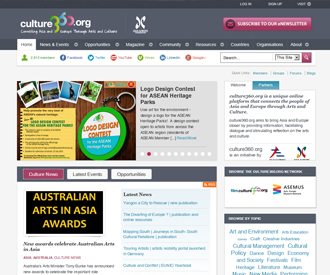
It’s been wonderful to see the growth of the Culture360.org network. I had been involved with On the Move and knew these platforms could be useful. We developed Culture360.org to trace the development of Asia-Europe cultural collaborations and to attract a community of interest. It is so much more powerful for an organisation to encourage and empower others and not only itself.
|
|
|
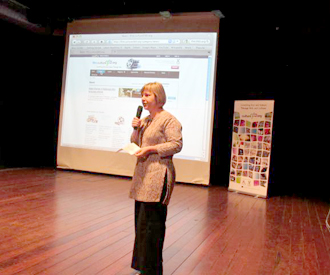
| The Culture360.org, Cultural platform run by ASEF | Katelijn Verstraete at ASEF |
MADV : What do you see from your current perspective at the British Council?
KV : Working for the British Council is a logical next step. It is a UK national institute of culture but strongly believes in multilateral collaboration. Now is an interesting moment in Asia: governments have a new interest in culture, strongly focusing on economic benefits and cultural identity. Europe was first to study the economic side of culture, but Asia’s entrepreneurs are creative, innovative and dynamic. I am interested to facilitate mutual learning from the best of both. What can we do to bring together the private, public and civil sectors around the table to identify common interests and projects?
The last ASEF project I worked on was a study on cultural funding in Asia (http://culture360.org/asef-news/mobility/). The experimental arts are the R&D for the creative and cultural industries and need support from governments and foundations. A lot of money in Asia comes from private individuals so it’s not transparent and private companies support the arts mostly from marketing rather than CSR budgets. I hope that crowdfunding will pick up to support the arts. Europe, for all its current austerity, still puts a lot of financial support into culture but governmental funding will decrease. We should continue to defend governments’ supporting public good by creating the right policy frameworks for public-private-people partnerships.
Cultural leadership is not only about strengthening the professional capacities of individuals but also about putting culture into a leading role in society. There is a generation gap in Asia : young people are not necessarily getting opportunities to lead the institutions - in some cases it’s clear they prefer to work elsewhere, but we need strong leaders who can demonstrate culture’s value in society. Arts organisations and artists play a role in social innovation and need to embrace technology better to reach people. The cultural and other sectors can learn from one another. International exchange helps by learning from each other and working together on moving agendas.
The British Council’s Connections through Culture builds capacity of cultural practitioners to strengthen the sector. It has been operating for over ten years and we can see the long-term impacts. Art-Think South Asia is a capacity-building programme initiated by the Goethe Institute, of which the British Council is a partner. It is not, however, led by either of the cultural institutes but rather by an independent private NGO in India, Khoj. This is a more sustainable model. These kinds of mobility schemes create strong networks, professionalise the sector and are important platforms of trust.
MADV : What are you dreaming of these days?
KV : One of my many dreams is to build stronger bridges between arts and social entrepreneurship. I believe in ‘art pour l’art’, and art for social change, but the power of culture can be stronger by creating better access. Arts and culture for me is about human development, not just economic development. Hence my interest in areas such as arts and disability, arts and health. Another dream is to work on more practice-based research and documentation on cultural development in Asia. Europe is rich in this. I can see a need for the academic and cultural sectors in Asia to document and globally share good practice. There is a lot to learn from Asia. Of course the Asia-Europe mobility fund is something I dream of strengthening more. How can Creative Encounters and Arts Network Asia gain more support to stimulate more Asia-Europe and more Asia-Asia mobility? This is something for all of us in the sector to work on!
MADV : Can you tell us about some current initiatives between the British Council and Korea?
KV : Many artists and cultural operators in other Asian countries regard Korea as an excellent model of how international strategies can be created to support cultural production. KAMS has played a crucial role in this. Film and visual art biennales in Busan (http://www.biff.kr) and Gwangju (http://www.gwangjubiennale.org) are also very respected on the international scene, not only for promoting Korean artists but for promoting Asian artists. Diffused by social media, Korean culture is very popular and the Korean language is among the most popular languages being studied today.
The British Council is doing a lot of work in connecting UK contemporary art & design and performing arts. (https://www.facebook.com/kr.arts.britishcouncil). We are working with Korean partners on a Korea focus during the next London Book Fair in 2014 and on a strong cultural programme in UK and Korea. Korean television serials, film, pop music and opera singers are all well-known in Europe, but it’s important to get to know contemporary Korean culture more through literature!
The British Council hopes to extend our work with Korea to the multilateral level because of the role Korea plays in Asia. We are currently exploring collaborations in Asia on cultural leadership and innovation. We are setting up a forum in HK on “Cultural Leadership : The Asian Way?” on 26th July, in partnership with the Advanced Cultural Leadership programme of Hong Kong University. We hope Korean organisations can be part of this. There is a lot more interaction between Asian countries now and hence the British Council wants to connect more regionally, in addition to our bilateral initiatives.
|
| |
 PREV
PREV
.JPG)
.jpg)
.jpg)
.jpg)
.jpg)












;)


