





The Theater Should Be a Genre Reflecting on Today’’s Paradigm
[K-festival Directors] Interview with Byung-tae Son, artistic director of Busan International Performing Arts Festival
|
| |
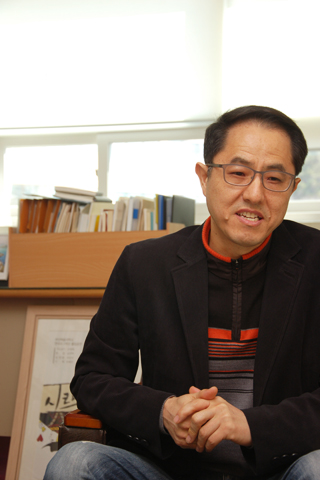
The Dacade-Old Busan International Performing Arts Festival Now Focuses on "Digilog"
Q : The year 2013 marks the 10th anniversary of Busan International Performing Arts Festival. Do you have any special program or work in store for this occasion?
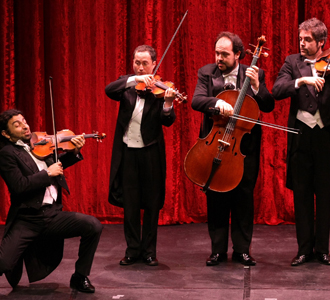
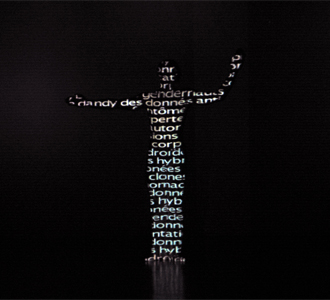
A : The Festival had a theme for every year. For example, the theme for its first year was "With a Smile." So instead of preparing something special, this year’’s Festival will have a theme that will allow everyone to look back its past nine years and to think about what its another decade will look like. In that sense, this year’’s theme is Digilog (meaing the encounter between "analogue" and "digital"). I recently had some chances to watch invited performances during other festivals held in Seoul and other cities. A couple of works were produced by means of computer mapping but none of the festivals dealt with the theme in a comprehensive manner. So this year’’s Busan International Performing Arts Festival will have this theme as its main concept to comprehensively discuss the future direction: if we will be able to apply to the theater the challenges generated between "analogue" and "digital." A couple of works including the opening one will be the performances that brought about the most enthusiastic response from the audience and that inspired the most exciting festival, among the works that were already invited for the past ten years. The opening performance will be Paganini by YLLANA Production from Spain.
|
|
|
Q: Does it mean that Paganini was already invited before?
A: Yes, it was invited in 2009. It generated the most enthusiastic response among the invited works and it is also the most suitable for a festival. Its genre is actually closer to music theatre rather than the theater. The musicians play musical instruments in the most professional way to provide the work with a dramatic form. We believe that this performance gave the greatest fun to the audience, making them laugh. The closing performance will be a work related to Digilog, this year’’s theme. It is an Austrian work that is closer to dance. The Festival will be the occasion of the Korean premiere of this performance which was produced by using digital mapping in diverse ways.
Q: To summarize, the opening performance is closer to music theatre and the closing one, to dance. Among the works that have been selected for this year’’s Festival, there are also the ones that belong to a variety of genres other than the theater. As a recent newspaper article said, is this to attract a wider variety of performing arts genres by changing the name of the Festival?
A: Although the Korean name of the Festival is "Busan International Theater Festival", its English name has always been "Busan International Performing Arts Festival." It began with the concept of a theater festival but we have nourished the ambition to transform the Festival into a real venue for international performing arts. The City of Busan also says that it is a good idea but more discussions are needed with the theater scene. We think that the discussion will start in earnest next year to change the concept of the Festival. However, this year’’s Festival will rather be focused on the theater. Citizens of Busan are quite dynamic. If there is spoken dialogue during a performance, we need to make subtitles and they wouldn’’t want to watch a performance and read subtitles at the same time. Considering such a dynamic audience in Busan, we have invited a great number of mime and dance performances. Moreover, we have also wanted to discuss the trend of "convergence" in the arts. A festival is literally a festival. So we want to make it dynamic and enjoyable to meet the needs of our audience.
|
|
|
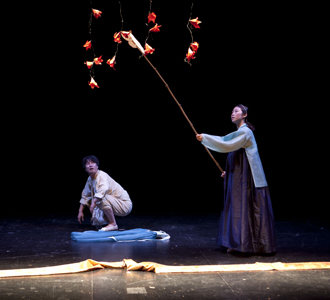
Q: Will there be any special and experimental work during this year’’s Festival?
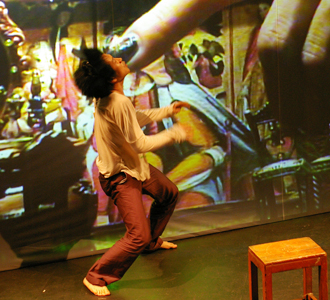
A: There is a work I really wanted to invite but I gave up on it because a problem arose during the negotiation on the fee. Among the works that will be presented during the Festival, Chapter 6: Life by Anomic Multimedia Theatre is interesting. This performance was produced through computer mapping. The troupe has presented many "digilog" experimental performances and its excellent computer designers have combined the theater dialogue and acting with computer mapping. So it is something to look forward to. The troupe will perform for the first time in Korea. Through a negotiation, we agreed on an appropriate amount of fee and the troupe will also be supported by the British government for their airfare. Everyone working in this field can recognize good works but major festivals are limited to the Avignon Festival or the Edinburgh Festival so it is true that there is a competition; if we want to invite a work that was presented during such world-class festivals, we need to pay a greater amount of fee to the troupe. Nevertheless, our Festival’’s principle of invitation is that we offer large amounts as much as we afford to the invited troupes while they are supported by their countries for their airfare, though it doesn’’t mean that we pay higher amounts compared to other festivals. As for this year’’s invited performances, all of the troupes except two are coming to Korea by paying their own airfare.
|
| |
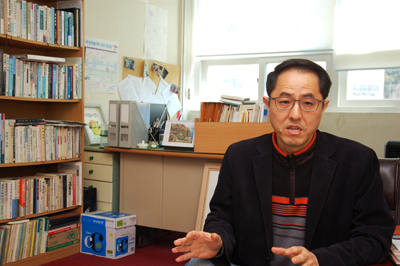
The Quality of the Festival? It Depends on Training Professionals
Q: Recently, there has been some opposition between the Festival’’s secretariat and the theater people regarding the appointment of the secretary-general of the Festival. Could you explain this in more detail?
A: I work on the spot so I try to listen to both parties. What the theater people basically argue is that the Festival was born in the theater scene so they should organize the Festival themselves. But the Festival’’s current secretary-general isn’’t from the theater scene and actually, none of the secretariat members are theater professionals. But Mr. Eun Heo, secretary-general of the Festival, has worked on international theater festivals for about ten years so he knows about such events better than anyone. I believe that a year and a half is quite short to evaluate him and that he should be given one more opportunity. Meanwhile, he should be praised for securing the government support of 100 million won for this year. This matter will be discussed again when appointing a new secretary-general in June.
Q: The program "Go, Avignon Off" is at the heart of the issues raised in relation to the festival management of the secretary-general. This issue should be resolved. Is there any problem related to the agreement on the selection of works?
A: It is true that the current opposition is related to "Go, Avignon Off" (For this program, the secretariat of Busan International Performing Arts Festival selects Korean works to give them an opportunity to be presented in the "off" category of the Avignon Festival in France, one of the top three global theater festivals.) because of the MOU that was signed by the former secretary-general with Avignon a year and a half ago. Under these circumstances, this issue has become visible. I believe that problems related to the Festival and its evaluation are separate but I don’’t know exactly what will happen in the future. As for the performances that were selected last year, the venue rental problem was solved and the troupes will perform next year. Following a meeting, we decided to have the "Go, Avignon Off" program this year, too, because we already received applications in public. The selected troupes will perform in Avignon next year. Next near’’s Festival will have a new program called "Go, International Festival" to select troupes.
Q: We cannot leave out Busan International Film Festival to compare it with your Festival. The film festival came to be known to many foreigners as one of the major festivals to visit in fall. Do you look forward to making your Festival one of the major spring events?
A: I have looked forward to it since the very beginning of the Festival. I have actually made efforts to improve the quality of the Festival so that people can come and see Busan International Performing Arts Festival in spring and Busan International Film Festival in fall. This is a matter of people, rather than that of budget. What is important is to train professionals who will work for the Festival. As for the budget, I believe that the Festival will need up to 1.5 billion won over the next decade. I don’’t mean that a bigger budget will ensure a better festival but I believe that such time and money will help us organize a festival that would be comparable to Busan International Film Festival.
 PREV
PREV
.JPG)
.jpg)
.jpg)
.jpg)
.jpg)












;)


