





"The World is Sharing the Value of Korean Traditional Music"
[People] Sun-Kook Kim, President of Just Music and Winner of the Musique du Monde Prize Awarded by l''Académie Charles Cros
|
|
|
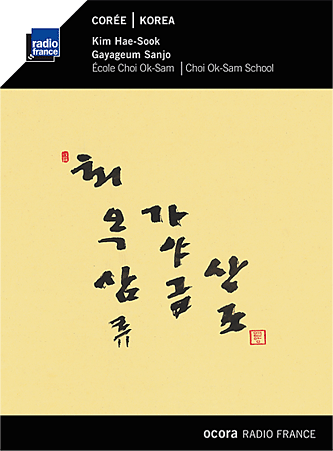
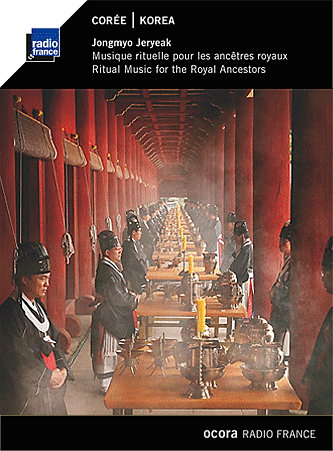
| Kim Hae-Sook Gayageum Sanjo, ocora RADIO FRANCE | Jongmyo Jeryeak, ocora RADIO FRANCE |
I Couldn''t Believe That the Prize also choose me Even at the Moment When My Name Was Called
Mr. Sun-Kook Kim, president of Just Music who planned and produced the albums with Mr. Pierre Bois, the artistic director of la Maison des Cultures du Monde (director of INEDIT), attended the award ceremony of Charles Cros in Marseille. When asked to talk about winning the prize, he answered, "Such a big prize seemed to be far from me. I have never imagined that the albums I produced would win such a prize." He continued, "I couldn''t believe that the Prize also chose me even at the moment the jajinmori melody of the Gayageum Sanjo by the master Hyun-suk Park was heard and my name was called. I was a little puzzled."
Describing the ceremony, Mr. Kim seemed to bring back the memory of the touching moment.
"A jury composed of about 50 French music professionals rigorously select albums that will be the winners of l''Académie Charles Cros. At first, I couldn''t believe that they had chosen albums of Korean traditional music as winners. That is because it means that intellectuals representing France''s arts scene shared the value of the Korean traditional arts. Personally, I was very glad that the life of Korean masters embedded in their music was recognized by the Music experts in France. I was also happy as the producer because the albums I had prepared with great care took such an international prizes. I thought that I would continue to do more on this way and go further. On the other hand, I came to feel a greater burden of responsibility. Thinking that more people will listen to Korean traditional music, I will have to prepare a performance and a recording with greater efforts."
|
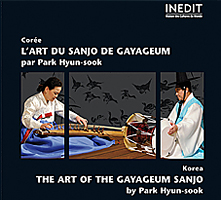
These three albums were born during a meeting with local professionals that were held just before the performances of la Maison des Cultures du Monde that was going to take place in September 2011 in Paris, France. During the meeting, the ajaeng sanjo by the master Young-gil Kim was being played as background music. The director Pierre Bois was deeply interested in this music and said, "What is this music? Who played it? If its album wasn''t released yet, we''d like to release it." The plan to release the album was immediately confirmed. Mr. Bois also said, "I want to listen to the geomungo sanjo that will be performed by the master Jae-hwa Lee three months later." He also suggested, "How about releasing the two albums at the same time?"
Afterward, the sanjo concert by the master Jae-hwa Lee (who was designated as a holder of the intangible cultural assets no.16 the geomungo sanjo in 2012) took place in Paris with great success. This concert further encouraged them to release the album. Indeed, the concert had seven curtain calls and two additional songs as encores. Mrs. Jae-hwa Lee herself felt encouraged, saying, "I have played geomungo sanjo for 50 years, but it is the first time to receive such an enthusiastic response."
As for the tracks included in INEDIT''s new albums, the geomungo sanjo by Jae-hwa Lee and the ajaeng sanjo by Young-gil Kim were newly recorded by Mr. Sun-Kook Kim while the gayageum sanjo by Hyun-sook Park is the live recording at the theater of la Maison des Cultures du Monde in 2010.
|
|
| |
| Sun-Kook Kim, President of Just Music Winner of the Musique du Monde Prize Awarded by l''Académie Charles Cros | ||
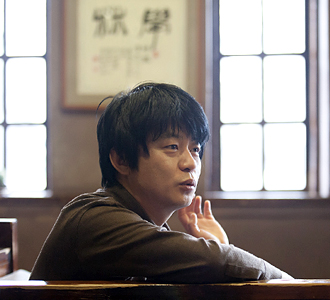
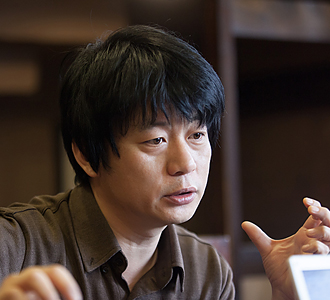
Modern Reinterpretation of Korean Tradition
Mr. Sun-Kook Kim is a world music professional and a record producer but not a Korean traditional musician or scholar. However, his affection for Korean traditional music has made him deeply involved in the recording of Korean traditional tracks. His current priority is to produce records of Korean traditional music to introduce them to the global market.
Mr. Kim released the ''Korean Traditional Music in the John Levy Collection at 2010. The collection is consists of Korean traditional tracks from the 1960''s that was left by John Levy (1910-1976), a British music scholar. In the same year, Mr. Kim received a suggestion from the ocora, a world music label owned by Radio France, a French public radio station. This is also when the ten-year project of Korean music started in earnest. The albums that have been released so far include the Royal Ancestral Ritual in the Jongmyo Shrine and its Music (2011) and The Gayageum Sanjo by Hae-sook Kim (2012). These albums have been distributed all over the world through Harmonia Mundi, one of the worldwide record companies in France.
|
| |
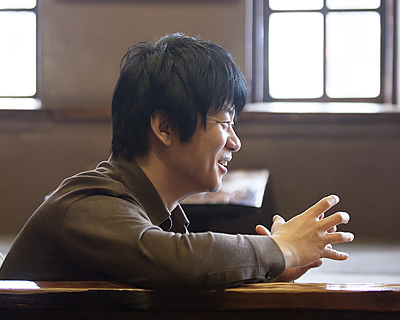
This year''s Bable Med, during which the award ceremony of l''Académie Charles Cros was held, was a real performing arts market where not only world-renowned artists and festival planners but also a great number of distributors, record producers and agency-related people gathered together. The fact that Korean traditional music was introduced on this occasion was very meaningful to Mr. Kim.
Mr. Kim said, "It is time for us to think more deeply about how to introduce Korean traditional music to the world." He added, "In my view, the fact that the Korean albums were awarded the prizes this year somewhat formed a basis enabling the modern reinterpretation of Korean tradition to be accepted by the overseas audience."
The artists who have devoted their life to refine their arts must be recognized. Korean traditional music doesn''t lack anything in comparison with any world music. We had better let go of the idea of " promoting" Korean tranditional music. Rather, I believe that cocentrating on making people listen to Korean music will lead to its success."
|
| |

Mr. Kim dreams of a day when the people like other famous world music will really accept and enjoy Korean traditional music.
I''m confident that in the near future, Korean traditional music will become one of the world''s major genres of music and performing arts. An environment where Korean music will receive treatment that it deserves in the global market will be created soon."
|
| |
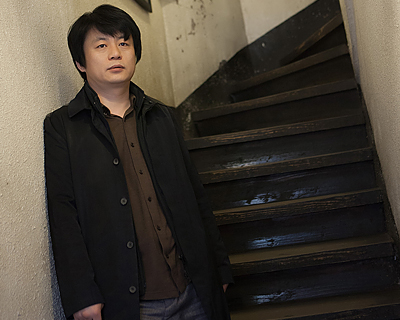
What Mr. Kim said with confidence also seemed to be a promise himself. As I was leaving after the interview, I suddenly came to wonder why he named his company "Just Music." When asked, he answered like this.
"When someone asks me, ''What do you want to do?'', I answer, ''Just music!''" I Just love music and concerts. I''m the happiest when I work on them."
 PREV
PREV
.JPG)
.jpg)
.jpg)
.jpg)
.jpg)












.gif','The good news came from Bable Med, a world music e..');)


