





Creating today''s dance inspired by contemporary themes
[K-festival Directors] Mae-ja Kim, Artistic Director of Changmu International Dance Festival
Private organizations often prepare festivals actively, a trend which is desirable. These organizations do have professionalism, willingness, mobility as well as a variety of human networks but in most cases, money is the problem. Although the government provides these organizations with subsidy, both the giver and taker actually feel uncomfortable about it and they try to hide such a feeling. Under these circumstances, I met with Ms. Mae-ja Kim (chairman of the board at Changmu Arts Center) who is leading Korea''s oldest international dance festival. Ms. Kim has led Changmu International Dance Festival on her own for 20 years since 1993.
|
| |
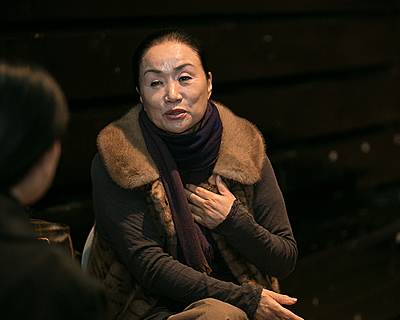
Ms. Kim, better known as a dancer in and out of Korea, has continuously presented creative dance performances based on traditional Korean dance. In other words, she is a dancer specializing in Korean dance but she can also be called a choreographer of contemporary dance because she is creating today''s dance, inspired by contemporary themes. Moreover, along with Changmu Dance Company which is proud of its history of over 30 years, she actively performs on different continents including the Americas, Europe, Asia and Africa.
I wondered why such a dancer who is active in artistic creation started hosting and running the international festival. I also thought that talking to her one on one would allow her to tell stories that are different from what people generally say. That is why I visited Post Theater located near Hongik University that is directly run by Ms. Kim.
"Why am I running a festival on my own even if it is not profitable? That is because I''m an artist. My own artistic activities are important but I think what is more important is to exchange ideas with others. That is, in addition to preparing my own performances, I need to watch my friends'' performances, to have a sense of sharing and to exchange ideas with them. That is how performing arts are developed. To summarize, I host the Festival because true artistic development is enabled by exchanging ideas with others using the human body which the universal language transcending national borders and cultures. Even if I don''t have money and I make some losses for now, I can pave the way for my artistic activities through the Festival."
|
| |

It''s been 20 years since the Festival started. However, considering the fact that its financial problems forced it to be suspended in 2006 and 2008, this year marks its 18th year. In the 1990''s, at the Festival''s very beginning, it mostly took place at Hoam Art Hall, which no longer exists, and Post Theater. Post Theater is small so larger theaters had to be rented so in the middle of the 1990''s, the Festival performances were presented at several theaters including Hanguk Performing Arts Center and Towol Theater located inside Seoul Arts Center. However, recently, the Festival was moved to the suburban area of Seoul to be held at Uijeongbu Arts Center (2009 and 2010) and Goyang Aram Nuri Arts Center (2011 and 2012).
What is notable for Changmu International Dance Festival is that every year has its general theme which, in turn, determines which dance companies will perform during that year''s event. In the case of the most recent Festival that was held in 2012, its theme was the "Evolution of the Body and Soul" and the 2011 one had the theme of "Meet Asia through Dance." At first, the Festival elaborated on quite serious themes related to dance such as "Butoh, the Genealogy of the End of the Century" (1993) and "European Avant-Garde" (1994).
For the past 20 years, a large number of Korean and international artists participated in the Festival. I personally think that the greatest achievement of Changmu International Dance Festival is the introduction of Asian contemporary dance. For example, to introduce Japanese Butoh dance for the first time in Korea, the Festival invited Kazuo Ohno, one of the founders of the dance, as well as world-renowned dance troupes including Sankai Juku, a butoh dance troupe, and individual dancers. The Festival also introduced African dance and artists and troupes from the Pacific rim including Australia. Next year''s theme is "Arab Dances" and it appears to be a natural choice for the Festival presenting international dance.
|
| |
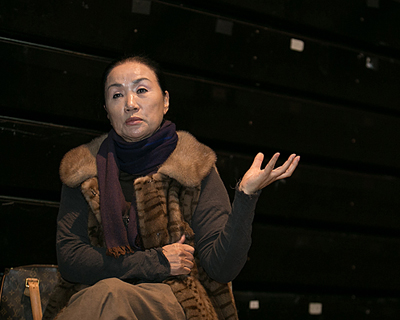
"This year, Changmu International Dance Festival is going to introduce a variety of Arab dances. Participation of many troupes has already been confirmed and their countries include Israel, Lebanon and Turkey. But discussing with the Arab dance companies, I found out that there is a big problem in inviting them. That is, many of them are unable to participate in a cultural event in a non-Arab country due to the complicated political conflicts in Arab countries. I felt perplexed but I know that it is a very important and sensitive issue for them. So I''m approaching the problem carefully while I do understand that it is ''absolutely impossible'' for them to perform in a foreign country."
No wonder it would not be easy to present Arab performances during a single festival, providing the audience with such a rare occasion. It already seems difficult to do so from the beginning. However, I was amazed by the fact that Ms. Kim, who has the largest international human network in Korea, is now reaching even Arab countries.
It was actually Ms. Kim who greatly contributed to enhancing the status of Korean ballet. Some would wonder, saying, "Why would a traditional Korean dancer be interested in ballet?" but Ms. Kim formed a basis for the globalization of the repertoire of the Korean National Ballet by helping it sign contracts with world-renowned choreographers.
To be more specific, Ms. Kim has been close to Yury Grigorovich, artistic director of the Bolshoi Ballet. She thus helped the Korean National Ballet meet him. She also knows other internationally renowned choreographers; she choreographed performances with Carolyn Carlson, a French contemporary dancer, and she was also very close to the late Robert Joffrey of the Joffrey Ballet. Moreover, Changmu International Dance Festival directly reflects her relationships with famous dancers from China and Japan and major persons in the dance scene. Indeed, Ms. Kim knows an amazingly wide variety of dance-related persons including not only dancers but also planners, dance scholars, presidents of theaters, critics and even those running world-renowned businesses of dance products. The introduction of Arab dances would also be the natural fruit of Ms. Kim''s wide human network.
It is actually very difficult to watch Arab dances in Korea because of unexpected problems including Arab women''s restricted activities, problems that may arise from these countries'' exchange with non-Arab ones, religious issues, these countries'' economy facing challenges and their perception of culture.
That is why it is great to see Ms. Kim''s plan to introduce Arab dances regardless of such challenges and to see the feasibility of her plan. I then agree that everything is thanks to her "good friends" and I start feeling envious of her wide human network.
|
| |

"Good friends? I have many of them. But even if I''m very close to them, I cannot ask them for help anytime. They are artists so I should respect their artistic life. Unfortunately, I can''t call them even if they are available when I don''t have sufficient means of treating them and while I''m abroad. To be able to be treated as an artist, I should treat them in a proper way because everyone should be treated well to make our exchange work."
Changmu International Dance Festival started with the purpose of concentrating on dance and discussing the arts. The fact that such a festival has existed for 20 years by being led by a single dancer proves Ms. Kim''s great enthusiasm and willingness. Ms. Kim runs not only the Festival but also a wide variety of dance businesses covering all areas related to performing arts including a dance company, a theater, a monthly dance magazine and an educational program. Nevertheless, Ms. Kim''s first priority is to engage in artistic activities, in other words, to perform. That may be because she herself is a dancer who still dances. Right after this interview, she was heading to her dance studio in a hurry.
 PREV
PREV
.JPG)
.jpg)
.jpg)
.jpg)
.jpg)












.gif','Some say that festivals should be led by the priva..');)


