





A 15-year-old performance, Nanta''s birhtfather & a ''Psy'' in the Performing Arts Scene
[People] Seunghwan SONG & Jaram LEE, ''Power Persons'' in the 2012 Korean Arts and Culture Scene
At the end of last year, Korea Arts Management Service''s [weekly@Arts Management] zine conducted an online survey asking who were the ''Power persons'' of the 2012 Korean Arts and Culture Scene. The survey had two categories: arts administration and arts creation. Two people were selected in these categories and were interviewed.
|
|
| Jaram LEE & Seunghwan SONG |
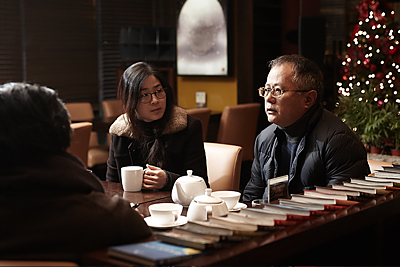
Who is Seunghwan SONG? SONG, who epitomizes a young at heart man in his 50''s, is a long-time star who created the legend of Nanta. With this single work, SONG has become the most successful entrepreneur in the performing arts scene in Korea. Most recently, he has also appeared in the drama, Childless Comfort, (screenwriter: Suhyun KIM) which aired on a mainstream Korean TV channel. His role in this drama is a jealous and fussy second son. This drama has allowed me to rediscover Seunghwan SONG the actor.
Who is Jaram LEE? I met this artist with an amazing genius for the first time during the showcase of Ukchuk-ga at this year''s PAMS and came to know her works. Of course her name has been familiar for 28 years because she sang My Name, Yesol! at the age of five. This extraordinary artist is knocking on the door of the global market with a work updating pansori (a genre of Korean traditional music) with a new concept and a new form. Writing for the Korean government''s portal called Sympathy, I even praised her by saying that she is comparable to Psy in the performing arts scene.
What, then, is the relationship between these two people? It is quite easy to imagine a reunion between the two masters but it was actually the first time that they had met each other. In any case, while first encounters are usually awkward, SONG and LEE established an instant rapport toward each other as if they had known each other for a long time.
Q. Jaewal JUNG ("JUNG") : Thank you for taking the time out of your busy schedule at the end of the year. Could each of you summarize what you did this year?
A Seunghwan SONG ("SONG") : As for my official work, serving as the president of the Korea Musical Theatre Association was meaningful. I have been in this position for two years: I fulfilled my predecessor''s remaining one year before serving my term this year. There have been fruitful results. For example, the Association held the Seoul Musical Festival in collaboration with Chungmu Art Hall in August, spreading a musical boom. Moreover, the ''Creative Music Upgrade Project'' designed to invigorate creative musicals was completed well. The crown jewel of this project is the fact that we secured a government budget of 3 billion won for these projects.
A Jaram LEE ("LEE") : For me, this year was that of Ukchuk-ga. In May of last year, I was invited to the Uijeongbu International Music Theatre Festival and I also had the chance to perform at LG Arts Center, a "dream" venue for me. These performances have made Ukchuk-ga a major part of our organization''s repertoire. As I participated in the showcase of PAMS, I also had an opportunity to make a leap forward to expand into the global scene. To summarize, this year formed a basis of growth, helping us build a positive atmosphere to continue into next year.
Q JUNG : It is technically difficult for me to interview two persons who are different from each other in terms of their ages, current positions and paths they follow. So I''ll ask questions separately, except those about your common interest. I''ll ask Chairman Song first. What is the current situation of PMC Production that has enabled today''s success of Nanta?
A SONG : As for its current business, it''s continuously growing. Nanta is still successful as Chinese tourists have gradually joined the audience that had previously been mainly composed of Japanese tourists. I heard that this year, the number of foreign tourists traveling to Korea had reached 10 million. About 1.2 million of them watch Korean performances before going back to their countries, of that, about 800,000 of them watch Nanta and Chinese tourists numbered around 100,000 of the Nanta audience.
Q JUNG : In addition to Nanta, PMC Production has continued to produce and present creative musicals. What are the titles of your repertoire and how were their results?
A SONG : Let me start by introducing a new work that will be presented at the beginning of next year. Wedding, a performance that was ambitiously produced following the success of Nanta, will premiere on an open-run basis at Chongdong Nanta Theater next March. Meanwhile, Nanta will be moved to a theater located inside the Salvation Army building in Chungjeongro. As its title tells us, Wedding is a musical show that depicts what is happening in a wedding hall, using songs and dances. As in the case of Nanta, it targets foreign tourists. Another musical called Lupin will be presented at the Samsung Card Hall inside Blue Square, starting from February. The performances that were or are currently being presented include the musicals The Brothers Were Brave, Dalgona, The March of Youth, The Origin of Pushing and Pulling and the musicals for children like Nanta (for children) and Robocar Poli. Our repertoire includes about 20 performances. I can''t say that all of them have been successful but they have all enjoyed at least modest popularity.
A recent media report says that the revenue of PMC Production is 37.8 billion won, its gross profit, 7.1 billion won and its net profit, 5.6 billion won, as of 2011. Indeed, PMC Production boasts a size and results that are commensurate with a robust company representing Korea''s performing arts scene. Built upon such growth, PMC Production is planning to be registered in the KOSDAQ market in 2014 through an IPO. Earlier this year, Song appointed a younger friend who took charge of the marketing of Nanta at its very beginning as the company''s CEO. SONG then came to serve as its chairman and artistic director. In the meantime, Gwangho LEE, who created the legend of Nanta with SONG, became the chairman of PMC Networks, the holding company of PMC Production.
|
|
| Seunghwan SONG |
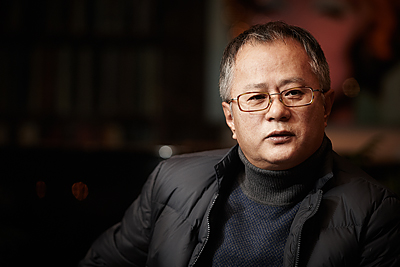
Q JUNG : Recently, there are many successful production companies thanks to the growth of musicals. But it is true that skepticism about the stability of management always exists. From the perspective of a person in charge of a company (organization) that maintains sound growth, what process is required for an ordinary performing arts organization to reach the level of PMC?
A SONG : I have a theory called the "four-step cycle." First, you need to secure good content. But don''t think that everything will work well even after finding good content. The second step is about coming up with marketing strategies that are designed to make profits. Third, you need management that will maintain the life of the content for a long time. Lastly, you invest the profits made by your "killer content" in the research and development of future works. If a performance company (organization) succeeds in making these steps, they form a virtuous cycle, the organization can be said to be successful. In this context, the path to the success in performing arts is similar to that of the manufacturing industry. Of course, the expertise required for each step is more important than anything. As the representative of PMC, I don''t feel that I deserve all the credit for the fruits of success. Such success wouldn''t have been achieved without the help of a friend called Gwangho LEE took on any difficult work, as the person in charge of business administration.
Q JUNG : Jaram, you have already become a star, being widely known as Jaram LEE e Korean classical musician. Could you explain why you created an organization called Pansori Project ''ZA''?
A LEE : In the short term, actual profits are much bigger when each of the members of the group (including myself) performs alone. So sometimes, I find it difficult to make ends meet. At that time, I feel skeptical and say to myself, "Why am I doing this?" As a human, I sometimes think that there may be bigger wealth and honor in solo efforts. Overcoming such skepticism and jumping to the next level require each other''s help. Working with great artists sharing common goals and stimulating each other, we feel hunger at the same time and we eat together. That''s the way we live. I formed the organization Pansori Project ''ZA'' because I wanted to make a small commune where we would be able to share such happy moments together.
Q JUNG : Good for you. Performances by a group who enjoy each other''s company will certainly bring happiness to the audience, too. I see that you are performing both in and outside of Korea in an attempt to share such happiness with more people. In your view, what is the general response to Sacheon-ga which premiered five years ago and to Ukchuk-ga which premiered two years ago?
A LEE : I feel good because there are more people who like them than dislike them. Nevertheless, I still face the difficult challenge of predicting where my artistic satisfaction and the audience''s tastes will meet each other next. Moreover, I still don''t know if Sacheon-ga and Ukchuk-ga can yet be regarded as "good content" that Chairman Song mentioned as the first step toward success. I''m just considering the realistic possibility of using them as content as our overseas performances become more frequent in the future. I think that pansori can only be presented in this way. I also believe that securing growth and sustainability of these performances as our group''s centerpiece will require a professional tour manager''s role.
|
|
| Jaram LEE |
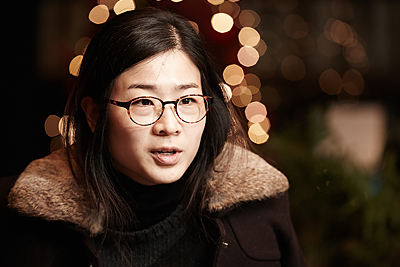
Q JUNG : It seems that at this point, Jaram needs some advice from Chairman Song who is a master hand at arts management. Chairman Song, do you have anything to say to this promising younger artist?
A SONG : Jaram made music for the original musical Seopyeonje (2010) and she also appeared in it. That particular musical demonstrated that Korean sentiments and tastes can be shared in a musical after all. On the other hand, what is regrettable is the current lack of popular appeal of local original musicals. It is great to pursue auteurism and artistic value but if you want to make a commercial performance, you need to add stories and songs that are going to be more attractive to the public. In other words, you should ''remove ink'' from a performance. Genres and forms are not very important. But it is OK to have many brands whether it''s Sacheon-ga or Ukchuk-ga. If you want to appeal to the public, you had better actively look for professional producers, directors and agencies. PMC also started from scratch with only four people but the company now has grown to 150 staff members. I continuously worked hard and after some time, I was able to achieve great success.
It is actually not easy for the arts administrator Song and the artist Lee to find something in common, considering their respective stages or positions. One of them has already reached the heights of success after putting in a lot hard work and focusing on his vision and the other is an artist who still needs to learn what is required to succeed beyond pursuing just artistic achievement. There is still a big difference between the two in terms of what they pursue: either commercial arts or basic arts. However, even if an artist pursues basic arts, a reasonable knowledge of arts management is essential as long as he or she works with an organization. In that sense, PMC''s success story still serves as a valid reference for Jaram LEE.
Q JUNG : I have a general question for Chairman Song. Does the Korean musicals industry have real potential?
A SONG : It is obvious that the industry is growing. The market is worth about 250 billion won and it is growing every year. But what is worrisome is the fact that original musicals don''t work very well compared to licensed or imported musicals. Compared to K-pop, television dramas and films, musicals lack creative human resources such as good authors, composers, actors and directors. As Korean cinema has enjoyed recent growth thanks to the talents of the graduates of a professional school called the Korean Academy of Film Arts, musicals also need such a growth engine at the ground level. I''m sure that if a large number of professional writers and artists created musicals that touched the very heart of Korean sentiments, the current musical market would quickly change to be focused on original musicals.
Q JUNG : Watching you for a long time, I have been amazed by your energy. You are the leader of a planning and production company, the president of an association representing a specific field, a professor at a university and an actor. Isn''t this too much for you to handle all by yourself? How do you manage your time?
A SONG : Since I made my debut as a child voice actor at KBS in 1965 when I was eight, I have always played multiple roles. You can do it if you think that a month has 90 days. In other words, for me, I consider that mornings, afternoons and evenings are all like their own individual day. I roughly divide my day into three parts: teaching at school in the morning, filming in the afternoon and rehearsing for a performance in the evening. It may only be possible because I don''t drink at all and I don''t have children. Anyway, I have worked a lot for years. But next year I have been offered a sabbatical year by the university so I''ll take a break then. That is why I decided to stop serving as the president of Korea Musical Theatre Association this year. While I was busy working as an entertainer, I took three years off in New York from 1985 to 1988. It was during that relaxing period that I was able to create the legend of Nanta. Without such a break, Nanta wouldn''t have been born.
|
|
|
|
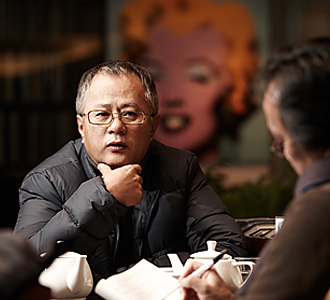

A JUNG : I should have talked more about Sacheon-ga or Ukchuk-ga with Jaram but I feel sorry that I didn''t have much time for that. Let''s talk about the works next time. Now, please let me know your plans for the future.
A LEE : I''m still learning (currently earning a doctorate degree at Seoul National University) so it is also important for me to complete this course. I''ll perform pansori for the rest of my life and my dream is to positively influence the next generation. To do so, I need to not only pour out my talent but also further develop myself. For example, I could acquire different kinds of talent such as modern dance and acting. That is also what I want to do with the organization: to help the audience understand pansori from a different perspective by popularizing the genre. It is equally important to carefully document, systemize and ''stylize'' this process. But I''m worried that I''m not the person for such a job.
Many of the foreign producers, promoters and festival planners who visited PAMS this year were interested in not only the work Ukchuk-ga but also the artist Jaram LEE. Indeed, they mentioned her name frequently, choosing her as the first person they want to invite. They said that the uniqueness of pansori''s composition of sounds and gestures is attractive. In addition to such uniqueness, the performance''s universal appeal was enabled by wisely borrowing the principle of Brecht''s epic with which westerners are familiar and this also made it appeal to them greatly. If the promising content is welcomed by the global market and becomes the ''killer content'' of Song''s success formula, a globally successful performance may be born from this art. In many different ways, I''m sure that both of them will be very active next year as they have been this year.
 PREV
PREV
.JPG)
.jpg)
.jpg)
.jpg)
.jpg)












;)


