





[K-Festival Directors] Do not betray art.
[Who&Work] Sutaek YIM _Artistic director of Gwacheon Festival
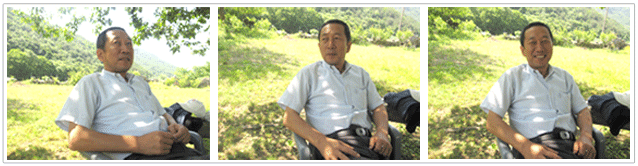
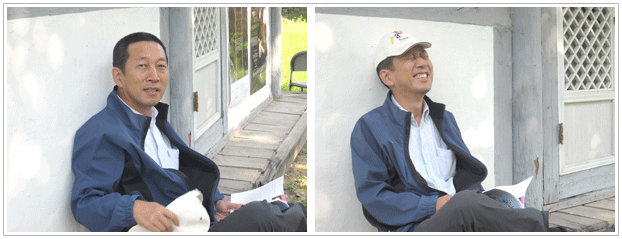
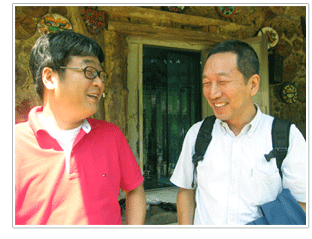
In most of the major performance festivals in Korea, it is the artistic director who takes responsibility for the festival. However, it hasn''t been a long time since this sort of artistic director system has been implemented. Who is the longest-serving artistic director of performance art festivals in Korea? It is perhaps Jingyu YOO, art director of the Chuncheon International Mime Festival. Having founded the mime festival around 20 years ago and served as the art director since then, there is nobody who can compete with YOO. However, given that the mime festival was created by the Korea Mime Council and that the artistic director system back then operated in a different context from today, the closest figure to being Korea''s longest-serving appointed artistic director is Sutaek YIM. He served as the artistic director of the Gwacheon Festival for 7 years, beginning in 2003. I met up with YIM on June 25th, during the general meeting of the Korean Performing Arts Festival Council held in Mount Songni. (YIM is also the first chairman of the Korean Performing Arts Festival Council.)
|
|
| Sutaek YIM _Artistic director of Gwacheon Festival |
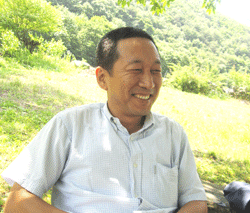
Korea''s longest-serving, appointed festival art director
Q : What is your job?
A : Besides being an artistic director for a festival, I work in various other fields, including as a university lecturer and translator. Of course, I am the artistic director of the Gwacheon Festival. The last time I worked as a director was two years ago, for the "Mouse Hunting" performance. Even then, I couldn''t really concentrate and it felt awkward. I felt like it was unscrupulous behavior to direct an indoor performance when I was also the artistic director of a street performance festival.
Q : Couldn''t you have directed an outdoor performance then?
A : I don''t know. I haven''t thought about it yet. My role is to create good street performances to excite young people. This is also the reason why I hold a series of discussions throughout the process of creating a performance. Two of our performances from last year are going to France this year, which is a small but fruitful reward for us.
Q : Which performances are going?
A : Visual Theater Company Ccot''s The Self-portrait and Alice Kim''s Chic are going to France. The works will be featured during the off program at the Chalon dans la Rue and as a part of the official program at the Festival d''Aurillac. I am proud and happy.
Q : How did you get involved in the Gwacheon Festival? It is quite a challenging festival...
A : I got involved in the Gwacheon Festival in 2003. Until then, I didn''t have much interest in street performances. One of my high school friends, however, was running for mayor of Gwacheon and I thought I''d help him to instill culture and arts as a part of his campaign pledge. Later on, I found out that none of my ideas were adopted. The friend, however, was elected as mayor. At the time, the artistic director of the Gwacheon festival was Inbae PARK. He succeeded Jintaek YIM and Jinsu JUNG and held the artistic director position for 3 years, starting from 2000. I think that time was a period of change for the festival. I was his successor, and I suddenly became artistic director. More so than anything, I think my forte was that I am and have been a Gwacheon resident since the mid-1990s. (laughs)
"I fell for the charms of street performance while organizing the festival."
Q : So at the time, your interest or fondness for street performances wasn''t that great?
A :Yes. I''ve said this in interviews at the time as well and even thought about moving the core of the festival indoors. However, when I actually saw madanggeuk (traditional Korean street performances) and street performances, I fell for their charms more and more. I gave up my idea to give more weight to indoor performances soon afterwards. The festival changed me. Three years ago, I eliminated indoor performances from the program altogether. Isn''t this a surprising change!
Q : I think there must have been a trigger for this surprising change.
A : Actually, the success of our 2003 festival was a big push. The opening piece, The Prayer was a big part of this success. The year 2003 was when U.S. troops invaded Iraq. I saw an article that reported there was a dance performance in Baghdad, 5 days after the war ended. It was shocking. It was a great attempt to show what art really is. I wanted to find the team responsible. After some inquiries, I saw a special KBS program about it and contacted the show''s producer and a translator to finally reach the Baghdad team. In the end, we were able to feature a performance with HOBT of the U.S., Mardok Theatre Group of Iraq, and Korean artists. Before the performance began, the American artists apologized to the Iraqi artists with tears in their eyes. The American artists also told them that they hope they acknowledge that there are many Americans who are opposed to the Iraq War. And so the performance began with this touching moment, and it turned out to be successful as well. It is also surprising that the hottest global issue at the time was touched on in a small Korean city with only 60,000 residents.
With the success of this performance, the festival committee became incorporated in 2004 and I was appointed as artistic director for an official, three-year term. This year is the last year of my two terms as artistic director. Do you know the public''s rate of awareness for our festival? It is 93%. And the participation rate is 87%.
Q : Are you saying that the festival is doing quite well?
A : Honestly, these days, it''s quite tough. I think globally, street performances are in stagnation mode. It is getting more and more difficult to find performances that really grab your attention. I don''t think performances like that are even coming out of France, which is almost like the home of street performances, as artists come out of poverty there. I think it is like that, though, with art.
Q : Tell me the secret to being a long-serving artistic director.
A : You have to keep to your principles. You need to be able to persuade others of your artistic point of view, and you can''t ever be servile. You can''t use flattery, either. It is quite stable for me now, but in the beginning, I really had to fight my way through. When we all didn''t know each other well, we even went to the city council and fought viciously. Some of those who were the hardest on me are now my biggest supporters. There was also a lot of conflicts with public servants, but in the end, "art" solved the problems. Sunshin YI once said that you die if you think of ways to survive, and live, if you embrace the risk of death. Every year, I open the festival, risking my reputation. I think perhaps, these days, people''s fighting spirits are weak.
Q : What is the underlying philosophy of the Gwacheon Festival?
A : It is art. In the past, I laid out a few detailed rules. For example, I spoke of detailed points regarding technical quality, the modernization of the traditional, and the reflection of current social issues in the works. However, when everything is actually in motion, it is hard and cumbersome to keep with these points. And it may be simple-minded, but I didn''t want to lose the element of "deviation," which is one of the basic qualities of festivals.
Street performances have grown vastly and there has become a big need for them
Q : You have spoken a few discouraging words regarding the festival scene in Korea. Do you think the future is that dim?
A : I think the opposite. As the closed-door culture becomes stronger in the 21st century, the times also call for more outdoor life. Festivals, especially those that feature street performances, have a bright future. Last time, we held an inaugural assembly of the Korean Street Art Center in Yongin and 103 people came. We thought only two to thirty people might show up, so it was a big surprise. There were a lot of programmers and those from cultural foundations. This is evidence that there is a lot of interest.
Q : Now that I think of it, you are also involved in the Korean Street Art Center.
A : Yes. I took the co-head position along with Manseok KIM when the center opened. I hope you take notice of the fact that the center''s title includes the words "street art" instead of "street performance." The term street performance, instead of outdoor performance, seems more appropriate, and within a larger context we call it street art.
Q : So does that mean street performances have evolved that much?
A : Yes. I began in 2003, and looking at the industry from a quality and quantity point-of-view, it has grown a lot. Floriane Gaber, a street performance critic, came to our festival in 2004 and asked why we were doing what we were doing. She said it was not street performance. It was a moment of humiliation for us. So I said, "Come back after 10 years." Korea is a dynamic society; I think it will be less than 10 years.
Q : Has she come back?
A : She hasn''t come back yet. I told her to come after 10 years but she said she wants to come before then. I think she can come now. I tell my juniors to stop organizing indoor performances with funding that is hard to come by and waiting for an audience that will not come. The regional government and festivals will give them funding. There are now around 20 organizations in Korea that produce street performances. I think street performance is a viable business. I think I chose the right field. I am very lucky.
Keep to your principles and build trust
Q : You are known for your straight talk and radical opinions. Do you encounter problems because of this?
A : I have made many people uncomfortable. And so there are many who are scared of me or don''t like me. But everywhere I go, I speak honestly. I think when you say "radical," you are, for example, talking about my stance on tourism festivals. Tourism festivals can never succeed. By that I mean that festivals with tourism as an aim cannot succeed. I am adamantly opposed to speaking of festivals in terms of being an economic or industrial boost. This is why my public relations staff is always on edge whenever I meet journalists. I am told outsiders say, "They must have a hard time," regarding my staff. But inside, it''s not always like that—believe it or not.
Q : What is the most important thing regarding festival management?
A : I don''t know a lot about management and I don''t get involved in it that much. However, I abide by the rules. If the rules are wrong, we can correct them and move on. The thing I emphasize the most is trust. For performances, I tell people not to read the contract but to just sign. I''m telling them to trust me. I have never betrayed anyone. Trusting someone is much more economical. If you don''t trust, it is so difficult and exhausting.
|
|
Q : Please say a word to those who want to work in the festival sector.
A : I interviewed the president of EMI once and asked a similar question. His answer was simple—"Don''t betray music." I want to say the same thing—"Don''t betray art." Stay on the right path and don''t be afraid. Failure comes numerous times, repeatedly.
Q : Is there anything else you want to say?
A : Yes there is. I have never thought of myself as a great artistic director. I''ve never boasted about my position. When our festival got chosen as the best festival in Gyeonggi Province last year we received many congratulatory phone calls, but inside our office, it was rather quiet—because it was only natural for our festival to get chosen. I am thankful for how proud our staff are of the festival. But there are so many great festivals out there. The artistic director of Kunsten Festival Des Arts in Belgium comes to mind. She looks not at works, but at people. In a word, she is a guru. There are a lot of risks and it is still quite unstable. In fact, I am like that these days. If I don''t think the person is "it," I never invite them to the festival.
Because street performances and festivals have not yet become fully established but are rather still growing, there are a lot of things to do to make them grow. From format to everything else, they are all something to worry about. As an artistic director, organizing the opening performance is always a difficult crisis to overcome. So it''s always hard work and I feel I am still lacking. I always feel the need to withdraw and study.
 PREV
PREV
.JPG)
.jpg)
.jpg)
.jpg)
.jpg)












.jpg','In most of the major performance festivals in Kore..');)


