





[K-Festival Directors] This is why having a good producer is important
[Who&Work]Jeongja BAE_Head of the Bananamoon Project
The first time that the fancy envelope with a yellow print on a green background caught my eye among my mail was perhaps last year, when the chilly breeze began to blow. In contrast to its fancy packaging, the contents inside were press releases of mostly small-scale theater performances. They weren’’t for up-and-coming plays with big-name stars or that had gained internationl prestige by winning something like a Tony Award or an Evening Standard Theatre Award, but rather for "young plays" or works by Donginje-Geukdan (experimental theater companies run by a small pool of joint investors)
The ones who sent the envelope were the Bananamoon Project. The company name was just as witty as the envelope design. As if it were saying, "Please remember me," the first impression I got from the package was that of a ambitious producer full of fresh inspiration and passionate dreams. However, after meeting the head of the company, Jeongja BAE, I had to correct my first impression. (But don’’t get me wrong—this doesn’’t mean she is not ambitious or full of passionate dreams.)
 | |
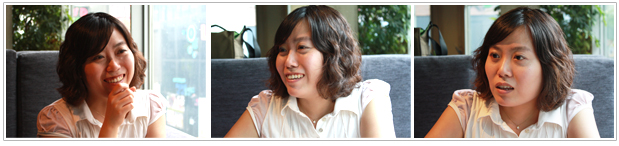
| Jeongja BAE, head of the Bananamoon Project |
Not undermining oneself
The Bananamoon Project is the first company BAE founded after breaking out on her own. So to say it is a company that is just starting out is not entirely wrong. BAE herself, however, is a veteran producer who has produced various acts in Daehangno for ten years.
She acknowledges that she hasn’’t stopped working once in these last ten years. "I started when I was really young so I am younger than most of my colleagues," she said. BAE has worked for theater companies in Daehangno, including Moonhwa Icon and TOBE Company. When she was in Moonhwa Icon, working with third wave of members from Hyehwa No. 1 led her to a gig with the theater company Yeohaengja. After working in production, public relations, and marketing, she founded the Physical Theater Festival in 2006, now in its fourth year.
For the last 10 years, BAE has worked in various fields related to theater, production, and festivals. Her resume is ranged and pragmatic, a resume that can’’t be explained in only a couple of lines with a high-ranking title at a big company or a fancy degree (although she is the head of the Bananamoon Project, she refers to her title as "department head"). Her job transitions weren’’t something she necessarily planned. She said that whenever she felt like she was undermining herself in her job, the first thought that ran through her head was to finish whatever she was doing first before planning her next move. "When I did that, somehow, another project came to me," she said. For example, when she quit her job at Yeohaengja, she met Bonggyu LEE, head of TOBE Company, on the bus ride back home; she then went on to work for TOBE.
"When I first started writing press releases, I read books related to the production, even though nobody told me to do that," she said.
"By doing this, I felt that I was learning and growing, and not just finishing my work. However, at some point, I felt as though I was turning into a vending machine. Because I had to conduct work on various works at once, I worked systematically, using skills that I had gained."
It wasn’’t just mannerism or a problem with excessive amounts of work. At the time, she worked mostly as a producer for Daehangno theater performances. Because these were small-scale performances, there were a limited budget for public relations and marketing and no room to discover and try new things. So whenever she felt she was getting exhausted, she would move on to a new platform and create new projects and meet new people. That is how she built herself and her career.
Although she said she can’’t carry out long-range plans, as her past work shows, she doesn’’t hesitate to make decisions and act on them.
If you are a person who has to follow your own path, instead of following an ascribed road, making a sudden decision is just as important as drawing a solid future path for yourself. Jeongja BAE will probably say that she has made cautious decisions so as to not let herself be undermined.
"A whole other gap that I am able to see"
As the new millennium approached, art production and management became a separate, specialized field, and with this there was an influx of experts in this field. However, many producers and managers, especially those for small-scale Daehangno performances, started off mostly in creative roles, such as actors or directors, and then chose a path in production. They sometimes switched because of their faith in the industry, and at other times because of circumstances in the theater sector and being saddled in a certain role.
BAE on the other hand, was a member of her university’’s drama society, and she has worked in the production field ever since her stint as the youngest producer in the Yeonwoo theater company. Looking at her choices, the path she took seems far from the trends in the production and management fields of today.
During the early 2000s, when planning and management started becoming a separate field, public relations and marketing agencies started popping up. (Another form of this trend was when the public theater culture institutes that were a part of local governments started conducting cultural administrative work and large-scale commercial productions.) The companies that BAE worked for, including TOBE Company, were all a part of that flow. However, the main business of these companies now is not promotion and marketing. This is because they are expressing a huge amount of interest in production; more than mere interest, as there are even those that already have their own production system, with theater companies and theaters, even though the companies may vary in experience or scale. Eda Entertainment and TOBE Company are two such companies. These companies are now seeking the market for commercial performances that differ from the existing popular entertainment performances. So the question of how to make a profit with theater performances is a big issue in the production and management field.
However, BAE seems to be going against the flow, much like a salmon. "I’’m not the type to make plans before I act and I usually just make trouble and see what happens," she said. However, her plans for the future, after her ten full years in the business, look very clear. She added that the founding of the Bananamoon Project was her making trouble, and that because she had no firm plans, she is now even answering all the phone calls to the company herself. However, the reason Bae "made trouble" was because she wants to operate the Physical Theater Festival for at least ten years. She admits that the thought of continuing to run the festival when she had other work made her feel uncomfortable, as if she was just laying the groundwork and not taking responsibility.
I wonder if her uncomfortable mindset is due to a sense of duty that stems from her sincerity. Maybe it is this mindset that fuels her to fulfill her desire to "show people how diverse theater is," to create a festival, change jobs, found a company and labor over what she says she lacks the most, "management skills."
|
|
Producers are the mediators of communication
When I asked BAE about marketing with the purpose of getting useful tips from producers and managers in the field, she replied, "I am not good at marketing." However, the nuance of her statement was different from a lack of self confidence, or humility. Rather, I could sense a subtext, in that she doesn’’t consider marketing to be the be-all and end-all of production and management. I wonder if the Physical Theater Festival, which she said she wants to operate for at least 10 years, is her current goal.
"When I was working for Yeohaengja, I saw various performances, attended international festivals. There were interesting performances and those I wanted to introduce to other people," she said.
"I also came to think that the work I did in Daehangno is a very small portion of theater. The Physical Theater Festival is not something that I created to argue a certain theatrical ideology or value. "It was created, perhaps, more in the hope of encouraging people to watch a more diverse pool of performances. This hope I have, I think, will help make the Daehangno scene more diversified—not because I have superior skills but because I noticed a certain gap that other people couldn’’t see. This is what gives me joy and fuels me to keep working. This is important."
BAE said that the "gap that others can’’t see" isn’’t aiming for any specific form, field, or value, but that it lies in the problems that occur in the production process. Although production has become a separate field onto itself, BAE said that this field she is involved in is less a profit model and more a role of producer working in partnership with creative people.
"When people think of producers, they often only think of commercial performances, but this isn’’t necessarily so. I think that there is a need for producers who can also play the dramaturge role as well," she said.
"Of course, this is a bit different from the dramaturge role that is predominant now—there needs to be mediators of communication who can bridge the space between the work and the audience.
The first person to receive the audience after a performance is the producer, who can read the reaction of the audience by just looking at their facial expressions. Producers are the first ones to see the audience’’s reaction, such as by preparing press releases or answering questions about performances, and it is important for them to form strong partnerships with the creators."
I find myself nodding while listening to BAE.
"However, marketing or management skills are important as well, because they also have to carry a financial responsibility. But marketing is quite difficult. People don’’t show up when it rains, when the weather is bad; they don’’t move when it is cold or hot, and the theater is empty when there is a football match..."
Like what she said, trying to develop a groundbreaking tool for promotion and marketing in small-scale theaters might be a rash challenge. And because BAE contemplates on ways to approach the audience as a mediator of communication between them and the creators, rather than as someone who sticks her neck out to promote the works as widely as possible, it makes me believe in her even more.
"In the end, the work is what is important," she said.
This is true. And that is why a good producer is important.
 PREV
PREV
.JPG)
.jpg)
.jpg)
.jpg)
.jpg)












.jpg','The first time that the fancy envelope with a yell..');)


