





Jaram LEE, A Narrative Singer who Sings Her Life with All Her Soul and Might
[Who&Work] Jaram LEE_ Pansori Project ‘ZA’
|
| |
| Jaram LEE Ukchuk-ga |
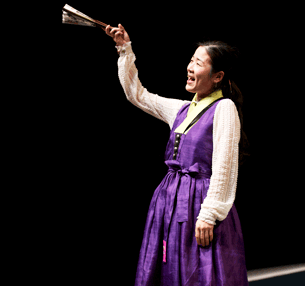
Pansori (Korean narrative singing) used to remind me of a performing art presentedby a singer dressed in hanbok(Traditional Korean dress) in front of a folding screen. A pleasant shock struck me when I saw Jaram LEE in one of little theaters in Daehak-ro (Korea’s youth cultural space) in the early fall in 2004. She was dressed in a T-shirt and blue jeans and played a pansori on the theme of gender equality issues in Korean society with wit and satire. At that time, I vaguely thought what a talented person she is.
Not much later, I heard that Jaram LEE will adapt and perform Bertolt Brecht’’s The Good Person of Szechwan in the form of a pansori called Sacheon-ga. I was skeptical, but went to see Sacheon-ga and was amazed at its plot and composition. I was utterlysurprised by her talent as a composer, and realized then what a wonderful artist she is.
Sacheon-ga was showcased in New York in early 2011 and was acclaimed overseas. Jaram LEE went beyond language, culture and other barriers by performing in front of the audience in New York, who weretotally unfamiliar with the form of pansori and Korean language. She delivered details as well as the storyline, fascinating the audience. I was thrilled at her talent as a gifted performer.
Jaram LEE once again adapted Bertolt Brecht’’s play as the pansori Ukchuk-ga and put it on the stage. Ukchuk-ga is a story about a woman who struggled to survive on the battlefield but eventually lost all her children to war and became a tougher as a result. Jaram LEE portrayed fortitude despite the cruelty of living on the stage. I became aware that Jaram LEE has developed many talents, as an actress, a creator, and now as an author. That is why I liked lines from her play.
Q: How is it going these days? I heard that you did an international concert tour in the summer.
A : I visited London at the invitation of the Korean Culture Center in the UK for a one-time performance. I arrived in London at night and did a rehearsal the next day, setting up the stage. The performance was to be held on the day after next. It was grueling for me to get over the jet lag and perform on the stage at the same time. After that I spent a lot of time alone during the summer and thought “Oh, this is my life. This is whatit looks like.” It was a time for me to look back on myself and my life.
Q: Did you perform Sacheon-ga in London? Did you start the concert tour for Ukchuk-ga yet?
A : The first international performance for Ukchuk-ga is scheduled to be held in early November in Lyon, France where Sacheon-ga was performed before. I played Sacheon-ga in a popular theater in Lyon, which was built and funded by the government in an effort to resolve the concentration of culture in central Paris. I felt so happy performing there. I stayed in Lyon for a week for the four-day performance. I had enough time to get adjusted to the new environment and spent lots of time in the theater, so not surprisingly I performed very well on the stage. I felt that I can interact with the foreign audience through the performance even better than with the domestic one. I presented the performance in amiddle-sized theater at that time, but this time I will give Ukchuk-ga in the grand theater.
Q: Did you have any cause to create an original pansori which addresses issues of our time? Personally, your original pansori was a fresh and pleasant shock to me
A : Gu-ji Story is my first work. As a college student, I saw diary-like stories posted by college students on one of the feminist websites. My heart was broken when I realized that they lived in such a dangerous world, experiencing absurd situations, yet I lived life too safely. I wanted to sing their stories. Pansori is the best thing that I can do, so I tried to deliver their stories in pansori without making any kind of adjustment. However their stories were too raw. I thought that this was not the way to go, so I decided to turn the stories upside down like Egalia’’s Daughters and wrote Gu-ji Story. It is my first work that I produced when I did not know about anything.
|
| |
| aram LEE Ukchuk-ga |
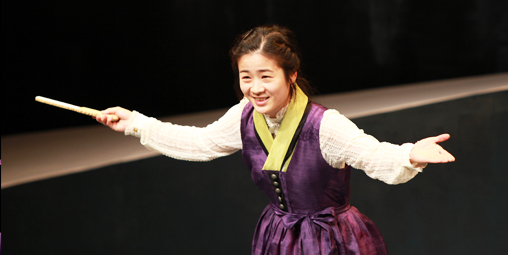
Q: How did you start to adapt Sacheon-ga from the original Bertolt Brecht’’s play?
A : I had an opportunity to perform, receiving a benefit called “Art Frontier Program” from Chongdong Theater. At first, I tried to create original pansori. I presented what I wrote to Inwoo NAM, the Director, whom I met in the Korean Musical Group “Taroo”, and asked him to direct the performance. But I felt that it was not enough. At that time I audited classes such as “Seminar for Plays” and “Playwriting Theory" in the Korean National University of Arts. In the playwriting theory class, I learned about Bertolt Brecht’’s "The Good Person of Szechwan" and thought that the character ShenTe is like me. I told NAM during a break about what I felt about ShenTe and he agreed to my idea. At first I was afraid of what will come up. I did composition alone so I felt anxious and unsure. I rehearsed before staff members but their response was not good. So I told the director that I will perform only pansori in the first part of the play without using any musical instrumentsoreffects. I made theright choice and it was like a small victory. After that the Doosan Art Center offered a proposal to upgrade the play.
Q: Your way of working and musical parts of your songs may be differentbetween when you composed Sacheon-ga and after, creating Ukchuk-ga. For the audience, Sacheon-ga feels large in that it was the first attempt and experiment on the mode of pansori, but Ukchuk-ga looms large as the re-interpretation and re-creation of Bertolt Brecht’’s play. As for music, Sacheon-ga makes us feel amazed that such a thing is possible, that Korean music can be harmonious with Western musicin a wonderful way.However, it is meaningless to distinguish Korean music from Western musicfor Ukchuk-ga. We can just feel through Ukchuk-ga that melodic and percussion instruments play a dramatic role in expressing the meaning of events or the characteristics of the characters.
A : All of us grew up on Ukchuk-ga. We continuously streamlined the play. We attempted to reduce three masters into one. Each of us has our own band and does individual work. So for Ukchuk-ga we thought that we need to leave what is really needed for the play. We seemed to care much more about Ukchuk-ga than about Sacheon-ga. We became confident and placed trust in the stage. Now, we are not trying to add to and fill the stage unnecessarily. I felt sorry and embarrassed for typing Sacheon-ga because I was not an author. I felt the same about doing composition. As an unproven author, I was sorry to someone else for writing stories.
I had a lot of stories that I wanted to tell through Sacheon-ga so that’s why I wrote it. However when I wrote Ukchuk-ga, I wanted to create a pansori performance that I wanted to watch. I asked myself that what kind of performance I would like to watch and felt that I like touching stories which make my heart beat faster. I like to see stories about the contradictions that people carry around with them. If that is the case, Mother Courage and Her Children is the right character to express all these elements. That is how I started Ukchuk-ga.
|
| |
| Jaram LEE Ukchuk-ga |
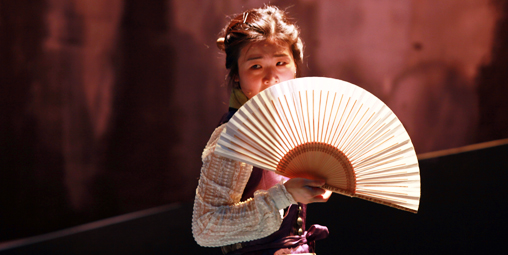
Q: Your first international performance was held in the International Theater Festival Kontakt, Poland, in 2010 where you earned the Best Actress Award. How did you feel about the response to your performance?
A : Devices for simultaneous interpretation were provided for the audience. The audience was busy hearing sound from their headphones and watching the stage. I expected that there would be no reaction from the audience; however I was embarrassed about that situation because I’ve never performed before without any response from the audience. When the latter half of the play started after the intermission, all the audience removed their headphones. After that, all went well. It was also delightful for me to win the great award in the theater because otherwise I wouldfeel sorrow and guilt that the foreign audience did not know anything about what we have accomplished artisticallyin Korea.
Q: Audience response from home and abroad is enthusiastic about your performance.
A : Audience response is one of the most fearful things for me. It is of great importance to me, but at the same time you should not trust the response from the audience too much. You should not be blinded by cheers and applause from the audience.
Q: You are very wise to have thought of that. But it seems like you are cool-headed and VERY strict with you rself.
A : I have tried to reflect on myself many times and be strict with myself. It feels like up until now I am probably the best scripter and composer of pansori. But I already said “UP until now”, and I know that that is also a trap.
|
| |
| Jaram LEE Ukchuk-ga |
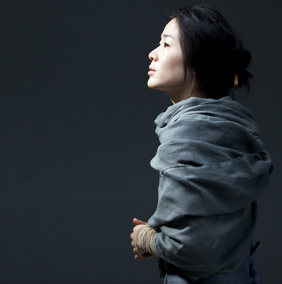
Q: From some perspectives, you are doing three jobs at the same time- singing pansori in full, doing band activity, performing original plays. What do they mean for Jaram LEE?
A : I have continued singing pansori in full. It takes several years to learn pansori and hone the skills to prepare for the performance. I completed singing thepansori pieces Simcheong-ga as a high school senior and Chunhyang-ga as a college sophomore. When I left the Korean Musical Group Taroo, I sang Sugung-ga in full. I was able to stay firm after completing Sugung-ga because I learned Jeokbyeok-ga and improved my skills. Now I still would like to complete singing pansori pieces. I would like to perform Jeokbyeok-ga once again in Seoul. I do not know why but I really want to play Simcheong-ga again. I thought about performing both plays for a long time and I can say that I will do that within about two years. I started to sing pansori with Simcheong-ga. It occurred to me that I would like to go back to the starting point.
I will focus on my activity in “Amado Jaram LEE Band”(a folk rock band) for the next two years. I started with an amateur band in the first place. Maybe I was lonely when I began with the band. I wrote lyrics like a diary, set them to music and sang. At first I start the band with a friend who played the guitar. However after making an album within ayear, it struck me that it’s not right to sell an amateur album for money. I realized I have to choose either to work hard for the band or to quit. So I planned to concentrate on the band activity for the next two years from September, 2012.
Q: I was told that you have no plan to do anew performance for a while, but international concert tours are still scheduled.
A : Yes, concert tours are scheduled. I try not to miss opportunities to perform overseas. Sometimes I wonder for how many years I can do such performances. I need to face reality. There wil lbe plays that I can do in my forties. However, overtime I will not be able to present the same performance as I am doing now. I would like to meet as many audiences as possible when I am still able to give performance with such strength.
 PREV
PREV
.JPG)
.jpg)
.jpg)
.jpg)
.jpg)












(0).gif','Pansori (Korean narrative singing) used to remind ..');)


