





Ensemble SINAWI_Creating an Ensemble through Consilience
[Who&Work] Ensemble SINAWI_Hyunsik SHIN, Songhee JEONG, Bonggeun LEE, Jihye KIM,
I used to see Ensemble SINAWI as just a group of young Korean traditional musicians. That changed in March 2012,when I read a daily newspaper’s special article about the harsh realities faced by artists who are engaged in a minor artistic genre in Korea. At that time I was on an international concert tour with a local Korean traditional music team. In the article, Ensemble SINAWI was described as a good example of a Korean traditional music group which struggled at first but created greatworks in an improving environment. The story of Ensemble SINAWI became meaningful to me at that moment, providing us with inspiration and solace, because we were following their path of gugak (Korean traditional music).
|
| |
| Ensemble SINAWI |
Coexistence and Harmonization of Different Elements
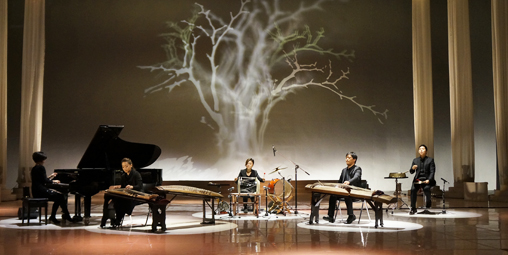
A (Hyunsik SHIN (“SHIN”)): At first Ensemble SINAWI started as a study group called “Project SINAWI”. We wondered what Sinawi was like in the past. Now there are numerous approaches to gukak, such as fusion and crossover. However we changed our way of thinking, after initially believing that emphasizing and maximizing our traditions would be a shortcut to going global. That is where we started.
As we continued our study, we became determined to engage in moreartistic activity, thinking that “seeking is more important than studying.” We started team activities after changing the name of our team to Ensemble SINAWI. We wanted to maximize SINAWI (impromptu traditional music) and regain the emotion that we lost. At the same time we also wanted to unravel our stories (departing from tradition) through the emotion of sinawi. That is why theensemble we are willing to create is an ensemble with music, but we also consider how we can approach people and how close we can come to them based on consilience through our ensemble. What we pursue is an ensemble with artists from other genres who are of one mind.
Q : I wondered that perhaps their broad concept of an ensemble which is based on consilience probably stems from that of each member of Ensemble SINAWI.
A (Songhee JEONG (“JOENG”)) : I am responsible for keyboard and music work, and among the team members, I am the one who was exposed to Korean traditional musiclatest. I went to Korea National University of Arts to study our traditional music but realized that I cannot understand traditional music just by training. The scope of traditional music is too broad, and each part of the music is deeply intertwined. I was offered a chance to study with others when I tried to find a way to fully recognize the traditional music. I stayed in atraining camp during the winter, studying renditions and songs performed by the elders ofthe past. I also met local people who learned and performed gugak not by training but throughtheir daily lives. It occurred to me that if I do not experience traditional music in person, I have no way of recognizing it. I cannot understand it just by studying.
|
|
| |
| Ensemble SINAWI |
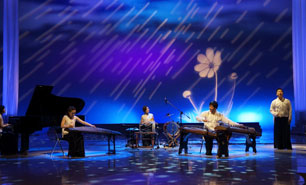
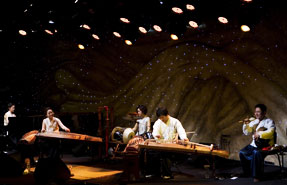
Q : One of the discourses surrounding different approaches towards gugak shows that there is room for debate on distrust in and utility of the use of piano or keyboard. I asked them about the role of Western musical instruments in Ensemble SINAWI.
A (SHIN) : The use of Western musical instruments clearly contrasts the unique characteristics of our traditions with those of Western ones. At the same time these can be used tocreate an identity of the rhythm and emotion which can be expressed only by Koreans through deep consideration. It is not about making music by using different musical instruments but about creating new grooves by mingling musical elements in each instrument. I am sure that is the way to secure universality and appropriateness of the music.
Songhee JEONG studied law and then learned composition at Korea National University of Arts. She also studied in the field of media interactive at KAIST. JEONG’s role is not to simply play the piano, compose and arrange music, but to meldour traditional arts and emotions into Ensemble SINAWI making it probably our most powerful cultural force.
Q : I wondered what they think about the use of Western musical instruments other than piano or keyboard.
A (SHIN) : It seems like the question of “Who is the musician, and what emotions does he/she express in the performance?” is more important than “What is the instrument?” Someone like Songhee JEONG would be able to create sentiments which only Korean people can express with Western musical instruments. We would like to play with anyone, no matter who they are, if they can understand our emotions - emotions that are changing with the times - and express them in music. Of course, musicianship is important, but we need people who are like-minded.
A (Bonggeun LEE) : I majored in pansori and am responsible for percussion, sori and scat (a style of jazz singing). When we play musical instruments in an ensemble, especially when we play impromptu music together, I use my voice as an instrument to make it part of the ensemble.
A (Jihye KIM) : I am responsible for percussion in Ensemble SINAWI. I joined the team onthe advice of those who graduated ahead of me from the traditional art academy, but I must admit, I felt a great burden to be part of the team at first. I did not feel confident that I could play shoulder to shoulder with the team members. I graduated much later than they did. At first, I was determined to learn from the other team members. Now they feel like my family members, with whom I can share even small things. In fact, I realized that a true ensemble can be made not only by simply playing instruments together, but spending time together and sharing experiences with each other.
|
| |
| Ensemble SINAWI |
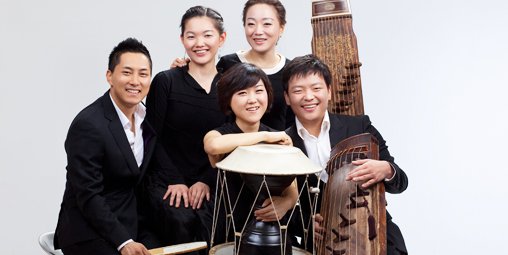
Q : After hearing stories from each member, I felt that Ensemble SINAWI is not lead by one person. It is like a festival celebrated by the team members who happily play their role in an ensemble.
A (SHIN) : Anyone is a leader in Ensemble SINAWI. As I already mentioned, anyone can play a leading role, but it is Jihye who is responsible for synchronizing music with various rhythms, and Bonggeun who adds a riot of color to music which is felt by the audience every minute. Songhee shows us the direction through music. Sera, who has outstanding musicianship, enables us to continue to perform by managing everything related to performance. (Laugh) Maybe I am the one who is left far behind in terms of musical contribution.
Q : The team started studying in 2007 and has continued its musical activities until now. When did the current form of Ensemble SINAWI take shape?
A (SHIN) : We have a goal which has not changed since we started studying for the first time in the winter of 2007. We need to build a team which concentrates on the authenticity of the music rather than depending on the government’s policy to make music. There were ten members when we started the team. However those who paid more attention to things other than music, or had no passion at all, quickly left the team. Only those with a strong will remained in the team. I got married with children but I thought that this is the right way to go.So without applying to any programs from institutions or organizations I practiced music with friends who produced the same types of music that I did.
After performing at a conference on the environment held in Europe in 2010, we met our manager, Sungu JEONG, and started working with him on an album. The members of Ensemble SINAWI were able to strengthen their trust in each other, create our identity and set the direction of the team by making the album at that time.
I thought that Ensemble SINAWI resembles the Jarasum International Jazz Festival, which I work for, in that Ensemble SINAWI ensured internal stability for about three to four years and then strengthened their identity and direction.
A real gugak (Korean traditional music) and a genuine Ensemble SINAWI
Without inherent power, it is impossible to set up direction and go in that direction. And in order to take a leap to the next level, you need young people with a genuine passion and new ideas.
A (SHIN) : We were influenced by many artists in establishing our identity and direction. We can say that we were significantly influenced by “Remember Shakti” led by Zakir Hussain, a British guitarist, and Zakir Hussain, an Indian table player. “Remember Shakti” clearly showed that we need to put more musical techniques, sentiments and philosophy into our identity while preserving our original concept. Listening to the music of “Remember Shakti”, I continued to ask myself what type of music I want to produce, why I create this type of music. I also tried to understand the era we live in and what kind of music it wants.
Ariane Mnouchkine, a French stage director of Theatre du Soleil, stayed here and worked with us. She helped us understand that we are not able to create a genuine piece of art without melting life into it. We also worked with Geunhyeong PARK, a Korean actor, and he also helped us recognize the importance of the path we choose. At first we had a fantasy that people would go crazy over the name of our team, SINAWI. But we learned what is important is the music we produce, not the fame we have, and we should continue to pursue this music.
Q : As Ensemble SINAWI was designated as an artist-in-residence by Chungmu Art Hall last year, it had an opportunity to extend their path and take off to the next level. Ensemble SINAWI produced a special performance which is a trilogy that includes Find a Way in the Traditions
A (SHIN) : We were offered residency programs from several other organizations before we were settled in Chungmu Art Hall. We did not want to be an artist-in-residency who,in exchange for money, performs music that he/she does not pursue. What we needed most is a space, so Chungmu Art Hall agreed to only provide a venue for us and not to interfere in our music activities. In fact, it is very difficult both for the concert hall official and the artist to achieve a win-win situation. Few artists are desperate for a space for a purely commercial performance while concert hall officials do not want to stage a non-commercial performance. Thankfully, Chungmu Art Hall respected the music that Ensemble SINAWI pursues and asked us to put on a genuine performance. Of course, we hold concerts for citizens of Junn-gu in Seoul several times a year, but even in these concerts we do not try to simply entertain the audience by meeting their level. We make an effort to show the real gugak that went unnoticed until now and the true music of Ensemble SINAWI.
|
| |
| Ensemble SINAWI |
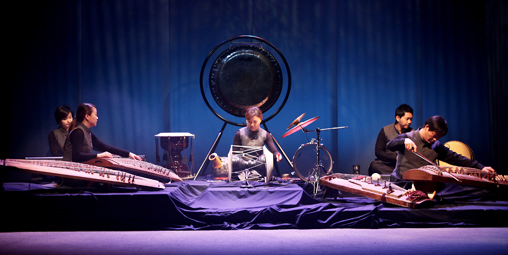
Q : I basically believe that gugak as a kind of Traditional Music has enough potential to become a recognized genre in World Music. I asked the members about their goals and the potential of Ensemble SINAWI as ‘World Music’.
A (SHIN) : As seen in “Remember Shakti”, I think that a World Music is a music that can be only produced by a certain band or a certain musician. In other words, it is about building a band’s own brand which distinguishes from that of any other band in the world. And that is the way Ensemble SIANWI is willing to go.
A (JEONG) : We do not study or target a certain cultural area in an effort to make our music a World Music. Korean traditional music, which is the basis of our music, has a lot of various elements so we would like to start from there. We also have frequent opportunities to perform with musicians from other cultural areas and those experiences are very helpful.
Q :Sinawi is a unique form of Korean traditional music which is performed improvisationally. What does “improvisation” mean for Ensemble SINAWI?
A (SHIN) : We are generally told that it is difficult to improvise gugak, and it’s considerably more difficult to maximize instrumental improvisation with the wind instruments than with string instruments. But I see maximizing nonghyun (vibration) and shigimsae (various ornamental techniques) as a basis of improvisation. In that respect, gugak definitely has a potential as an impromptu music. It just looks difficult to improvise gugak because it is customary for gugak musicians to establish a theory first and then produce music within the frame of that theory. As with the way in which sanjo (scattered melody) is created at first, if a musician produces music out of the frame by maximizing an individual’s musicianship and then sets up a theory, that would create a Korean style music improvisation.
As a jazz musician I could relate to Ensemble SINAWI finishing the conversation by talking about impromptu music. That’s because,just like Miles Davis defined jazz as “All others tread in their footsteps, widening the path”, Ensemble SINAWI is trying to change itself and extend its path.
“They are passionately immersed in music, producing such a large amount of energyon the stage that the audience cannot but be mesmerized by them. Once you fall in their music, you will be as lost to them as you are in jazz music. That’s right. That is the answer. Jazz, Korean traditional jazz, Traditions of Korean-style jazz.Ensemble SINAWI probably did not pursue that goal at the start, but the direction of their activity could be defined by this.” - EUMAG CHUNCHU(Monthly Magazine) March, 2012 / Eunsoo KANG
Ensemble SINAWI is scheduled to present their music to the world through “Find a Way in the Traditions” at PAMS 2012 (Performing Arts Market in Seoul 2012). In this concert, theywill stage an original traditional music which combines our own unique rhythm with the impromptu melody of sinawi, modern pansori (which is registered on the UNESCO World Cultural Heritage List) and other Korean traditional music from a different angle.
Ensemble SINAWI sees "Remember Shakti" as a role model and at the same time is making efforts to go beyond it. One thing which is interesting is the fact that I myself planned the first performance of Remember Shakti in Korea, at LG Art Center.I would like to finish saying that my connection with Ensemble SINAWI may have actually started from then.
 PREV
PREV
.JPG)
.jpg)
.jpg)
.jpg)
.jpg)












(0).gif','I used to see Ensemble SINAWI as just a group of y..');)


