





Communicating and sympathizing through a harmony of life and music
[Who&Work] Gyeonghwa YU World Music Ensemble ‘E-DO’ Gyeonghwa YU, Jeongcheol SEO, Cheong LIM, Minsu CHO
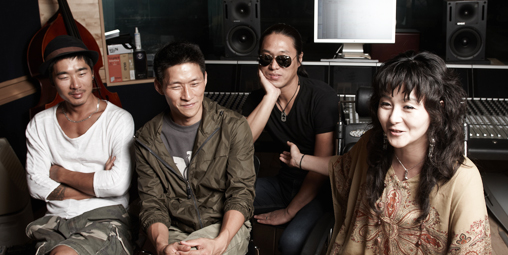
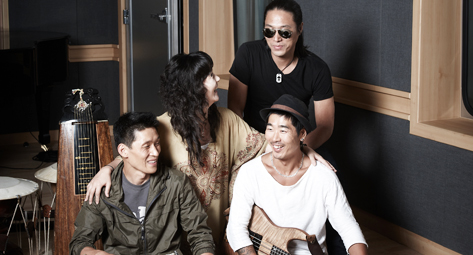
World Music Ensemble ‘E-DO’ is a music group that bases their work on Korean traditional music while accommodating influences from Indian music, jazz, rock and other music techniques to modernize their pieces. Through their work, they seek to create a bigger market for Korean music on the global stage. We sat down with ‘E-DO’members preparing for the 2012 PAMS Choice at a recording studio in Suwon.
‘E-DO,’’ a keyword for communication and sympathy
Q: : The name‘E-DO’’ is quite unique. What does it mean?
A Gyeonghwa YU (“YU”) : The name takes after the Chosun dynasty king, Sejong the Great, who was responsible for fostering our national culture. King Sejong left his legacy in many different areas, but amongst all others, he left behind remarkable achievements in organizing and developing traditional music. He was a composer, a performer and an instrument craftsman who introduced and organized all traditional instruments starting with the Pyeon-jong (carillon) and Pyeon-gyeong (percussion). In 1446 (the 27th year of Sejong), the court song Yeominrak was composed at the behest of Sejong, and was intended to be enjoyed by the common people. At that time music was sacred, and it was considered the preserve of royalty. But King Sejong thought otherwise, and he commissioned this song in order to communicate and sympathize with his people, enjoying it together. Likewise, the ensemble ‘E-DO’ seeks to sympathize with people of the current times through our music. The name is not simply a copy of King Sejong’s name, but we wanted to embody his philosophy by creating sympathy and communication in our music.
Q: Like the group name, we heard that each member is as unique and special. Please introduce your group members.
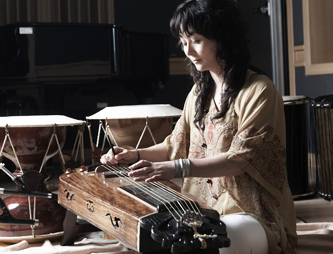
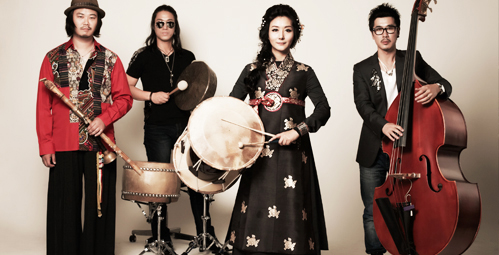
A YU : Our group is comprised of two people who have a background in traditional music and another two who are from the pop music industry. We each play Chil-hyun-geum (a seven stringed harp) and Janggu (double-headed drum with a narrow waist in the middle), Daegeum (percussion instrument), bass guitar, and drums, and we all are quite accomplished musicians in our own fields. Since we can each play at least two instruments, we often joke that we don’t accept members who play fewer than two instruments. Yeongseop LEE, who plays the Daegeum, Sogeum (percussion), and Taepyeongso (wind instrument), is the leader of Korea’s representative world music group “Vinalog,” and is the person responsible for opening a new frontier for Korean traditional music. Bassist Jeongcheol SEO is a member of the fusion jazz band Water Color, and is famous for his cross-over skills in jazz, pop and Latin music as well as composition skills. Drummer Cheong LIM played for the legendary Korean rock band “Baekdusan,” and he also performed along with Steel Heart and Lief Garrett when they had their performance in Korea. (Cuffing her hands as if whispering, she adds that Lief Garrett even lauded Cheong LIM about his damping skills. He is a really powerful drummer). Minsu CHO is in charge of percussion, and he was a founding member of the group Gong Myung. Having composed many songs for the group, he is praised for having created a miracle out of Korean traditional percussion. Knowing that he turned solo three years ago, we could finally get him to be a part of our group after several attempts to recruit him. Last but not least, we have Seunghwan YANG on the piano and as a composer, and he is currently completing his masters at NYU. Since each member is a ball of talent, time really flies when we get together to make music.
|
| |
| E-DO |
Music is the human soul, and the human soul is music
Q: Looking at your experiences in different fields, we cannot help but be curious about how you make music and what kind of music you make with each of you having such unique characters and different music styles.
A YU : Our music represents who we all are. Cheong LIM is a rocker, so his music has a lot of rock elements, whereas Minsu CHO, Yeongseop LEE and I have our roots in traditional music, so that is what we do. Jeongcheol SEO covers all sorts of fields including Latin music and jazz, and he also has a great understanding of traditional music. I think everyone has something to give from what they each have learned from their own genre, and as for me, the techniques I learned from when I stayed in India for a year adds to the group’s different techniques to create our team color.
Jeongcheol SEO (“SEO”) : I think that we need to learn about each other’s instruments to be able to make music together. For example, I get to know Gyeonghwa YU better by learning about the Chil-hyun-geum, and I get one step closer to Cheong LIM by understanding the drums. I didn’t know about traditional music because I spent my career performing applied music, so we are trying to find a way to keep traditional music as the common denominator in all of our music while finding harmony by putting different elements on top of it. And I think this is only possible if we learn about each other, let alone know about the musical instruments we play. We have to understand the people to understand their world of music, and we each have to understand each other’s music to understand the person. Since we make music by trying to understand and better know one another, I realized how happy performing made me feel, and that is when I really started to love doing what I do.
YU : Since we make music by improvising, we go through a pattern where sometimes we each flaunt our skills, and then on a different note we respect the others’ performances. Of course it’s not always easy. Traditional music uses a different kind of rhythm compared to western music, so at times we didn’t click. But nevertheless, all of us learned a great deal about traditional music by continuously studying to better understand traditional techniques. As for Cheong LIM, it took a long time for him to learn the systematic rhythm and techniques of Sanjo (a type of folk music), but now he is better than anyone at understanding and playing the piece. I think this process is how western music is becoming “gukak-ized (traditionalized).” Up until recently, it was gukak (Korean traditional music) that was westernized. I too, made music that way, but I came to think that it is better to find a way to share our traditional music with the rest of the world by gukak-izing western music. In India, western music converged with their traditional music and as a result their own music grew by leaps and bounds in depth and width. Learning from India’s experience, we are playing music to gukak-ize western music.
|
| |
| Gyeonghwa YU |
Q: Impromptu music seems easier said than done. What kind of method do you use?
A Cheong LIM (“LIM”) : Improvising is like having a conversation. If someone speaks to you saying “this is that!” then I would reply, saying “Oh is that it?” I think that’s improvising.
YU : I tend to think improvising is not necessarily improvising. Only those who have gone through hours of practice and training can play impromptu music. It doesn’t just happen because you’re playing freely.
The beauty of moderation, and Korean identity
Q: A lot of people in overseas music industries raise concerns about the negative side effects of western music instruments being used in gukak. What do you think about that?
A YU: I think the outcome of those concerns depend on how skilled the members are. Personally, the proudest aspect about this team is that every member is the best musician in their own field. I believe that this team’s greatest asset is the determination and pride the members have of their own music, because I think the musician’s skills are essential when western music is merged with traditional music. It cannot be a true harmony if western music is simply there to support traditional music. For this not to be a problem, the musicians must be extremely talented and skilled. It’s like Yin and Yang – they are two different energies, which cannot be the same. Likewise, Asian and western music cannot be the same, so the two have to strike a balance to achieve harmony. There cannot be too little or too much of either side, so we need to unite the east and the west.
SEO : Up until now, everything that was so-called “fusion” was simply adding gukak instruments in a jazz score to play a few bars. To make quality music, the utmost priority is to find a balance between the two worlds of music. We need to find beauty in moderation. In other words, it’s never putting more weight on either one side, and we have to understand each other and respect one another’s music when playing together. Before performing together, we need to try and understand each other for our music to truly be in harmony. This is why I said the human soul itself is music.
|
| |
| E-DO |
Q: : It’s safe to say that all members are past a certain age. How has your approach to music changed over the years, and what kind of beliefs do each of you have about music?
A YU : : I feel that music gets harder as I grow older. The approach I had was different in my 20s and in my 30s, and likewise I feel that I need to get older and wiser to better understand music. When I was younger I strove for difficult techniques and music, but as I get older I keep thinking music needs to be easy. I still struggle with this.
LIM : There was a time when I performed while I wasn’t feeling good. After the performance, an audience member asked me why my drum performance sounded so sad that day. It was then that I realized my drums were conveying my emotions. From my life stories, I find my passion to play the drums, and I try to put those emotions and stories into my music. As long as I can play music, I want to do it faithfully.
Minsu CHO : I was once troubled at a crossroads in my music career, but my wife was by my side the whole time. Thanks to her, I convinced myself that music was the only way for me. For some time after that, I loved music, but I couldn’t move away from my comfort zone. Before, I wanted to be the best in the world with my music, but now I am just happy about the fact that I can play music.
SEO : My interests have constantly changed ever since I was young. Musicians instinctively look for something new, and I was no different. I studied and played different genres but I could not help but feel empty inside. That is how I got to think about originality. I began to think that I needed originality as a Korean musician. When Korean jazz musicians perform overseas, foreign audiences look at the performance as if they are listening to chang (Korean traditional narrative song). That is why having an identity is so important for musicians. After that I became interested in gukak. For me, the “fun” factor is what keeps me going. The most important thing for me is to have fun while playing, and I am having fun even at this moment. That’s why I’m still making music.
|
| |
| E-DO |
Q: What are your plans for the PAMS Choice showcase and what comes after that?
A YU : We’re currently preparing for the 2012 PAMS Choice showcase. The main repertoires ‘Bird of Oblivion’ and ‘Ayuthaya’ are pieces that incorporate various different styles of music. New sounds are made with the effecter, some parts are overflowing with dynamism and energy and other parts are more relaxed to find a balance. We try to show everything we have on stage, and I hope the audience will be able to feel that energy through our music.
SEO: We’re also recording our first album, where all of our talents have come together in one package. I’m planning on continuing what we are doing now – we’re going to keep enjoying playing music freely, building on each other’s talents. From now on, rather than sticking to what we do best and what we enjoy doing, I want to venture out into new horizons using our different instruments and skills to make our group even stronger.
 PREV
PREV
.JPG)
.jpg)
.jpg)
.jpg)
.jpg)












.gif','We sat down with ‘E-DO’members preparing for the 2..');)


