





Defying Expectation with Ground-breaking Sound.
[Who&Work] Ilu LEE, Bomi KIM and Eunyong SHIM_Jambinai
The Gukak (Korean traditional music) group Jambinai believes that expanding boundaries lies at the heart of creating music. Using the characteristics of Gukak instruments as a basis, the group combines this traditional style with effects commonly used in Western/Electronic music. These added effects serve to create different tones and build different textures. This process has allowed Jambinai to discover new techniques, never before used in Gukak composition, and led them to create a new and unique sound. With Ilu LEE (pipe/guitar/programming), Bomi KIM (haegum) and Eunyong SHIM (geomungo) as the three main musicians, Jambinai released their first album Difference in February of this year. Since then, the group’s activity has included performing at live music clubs in Hongdae, as well as Korean traditional music performances. We had a chance to talk with members of Jambinai, whose own boundaries have been expanded by their recent nomination for the 2012 PAMS Choice awards.
The Album Difference: a product of the combination and separation of heterogeneous lements.
Q: What’s the story behind Jambinai?
A KIM Bomi (KIM) : We were classmates in school and, before we formed this group, we played together and shared our thoughts on music. We realized that we shared a common attitude to Music, and to Gukak: we didn’t like the direction it was going, and felt that combining different styles was important in moving forward. Putting traditional and western music together creates a mixture of two very different elements. We felt that there were too many pieces out there that were less than perfect because they were composed without a clear understanding of these elements. In this respect, we knew we made a good team. We weren’t too concerned with how to define ourselves. We wanted to practice, play music together and just have fun.
LEE Ilu (LEE) : Around that time I got an offer, through a different band that I was part of, to perform improvisations of Gukak, but I didn’t feel that the band suited my style of performance, so I joined Jambinai. We composed music for that particular performance, and the audience responded well. This is how we created our own album, and has made us who we are today. This all happened last year. You could say we’re a group of people brought together by chance, and by our shared musical goal.
| |||
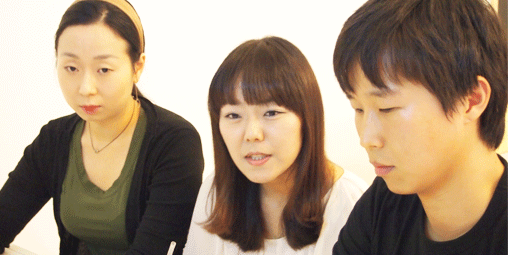
Q: Your first album Difference was released in February 2012. Tell us the story of its creation.
A LEE: Firstly, the title ’Difference’’ is a reference to the French philosopher Jacques Derrida and Neologism. Two years ago, when we participated at the Seoul Fringe Festival, Director OH Sunghwa recommended that we sign up for a support program called MAP (Mullae Arts Plus). Unexpectedly, we were chosen, and got the chance to produce our album. In fact, this was a chance for us to stop procrastinating and to finish off a few unpolished pieces.
SHIM Eunyong (SHIM) : Previously, we had each chipped in to produce the EPs but now, thanks to a lot of support from the director of Moon and I Theater Group, and everyone around us, we were finally able to release Difference. We are here today, with an album and movie, performing our own shows, thanks to all the love and support from our friends and family.
|
|
|
| |||
| LEE Ilu | KIM Bomi | SHIM Eunyong |
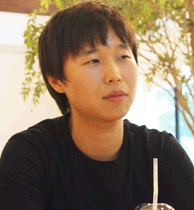
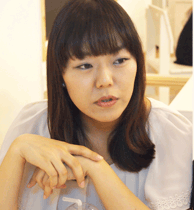
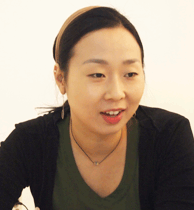
Q: All three members of Jambinai are traditional music majors. We’re curious to know how your knowledge base in this area has influenced Jambinai’s music.
A KIM : The Haegeum (Korean fiddle) is a melodic instrument, so when we’re composing Jambinai music I am usually in charge of the melody. Whenever we perform impromptu, it’s only natural that we play the styles that we are used to, so a lot of traditional musical elements blend in. The light fingerings, methods of giving vibrations to the string, grace notes, adlibs of the Haegeum etc. all mix in naturally with the music. I believe there is a traditional basis to all of my compositions.
SHIM : Personally, I try to break away from conventional playing techniques and I enjoy doing so. I try not only to discard the techniques of traditional music, but also those of Jambinai music. We are living in the 21st century - I believe that it is imperative for our playing techniques to move with the times.
LEE : I think traditional music has influenced my breathing. For example, when playing Sujecheon (Royal Court Music) the conductor starts after a beat, and you can feel the music starting in the air. There is no rule or regular tempo, but each breath guides us all. Maybe it’s because we all have similar traditional tendencies, but when we are playing, we don’t have to agree on what measure we will play in beforehand. Once one of us exhales a deep breath, we all play along intuitively.
The interpretation is open to the audience.
Q: Where do you find inspiration and how do you work?
A KIM : Lee Ilu comes up with a lot of motifs. We each use these motifs to improvise melodies and we move on from there. In other words, we develop the music together. This is what we did for our recent album. For a few songs, we just created an atmosphere and improvised within its framework, expressing whatever we felt at that moment. We then drew from this the ideas that we liked and developed them further.
Q: Jambinai has somewhat of a mixed identity. The theme of your first album Difference “cannot be defined in any way”. Your music, while built on traditional sounds, has many conflicting elements, and your band plays contemporary tunes – ultimately this leads us to varied interpretations of who you are as a group. How would you describe Jambinai’s musical identity?
A KIM: When we first released our music, many people came up with grandiose interpretations, and we were pleasantly surprised. Truthfully, we don’t really set ideological or philosophical goals when we’re making music, but rather we play whatever tune best expresses the message that we want to convey.
SHIM : When I met Jambinai, I had an uncontrollable thirst for a specific kind of music, and our performances have quenched my thirst. Of course, we always have to think about our identity, but we just want to enjoy each moment and I think this is the essence of our music.
LEE : If you ask what genre of music we’re playing – whether it is fusion, Gukak, or even just pop music - we don’t have a clear answer. I think we will need more time to find our true identity. I think we are still in the midst of finding our own unique color. Our music may seem like traditional music to the audience, but if we were to say that what we are doing is ‘traditional’, I think it would be a discourtesy to those musicians who practice and love authentic Gukak. Our identity is still in the making, so I would like to leave the interpretation up to the audience.
| |||
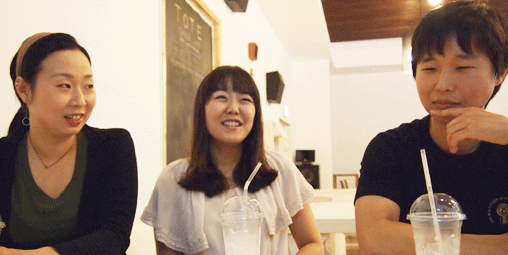
Preconceptions of Traditional Music
Q: Before being nominated for the 2012 PAMS Choice awards, Jambinai participated in many talent-discovery programs such as the Hello Rookie and Project Big Boy rock festivals, actively performing in a variety of settings from the club scene to traditional music performances. Performing to such a diverse range of audiences, you must have run into difficulties because of long-standing prejudice towards “traditional music.” What were those difficulties, and what problems are you facing now?
A LEE : We get feedback from people saying Gukak sounds scary, or that it feels like music for ghosts! It may be that our music is too difficult to communicate to the audience, or the media may be to blame for evoking such an atmosphere. It’s unfortunate to see that the majority of people do not even know the correct names of the instruments we play. I think the audience has quite a different view of traditional music, compared to our own.
SHIM : For musicians playing Gukak, it is a problem but also a challenge at the same time. Many of the younger generation Gukak musicians are also actively pursuing fusion Gukak, which I think may signal a turning point in the perception of traditional music.
KIM : Among our fans, there are some people who do not listen to traditional music in general, but like the music of Jambinai. I have faith that Jambinai can open people’s minds to traditional music. In addition, I believe our music will help people overcome popular preconceptions and realize that Gukak instruments can be used to produce a range of music
Q: How do you want Jambinai’s music to be conveyed?
A KIM: I would prefer people to regard our music as just “music” and not “Gukak.” I want our music to have presence, primarily as “music”, and not be restricted to those who want to listen to Gukak. I want it to be universally accessible, not just to a specific fan base. Why won’t traditional instruments work? Why can’t we participate in a rock festival with Gukak instruments? I hope to overcome the limited performance format and space usually allowed for Gukak. I would like to be able to play our music in a completely unexpected setting and be accepted.
LEE : In short, I hope people will be amazed by our music!
| |||
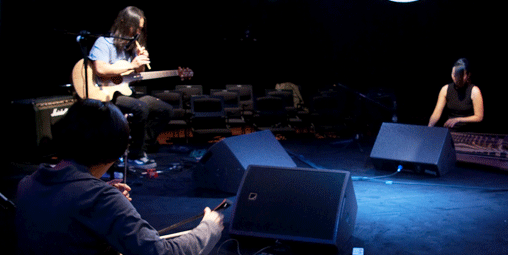
Q: Do you have any plans to take your music abroad?
A LEE : I heard that our album was being sold overseas. I hope to be able to perform overseas as well. If we were to actually perform abroad, our music would be the same as in Korea, not altered to suit foreign tastes. I don’t want to try too hard to show the “Korean” side of our music, just because we go abroad.
SHIM : Going overseas to perform is amazing in itself, but I think it’s more important to find the market that suits us best. I don’t know where that will be, but I believe it will be a great opportunity when we find it.
Q: What’s next for Jambinai?.
A KIM: We will give a performance on September 8th, at the Hongdae Rolling Hall, as well as many other live club performances. We are also preparing for the PAMS Choice showcase set for October. I have good memories of last year, when we were the opening act at the Pentaport Rock Festival. We weren’t expecting a large crowd but, to our surprise, a huge crowd gathered and they loved us. So I want to do that again. Personally, for me, overseas performances are just one-time events, so I want to perform in places where we get positive feedback from the audience and where we can make a profit. Further down the road, I want to raise the profile of Jambinai.
 PREV
PREV
.JPG)
.jpg)
.jpg)
.jpg)
.jpg)












.gif','The Gukak (Korean traditional music) group Jambina..');)


