





Conviction that Overcomes Crisis
[Who&Work] Christoph Slagmuylder _ Artistic Director of Kunstenfestivaldesarts
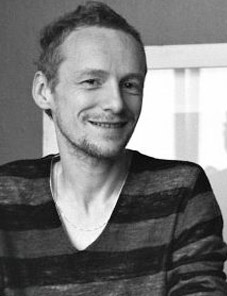
In May of every year, the world''s most avant-garde and experimental art festival opens in Brussels, Belgium. It is the Kunstenfestivaldesarts (KFDA). The founder of this festival, which first opened in 1994 and is now nearing 20 years, is Frie Leysen. The festival has played an important role in adding to the cultural function of Brussels, which has been growing into the capital of unified Europe. Many people recognize the artistic achievements of this festival, which has been presenting young talented artists to the world, apart from social and political backgrounds. When May comes around, many people looking to get a glimpse of the new trends come to Brussels. The current artistic director is Christoph Slagmuylder, and he has been successfully leading the festival since 2006.
He is one of the common faces at the annual TPAM - Performing Arts Meeting in Yokohama. Just like the Director Okada Toshiki who has opened a new generation of contemporary theatre in Japan, the directors who were introduced to Europe and the world through Christoph''s festivals are receiving attention from around the world. I met Christoph at the ‘2012 TPAM Performing Arts Meeting in Yokohama’, where the somber atmosphere still loomed from the radiation caused by the last year''s devastating earthquake and tsunami that swept through Japan and the Fukushima power plant.
|
|
| Christoph Slagmuylder |
20 Years of History, Yet the Future Unknown
The KFDA operates around 30 programs for 3 weeks with the budget of 3 million euros. Most of the festival''s budget comes from the two governments in Belgium, which means the Dutch speaking government, French speaking government, and the European Union. The festival makes multi-year contracts with the two Belgian governments, but the 4 year contract with the Dutch speaking government and the 5 year contract with the European Union ends as of this year. They should have entered into new contracts by now, as in the past, but this year it hasn''t happened yet. Even if they enter into new contracts, considering the Europe''s economic crisis, it is very uncertain if the festival will be able to maintain the scale of previous years.
"Because we are currently unable to predict the budget of the next year, it is very difficult to plan the festival for the next year. There are those who suggest that we get help from the private sector, but as we are struggling even in the public sector, the chances are slim. On top of that, it is difficult to even accept the situation, because the reduced public support for art, especially in contemporary art, is an attempt by the government to reduce their role as the financial support.
This year, it felt like I was preparing for the last festival. Due to budget issues, I think the next year''s festival is going to have difference in methods and scale from what we had done previously. However, we are planning the next year''s program based on the good relationships with the artists who we''ve been working with and the trust with festival directors from the past years. Although nothing is confirmed financially, we are preparing for the next festival with our friends."
I couldn''t help but see the disappointment in his face as he talked about his feelings as if preparing the last festival with a history close to 20 years and worldwide reputation. Nonetheless, I sensed he was putting in more effort than ever for this year''s festival even when he said this is the biggest crisis in history of the festival. The scale of the festival was unchanging. A big difference of this festival compared to summer festivals opening in Edinburgh and Avignon is that it doesn''t open during the vacation season but in May when everyone is hard at work. So, the audience in Brussels can only participate after their work or during the weekends, and this point is well noted by the planners of the festival.
|
|
| |
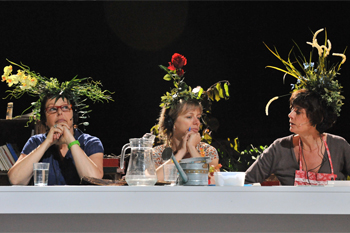
| SMATCH [2] _ Dominique Roodthooft, 2011 entry piece © Titanne |
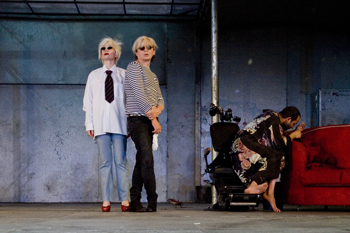
Factory 2 _ Krystian Lupa, 2011 entry piece © Bea Borgers |
Talk About Europe''s Cultural Identity
I guess the reporters coming from all over the world and living up to the expectations of known performing arts figures are an important side of the festival, but the most important factor for the festival planners is the citizens of Brussels, where it is being held. They are sparing no efforts in planning so that they can provide new artistic experiences for the people.
"I don''t predetermine special goals or directions before I start planning for festivals. I try my best to leave things open. I look for new stories that develop from the gathered results of artists'' creative works. At that point, I develop and add interpretations to the subject."
This was his answer when I asked him how he felt when he started planning for this year''s festival. But, this answer has already been introduced as the method of the former artistic director Frie Leysen during one of his past interviews. He had said, unlike her, he plans ahead before the actual start. As I mentioned that past interview, I asked him the question again.
"Honestly speaking, I did have a theme in mind. I wanted to toss a question on the Europe''s identity through this festival. With start of the Europe''s economic crisis, there are nonstop talks of Europe''s economic integration and identity. I wanted to ask about Europe''s identity in a cultural aspect. This kind of effort can be seen in the works within Europe, and correspondingly, in the reflected works outside of Europe as well."
Those who remember the history of this festival will know that the festival started from the questions of Belgian identity. In Belgium, which was built and created by artificial means, everything is divided half and half such as each branch of administration, educational system, and culture for Dutch speakers and French speakers. In this situation, it is not surprising to see the efforts to find the answer to the question of identity for binding the two governments and people. However, the director of this festival says he now has the question of Europe''s identity in his mind.
"I don''t see the current crisis in Europe as only an economic crisis. I also want to find such issues in the cultural aspects as well. Maybe these problems stemmed from the selfish thoughts such as my town and my territory. These problems always surface when we worry about what we may lose, and put up fences in fear. It is important to highlight and develop regional characteristics, but rather it became a hindrance in finding the identity of Europe.
I do have an advantage in my contemplation and efforts to find solutions for the fact that I''ve been living in this small country Belgium and in Brussels where diverse cultures come together. Since I was young, I wondered about my identity in terms of culture and language. I believe we should set this as the starting point to deal with issues under the surface such as social equality, cultural and exchange issues so that we can safely define the identity of Europe and overcome this crisis."
In fact, these points weren''t new to the policy-makers of the EU. The EU also considered the cultural identity as an important issue and seriously tried to come up with plans. It invested large amount of budget for many years so that each country in Europe can jointly create works and present them in various countries. The KFDA also participated as the key member in the program of joint production and performance with festivals from other countries through this budget. The EU politicians probably thought, through these processes the cultural exchange will become active and the identity of Europe will be better established than as individual countries. This may be true theoretically, however, there still are many problems that need to be resolved.
"The current President of EU is a Belgian. Do you know who it is? When I ask this question, no one can answer. Probably, many people are likely to think of German Chancellor Merkel and French President Sarkozy instead. What if there was a stronger EU? Right now, governments of each country are spending money on culture to preserve their tradition and identity, while the EU is spending money to dismantle such boundaries."
"For the last 5 years, I''ve been working on a program where 7 festivals from all over Europe came together to co-produce works and have tour performances. Frankly speaking, I started this kind of work just to get the funding. Working in such ways guaranteed stable and long-term funding provided by the EU. In the process, I met a lot of people and learned many things as well. However, as 7 different units came together it was that much difficult to come to an agreement during meetings, and it was also not easy to produce meaningful results."
Whatever the result may be, many co-produced programs were created through the program supported by the EU. They introduce artists who are not well-known to the festival directors, and select unknown yet promising artists. The co-production begins as they go through the process of learning each other. And when the production completes, they perform as they tour festivals that participated in the production.
|
|
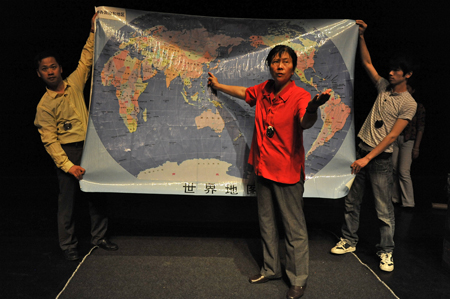
| This is China (C''est du chinois) _ Edit Kaldor, 2011 entry piece Co-produced by 4 festivals including KFDA, Alkantara Festival, and others © Luc Vleminckx / Academie Anderlecht |
Dreaming of An International Cosmopolitan
"Though there have been difficult processes and I haven''t yet received a satisfying work, for my next year''s proposal to the EU, I plan to expand the range of participation by adding 2 more festivals from Europe as well and by collaborating with 4 festivals outside of Europe. Including the Japan''s Kyoto Experiment, I plan to work with festivals in other continents such as Brazil in South America and Mali in Africa. Of course, I am working more towards invitation rather than co-production with the festivals outside of Europe."
At this year''s KFDA, there are 15 world premiers that are being presented. Three of them have been self-produced by the festival. The self-production method is different depending on the situation, but it consists of providing partial production costs, finding co-producers of the remaining programs, and providing technical and translation support. In the case of location-specific performances, the festival sometimes provides venue liaison and office space.
"When we create programs, 1/3 is from Belgium, 1/3 is from Europe, and the remaining 1/3 is from outside of Europe. The most important job for me when personally selecting the works is meeting the artists and seeing their works. Once every two months, I travel abroad to watch and select different works around the world. I also plan to visit Korea in early April.
It is too early to mention about the artistic achievements of our self-produced works which we will be presenting this year because we haven''t seen the final result yet, but the process itself was very satisfying. We have completed the text related tasks for the works this year, and there were some promising works that caught my attention during the re-read, translation, and refining process.
One of them is a work by a choreographer from Congo. It is a 1920''s African ballet piece with cubist costumes and Milo''s neo-classical music, and it conveys the dreams and visions of Africa during that period. Another work that I am looking forward to is a work from a German troupe, which is about a Nigerian and European businessman meeting each other and teaching about their different business methods. "
With the completion of planning for this year''s great festival, he is planning for tomorrow''s uncertain future. When the budget is reduced next year, Christoph promises to maintain the artistic quality and depth even if he has to downsize the staff and save elsewhere. He also says, in a situation where similar festivals are popping up everywhere, he must select the works with the utmost care and contemplate more about what the audiences really want. It seems the festival will move in that direction.
The KFDA which became a festival that questions the identity of Europe from the identity of a small country Belgium, it will be dreaming of an international cosmopolitan in the future. His dream is to push and lead the festival towards that dream. The main topics on the road to that dream are the issues of engagement, involvement, and participation. I think he will complete his cosmopolitan dream through such beliefs and contemplation.
"I don''t think art has to speak about politics directly, but I believe art should not turn its back on the current issues such as natural and man-made catastrophes, and issues of factions that are spreading in the Middle East and Greece. The key-task and responsibility of modern art is how we will stay artistically independent and autonomous while dealing with such issues."
 PREV
PREV
.JPG)
.jpg)
.jpg)
.jpg)
.jpg)












.jpg','In May of every year, the world''''''''''''''''s m..');)


