





Life of Rawness, Looking at the World as Something Unfamiliar
[Who&Work] Geun Hyung PARK _ Representative of Golmokil Theater, director
76Theater and "Theater Lab Hyehwa-dong No. 1" are where PARK attempted experimental plays. While this may be due to the identities of these particular groups, he also wanted to question and diverge from the established formats. “Although this may be because I did not study drama properly, I have always questioned whether I should continue to follow the traditional theatrical rules and sought alternative ways to express one’s actions.” Although he did not learn drama in a systematically way, PARK steadily established his own theatrical domains by encountering drama on stage. He has built his own theatrical styles and philosophy by learning the established formats on stage and denying them at the same time.
|
|
| |
| Geun Hyung PARK | ||
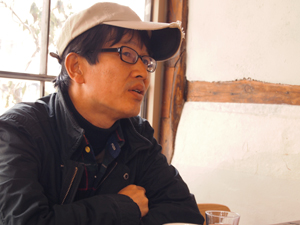
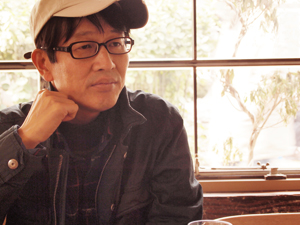
The Absence of the Father
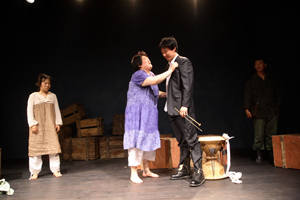
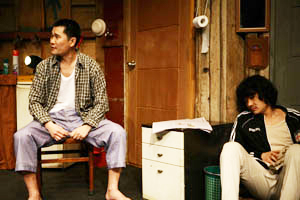
Geun Hyung PARK’s works repeatedly deal with the theme of “family.” From Mouse, one of his early works, the aspect of disorganized families is repeatedly exposed. Through Glory of Youth (1999), which tells a story of a disorganized family, PARK became a rising star in the theatrical world. His subsequent works on disorganized families, including Gyeongsuk, Gyeongsuk’s Father(2006), Don''t be Shocked(2009), were also received with great enthusiasm from the critics and the audience. He said: “If you look around, the concerns of most people mainly come from their family life. The Confucian tradition still governs the Korean culture, and family life is something that bind Korean people and can never be disowned. You may struggle to escape from this restriction but only to fail, and this “restriction” becomes yourself in the end. That’s probably what family life is. I find it most comfortable to talk about family life, maybe because I have a low level of education.” For PARK, family life is an existential metaphor that describes a life bound by destiny. The strong solidarity and sense of obligation about families comes from the Confucian values. The families in his works reflect the circumstances in Korean society of the day.
Geun Hyung PARK’s works on family life commonly deal with the absence of the father. The father in Glory of Youth maintains a minimal living by receiving money from his ex-wife, from whom he got divorced after losing his economic ability. The father in Gyeongsuk, Gyeongsuk’s Father abandons his family and flees by himself when a war breaks out. These fathers are presented as fathers who cannot perform their roles and as being insignificant. PARK explained: “In such a chaotic society just after the Korean War, Korean fathers would have been at a loss about what to do as they had few skills and still had to support their families.” The absence of the father, which is expressed in PARK’s works, shows the breakdown of Korea’s traditional society which results from the rapid social changes. These works satirizes the Korean society whose traditional values have failed to evolve under the rapid development of material civilization.
|
|
| |
| Gyeongsuk, Gyeongsuk’s Father | Don''t be shocked |
“Plays are What We See and Feel!”
Like this, Geun Hyung PARK’s works start from the lives of those around him. He recalled that through his theatrical experience which he started building without any knowledge of plays, he realized that “plays are not something that are prodigious, but are something that we see and feel.” While he is only talking about what is happening around him, his works subtly convey a sharp insight into the Korean society.
PARK tells stories about people who breathe together with him “right now and here”, and produces plays for them. As a result, the audience can realize the lifestyle of ordinary people in Korea even from his translated versions of foreign plays. “What I most focus on is that each of my plays must have Koreans on stage, be it my original play or a translated version of a foreign play. Korean audience would find stories on middle-class Americans rather unfamiliar, however effectively they might have expressed their culture or details. They need characters that talk and think like Koreans. This is why I slightly embroider translated versions of foreign plays before they are presented. A good example was when I directed A Long Night in the Tropics (by Oriza Hirata). You know that Japanese people are very polite. A significant portion of the script of this play was in salutation scenes. Even if Japanese people actually behave like how they behave in the play, we still find this rather awkward. Hence, when I embroidered the play, I modified these scenes so that they are easier to understand and look less awkward.” Even when he dramatizes classic works, he does not include lines that he does not understand. Hence, critics evaluate that his dramatized works, such as Hamlet and Chaika, are rather unilinear. Yet, you can understand these works very clearly.
|
|
| A Long Night in the Tropics |
Characters that Present the Actors as They Are
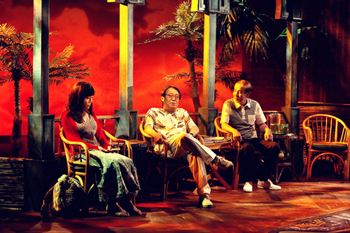
In Geun Hyung PARK’s work, actors are virtually everything and are regarded as the most important element. He is also well-known for his unique style of working. He leads rehearsals in a very relaxed way: so relaxed that you may think that he spends more time playing with actors than rehearsing. During rehearsal sessions he goes on a picnic to the skirt of Mt. Bukhan, or often plays together with actors in the rehearsal room. This shows his theatrical style, where he does not treat life and plays separately. “Since every actor has his or her own acting styles, I advise my actors to express these styles rather than being bound to the conventional methods. Although it is important to overcome their weaknesses by polishing up their skills, I encourage them to express what they can effectively show in their most comfortable conditions. In other words, I would like them to find what they can do best.” It is important to identify what actors can do well, which can be discovered from their daily life. As a director, Geun Hyung PARK finds out the actors’ strengths through everyday activities such as games and graft these strengths onto his works.
The role of actors are also important in creation processes. PARK does not plan everything in advance when he creates his works. He only makes a large frame, and then creates the play by communicating and rehearsing with the actors. As a director, PARK stimulates the actors’ desires and enables them to vent these desires. In other words, he finds their talents and blends these talents into their characters. In PARK’s works, his role as a director is to create an environment where the actors can easily demonstrate their talents to the full. Since actors in Golmokil Theater understand their strengths and are well-trained to express their inner side, they distinguish themselves in works other than those directed by Geun Hyung PARK.
Since PARK completes his works with the actors within a large framework, the qualities of PARK’s works are highly dependent on how successfully he has created a synergy effect with the actors. “Enabling the actors’ ability to the full is all down to me. Although it would be important to perform well, I do not pay too much attention on results. Because I''m insterested in the process.” As he emphasizes the importance of actors and discovers joy in the process of making plays, Geun Hyung PARK does not seem to pay too much attention on the audience. “Not really, since all these plays are presented for the audience in the end. As a director, I develop the work with a perspective of an ordinary audience. I also try to keep this perspective in practice sessions and rehearsals.”
Describing the Irrational World in an Irrational Way
Geun Hyung PARK’s works are similar to those of Harold Pinter in the way that they express the irrational world in an irrational way. Gyeongsuk, Gyeongsuk’s Father, describes a sudden reconciliation of an extreme conflict after the advent of God. In Don''t Be Shocked, the father who killed himself keeps talking while hanging in the bathroom. “These circumstances are just illogical. Yet, if you listen carefully to what people say, there is so little logic in these remarks. What we need to do is speaking, not writing. While the overall context should be well-organized, a remark that is abruptly spat out can be very persuasive.” Thinking that the world is logical is a modern delusion. The actual world is in fact full of absurdities and contradictions. Plays directed by Geun Hyung PARK strive to approach the truth of the world by using extremely irrational methods. PARK evaluates such jumps and irrationalities as “the experience that can only be expressed by plays.”
PARK’s works, which shows theatrical jumps while expressing the daily life just as they are, have been giving fresh impulses to the audience. Although Park is a major veteran director, his works present youthful and novel qualities as he continuously strives to diverge from the conventional ways. This is why some the audience continuously show an interest in works directed by Geun Hyung PARK.
Geun Hyung PARK directed Rain in Seoul and Rain in Aomori which were co-produced in 2007 by Golmokil Theater and actors in the Aomori province, Japan. His work Don''t Be Shocked has been invited to the 2010 BeSeTo Festival in in Tokyo.
Links
| Production information of Gyeongsuk, Gyeongsuk’s Father GO
| Production information of Don''t Be Shocked GO
 PREV
PREV
.JPG)
.jpg)
.jpg)
.jpg)
.jpg)












.jpg','Geun Hyung PARK is the playwright and director to ..');)


