





Building Lasting and Continuing Relationship
[Who&Work] Yoshida Kyoko _ President of US-Japan Cultural Trade Network
Founded as part of Arts Midwest headquartered in Minneapolis, Minn., in 2001, the US-Japan Cultural Trade Network (“CTN”) provides leadership, vision, information and support to enhance cultural trade between the U.S. and Japan. Under the leadership of its founding director, Kyoko Yoshida, CTN has designed and implemented a number of exemplary exchange projects with an array of committed partners and participants, developed long-term relationships and broadened the knowledge within the professional community about artistic resources and practices in both countries. After its successful and productive operation of five years in the Arts Midwest, CTN relocated to San Francisco in 2006 and became an independent nonprofit organization in 2007.
We sat down with Yoshida Kyoko who had played an intermediary role in cultural exchanges between Japan and US over 10 years at the convention of the National Performance Network held in Tampa, Fla., last December to hear her thoughts about exchange of culture and arts and CTN’s activities.
|
|
| Yoshida Kyoko |
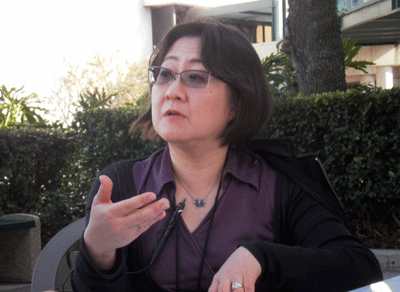
Q: Why don’t you introduce CTN and its major activities?
A: CNT is founded to provide leadership, vision, information and support to enhance cultural trade between the United States and Japan. Under those goals, we set some topics and categories. One of them is to co-produce and co-organize productions between US and Japan artists. Another area of CNT’s works is to support other organizations pursuing international exchange. And the third is to build up a database and a network among experts and to provide a lasting and continuing frame of exchange.
Here, I’ll elaborate on the third category of lasting and continuing relationship. Actually, it started at Arts Midwest headquartered in Minneapolis, MN. The Pennsylvania Council for the Arts and the New England Foundation for the Arts chipped in as well. Arts Midwest is one of the six regional arts institutions in the United States. Actually, the Midwest is just one of those flown-over states to and from East or West Coast. To overcome this public perception, Arts Midwest wanted to connect the Midwest population with people in other areas and countries. The Pennsylvania Council and the Ohio Council for the Arts showed enthusiasm about cultural and arts activities in the regional community.
Once we invited Japanese Taiko drummer Eitetsu Hayashi, offered courses at local schools, and performed in residency for three years. We visited a local high school. 95% of the students were African-Americans mostly born out of wedlock or with single parents. The kids could drop out at any moment. The school wished to boost their self-esteem and confidence in their future, and thought arts could help them. All parents watched their performance, and the entire school, teacher or student, participated in it. This is the model example of what Arts Midwest does.
In-depth Exchange in Need
Q: You’d achieved a lot. Why did you get independent?
A: The Japan-US Friendship Commission financed CTN projects for five years. It was limited in duration. After five years, it stopped. So, we had to make new moves to finance our projects. At first, we concentrated on the Midwest section. But I didn’t want to get limited to an area or two. Starting this project, I thought about standing on my feet, along with CTN some day.
What I wanted to do with CTN projects was to connect the United States and Japan. After World War II, the Untied States has long remained an ally of Japan. Lots of people think they know each other well. But, most people know New York and Tokyo. But they don’t know much about Dublin, Ohio, or Japanese-Americans.
Of course, numerous American groups and organizations work for cultural exchanges with Japan. For example, the Japan-America Society has almost 40 chapters across America. In New York, it even owns a theater, and it functions as mecca for major performances. Nationally networked, the society is like the America-Japan Society in Japan.
In addition to the number of communities and volumes of contents, the exchange should be contextualized, I believe. For example, Japanese people deem hip-hop some sort of vogue. But they don’t know about its history and African-American heritage. We’d like to explain much about the origins of our performances. People will understand more that way. It’s more than inviting Japanese artists or sending American artists to Japan. It should be reciprocal.
Relocated in San Francisco, we work on more joint projects and co-productions. Organizing a project usually takes 2-3 years. In most cases, it’s international collaboration. After getting independent, we’ve raised funds since the early stage.
Q: What are your noticeable works for the last 2-3 years since your spin-off?
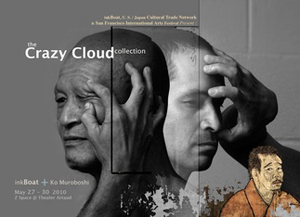
A: Several projects are successful in that context. One of them is the collaborative work by Japanese Buto master Ko Murobushi and Japanese-American Shinichi lova-Koga. Revolting from the appearance-obsessed authoritarianism, Zen Monk Ikkyu caught their attention. The monk was one of the most remarkable ones in the 14th century Japan, and left enormous influence on culture and arts of the country for centuries to come. CTN and the New England Foundation sponsored its production, along with the Maggie Allesee National Center for Choreography, which provided a venue for the creation. Put together, all these efforts helped InkBoat grow to a nonprofit organization. Now, it’s armed with the tools to finance itself.
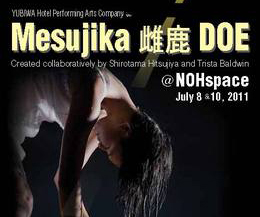
Another example is the ongoing project titled Mesujika Doe. Along with the Playwrights'' Center in Minneapolis, nine American playwrights had their works translated in Japanese for three years, and read and put them on stage in Japan. Japanese actors and actresses, and director have participated. We also invited five Japanese writers over to America, and read their works at the center after translation. We held a reading session of Mesujika Doe by Japanese director in Japanese. The Original of Mesujika Doe is written by American playwright. They found a deep connectivity with each other. Since 2008, they’ve worked on and created a whole new work. Their work is still going on, and we plan a tour with the San Francisco International Art Festival in 2012.
|
|
| |
| Crazy Cloud, a collaborative work by InkBoat | Mesujika Doe |
Swift Adjustment, Key to International Exchange
Q: What are your plans for five years to come?
A: We’ll continue co-producing and co-programming. We can make decisions fast and move fast. That’s the biggest merit since our spin-off. Actually, it’s vital to international exchange. Each country has its own fiscal year and cycle of funding. That’s why.
In addition, we want to grow more. We don’t have to be a huge organization. But it’s different from having solid foundations. Actually, we didn’t pay much attention to fund-raising. Projects came before everything else. To grow, we need new long-term and strategic plans, and a new board of directors.
Q: Global economy is very slow these days. How do you think it affects Japan-US cultural exchange?
A: Indeed, its impact is felt across the board. But it provides merits to small organizations, I guess. They live with small budgets, to begin with. When the economy is bad, people think about ways to pool available resources, and there comes collaboration. Small entities have worked on a collaborative basis to overcome what they face.
After 9/11, the US resources seem shifted from Japan to the Middle East. In Japan, the 3/11 tsunami disaster affected all, and its ramifications are still worrisome. Compared the Japan I left 20 years ago, it now cares about neighboring Asian countries. In the past, it mostly invited American and European works. Today, it invites the quality works of Asian artists more.
Q: What do you think is the most important key to international exchange of culture and arts?
A: Above all, reciprocity matters most. It’s not saying that inviting Japanese artists over the US, or American artists to Japan. Another key is the connectivity among previous and present events. It’s important to provide cultural and social backgrounds. That knowledge helps understand and appreciate more. That way, the effects of collaboration can be maximized.
Q: As leader in the field of international exchange, what advice would you give to those following your suit?
A: What I stress all the time is “Know why you want to go abroad and when.” For example, if an artist has never been abroad, it’s natural for the person to wish so. But the rewarding money is not that big. So, one has to take that into consideration, and know whether he or she still wishes so. Another thing to keep in mind is “Listen to what people say.” You have to seek advice from your supporters or your theater’s presenter. It’s more in need if the person is a novice. And it must be unequivocal. Especially for Asians, it’s really in need. They need to talk clearly. In Asia including Japan, it may be important to read surroundings and atmosphere. Here, they have to express clearly. Some training will definitely help.
 PREV
PREV
.JPG)
.jpg)
.jpg)
.jpg)
.jpg)












.jpg','Founded as part of Arts Midwest headquartered in M..');)


