





For the Life that Doesn''t Stay Dormant
[Who & Work] Young-oh WON _ A Director and Representative of Nottle Theatre Company
′Theater is life′
This is the first introducing phrase on the homepage of Nottle Theatre Company. The Nottle Theatre Company was founded in 1993 as an effort to find the ''experimental theater and a new theatrical language'', and currently, it consists of representative Young-oh WON including 5 actors. They are actively working as they travel between Ojeong Arts Hall of Bucheon Cultral Foundation where the Nottle is active as a resident artistic company and the Hooyong Performing Arts Center in Huyong-ri, Munmak-eup, Wonju-si, Gangwon-do. I met the representative Young-oh WON at Daehangno. He was sharper than he looked and with a low voice he carried on the conversation by comparing the life of an artist to a journey of a person seeking the truth.
|
|
| |
| Youngoh WON | ||
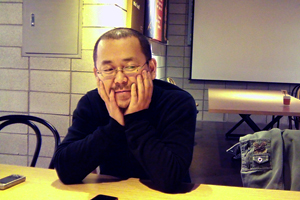
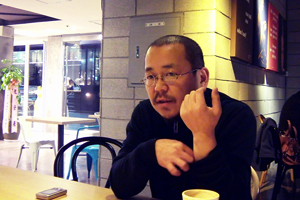
Q: Founding a theater company and becoming a representative of that company isn''t part of most people''s lives. Was there a special reason, opportunity, or something that you''ve been pursuing?
A:: I can''t say that I had a special dream about working in the theatrical scene, and like most people, I got into theater through a chance opportunity. Before the plays, I did Madang-Geuk (literally translated as open-yard drama), which is a type of open theatre. The 80''s in Korea was a period that demanded a very strong sense of duty from young people, and the field of Madang-Geuk was participated by many people with such ideals. I began to think that the Madang-Geuk didn''t welcome change even with the changing times, and the concept and format of the theater was fixed, which made me search for something beyond it. I believed that theater shouldn''t stipulate to a set regulation, and with this thought I started to search for new directions with couple of my seniors for about a year. After we created a theater company, we realized that we were bunch of novices who had never done a full-scale play and didn''t even have a clue on how to operate a theater company. So, we got stacks of books and studied one by one with the attitude that ''what we don''t know can be learned.'' Ironically, I think we were able to study and tried to accumulate experience without fear because we were so naive on the workings of a theater.
We regarded commercializing plays as something shameful, and we were also inclined to change such ideal. Then we began to seriously ponder and ask questions like ''What is surviving with theater and how can we survive by doing theater?'' Furthermore, we weren''t the mainstream of theatrical community and didn''t even know how they work either. Because our inclination was something experimental and unconventional, we often worried if we can survive in the theatrical community of Korea.
|
|
| |
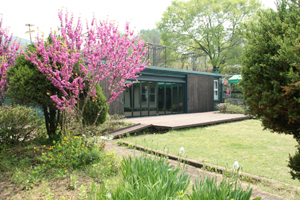
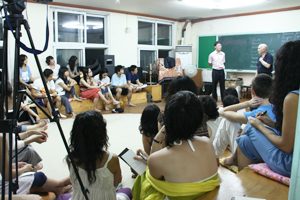
| Hooyong Performing Arts Centre | ||
Q: Isn''t doing an ''experiment'' different from doing an ''experimental theater?''
A: Around the time when we were making the theater company, we tried to convey social values and the troubles of mankind through natural and instinctive plays. To this end, we did significant amount of ''experiments'' as well. I think ''experiment'' is ''an attempt to evolve something.'' As we had jumped in without proper theatrical background, we needed to create something new and we didn''t have a choice but to experiment in order to do this. Otherwise, we thought it would be nothing more than imitating something that has already been established, and this wasn''t what we were pursuing. Even though we were experimenting, people around us said that we were ''doing an experimental theater.'' Personally, I think experimental theater is ''overthrowing the existing theatrical values.'' In contrast, our ''experiment'' can said to be an attempt at something that hasn''t been done before, in other words, it means that we are going through the stages of hypothesis and validation to create something new. In this sense, I believe there is a difference between experiment and experimental theater.
Q: What is ''something entirely new?'' Couldn''t the Nottle Theater Company unintentionally be presenting plays that has been already tried by others or ideas that had already existed?
A: At the same time these kinds of issues were being raised, there were also criticisms about our work. Some criticized our experimental attitude, which had no proper background knowledge of the existing theatrical community as an imitation of pre-existing plays. The fact that this kind of critique was possible led me to think maybe the theatrical community was that shallow so as to consider us knowledgeable in plays that already existed. Frankly, all we wanted was to try and experiment something newer just because we lacked the background in plays and the theatrical community. And this was part of our approach. So, we didn''t have any fear or discomfort with this kind of criticisms. Our aim was not to settle down in a frame with regulations, but to search for ''personal inner values'' or ''what we really are.''
Wandering and Settling Down
Q: Nottle is known to have a lot of performances abroad. Could you tell me about your experiences in international exchanges?
A: As we reached the second year since the founding of the theater company, we began to seriously contemplate about issues such as surviving through the formats of theater, life as a theatrical practitioner, and our status in the theatrical community. It was 1994. By chance, I participated in the international workshop in Avignon which invited a French language major who had interest in the theatre or a theatrical practitioner from each country. Back then, Avignon was a huge theatrical market. I became curious and believed that there were possibilities to make it in the market. In fact, I wasn''t aware of the theater or the theatrical world in Korea. Looking at Avignon, I began to think that there will be people who will like our play and that we will be able to find such people, though they are French, if we can create a good play. In short, I wasn''t afraid of leaving the frame of existing theatrical community. Once, I had participated in an international workshop in ChangMu Arts Center in 1995, I got an offer to go to Spain from a multi-national theater company directed by a Japanese director who was active in Spain, and I packed up my things the very next day and left for Spain. I had gained confidence to try new things through this one year of experience, and I also suggested activities abroad to the members of theatre company when I came back to Korea in 1996.
We created materials of our work processes one by one in order to introduce our work to the theaters abroad. We also bought a directory book, which I remember being very expensive, containing information of foreign foundations, public theaters, theater companies, etc. to send long letters to the addresses listed on the book. In the letters we didn’t mention performance fees or deals, but it was a request ''to take the time to watch our performance and evaluate them.'' Then, we got invited to the Monaco Festival in August of 1997. I told my members that "We are moving to France and this is the chance to live up to our own methods." At that time, we were earning around 10 million won through the Korea Theatre Festival. With this money, we bought 4 airplane tickets to France and started training in a warehouse in France. In spite of the cold, we began practicing at the front yard of the warehouse at 9am and finished at 6pm. We also toured by making a street theater in Avignon and other areas. After living in a warehouse in Avignon for 3 months, the youngest of the members exploded from the stress that has accumulated. Through this process, we were able to have an important experience of group living. Eventually, we returned home after spending all our money and 3 months of wandering life.
|
|
| |
| The Return | The Return in Adelaide |
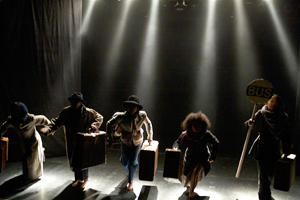
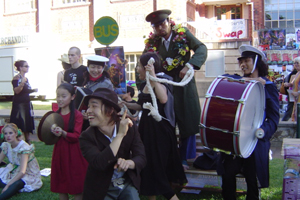
Q: I''ve heard that Nottle has a unique operating system. Please tell me what made you decide to go to Hooyong-ri, Wonju.
A: I tried a salary basis system which is rare in the theatrical community of Korea. As each member equally received a salary of 100 thousand won, I thought that the members can dedicate themselves to practicing and training at the theater company instead of working outside. Naturally, through this system, training and workshops started at 9 in the morning every day. After 3 months of the salary system, we began to get paid 400 to 500 thousand won through performances. We were able to create works within a relatively short time, and sell the works that we had produced. We were once involved in a performance and cultural program of YMCA (i.e. Young Men''s Christian Association) and this was the first time we sold our performance. The second time was when we participated in a street theatre section with an hour long mime at a festival. We have also participated in the Shakespeare Festival of Bukchon Changwoo Theater with the
I realized that every members need to improve their skills in order to become a world-class theater company after getting back from Japan. To achieve this mission, it required a lot more training and a space for implementing it. The necessity of living and creative space led us to the Hooyong Performing Arts Centre which was created by converting a closed-down school in Hooyong-ri, Munmak, Wonju. At that time, we tried settling in Hooyong-ri and participating in Avignon Festival all at once, because we believed investing in a space without specific and clear goal was risky. We thought that we can create some synergy by obtaining a space and preparing a performance in Avignon at the same time. The members and I went to Hooyong-ri in 2000 and officially opened the space in 2001. When it was first opened, there was a humble space that was created by knocking down a wall of two classrooms in a closed-down school, but with funding and renovation in 2004, the Hooyong Performing Arts Centre was able to equip itself into the current proper theater.
Aesthetic Value and Social Value
Q: Has anyone or theatre company ever influenced your life and your work?
A: My methods of creating work were about creating hypothesis, then experimenting and evaluating them with continuous training, and ceaseless self-awareness. I found out that the Ordin Theatre of Eugenio Barba was already implementing our contemplations. He had created the Ordin Theatre with the actors from all over Europe and traveled to learn and to train the actors. He wanted to go to remote towns and ''exchange'' the culture that he had brought with him. In other words, rather than just showing the performance, he made ''exchanges'' by learning others'' culture and sharing different skills. From the ''60s to the ''70s, they have been developing their own forms and genre by visiting not only New York, but also South America, Indonesia, and Sichuan in China. I had thought this was an ideal theater company. I thought it was important to do a month-long performance at a large theater in the heart of a city and win the cheers of the audiences, but the process of finding the questions and answers in the life of an artist was what was really important to me.
Q: There have been reviews that Nottle is more focused on compacted expressions such as body movements and visual effects rather than detailed descriptions and friendly interpretations. Does your theater company really pursue those qualities? What are some artworks that convey such philosophy?
A: Personally, I thought plays that center on the texts are dull and boring. I was more interested in visually appealing aspects or body movements that can come from continuous training of the actors. I think that the evaluation on the completeness of the artworks will reveal more accurate assessment with the pass of time. However, if I had to pick one, it would be The Return from the original work of Bertolt Brecht that best portrays our ideals considering its content and process. It''s about always running towards something new, but a life that is always out of reach no matter where you are. For example, people think it is nice when we tell them that we are going to perform abroad. But the reality is that ''there is no place like home and all you get is trouble when you leave home.'' The Return was first created in 2002. Since then, it was continuously modified and supplemented. And I believe through the performances in China, Australia, Romania and other countries, the performance has been growing with the aging of the experience and years. I also think the characters in The Return have come to resemble ourselves.
Brecht was a long time favorite artist of mine. I especially liked his poetry than his plays. I recall my first study work being that of Brecht''s, and I think that could''ve been the beginning of my tie with Brecht. There are many poems of his that are excellent for plays. During the days of President Bush in 2003, there was a broadcast of U.S.''s invasion of Iraq on TV. The news showed an Iraqi child playing and firing an automatic rifle, and the child didn''t look nervous at all. Though we often metaphorically say that life is a war zone, Iraq really was a place where everyday life was war. As I was watching this scene on TV, the story of a king who wanted to accumulate wealth through war from the poem of Brecht popped in my head.
|
|
| |
| La casa de Bernarda Alba | The Buddha My Body |
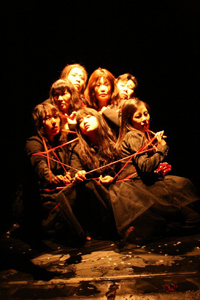
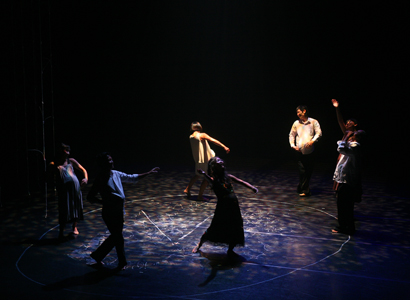
Q: The repertoire of Nottle includes Hamlet from the East, Woyzeck, La casa de Bernarda Alba, The Buddha My Body, The Return, and others. Most of theater companies search for new works and perform them, but Nottle has been focusing on developing a single work. If so, Nottle''s challenge and experiments can rather be viewed as fixed on a few works. As the representative of Nottle, what does ''work'' mean to you?
A: To me, work has the four phases of life, birth, aging, sickness, and death, and it grows every time it is performed. When the activities of artists are converted to economic value, they are still considered to be a part of the lower stratum, and because of this, there are often controversies surrounding welfare of artists and such. Nevertheless, I believe there still is respect for the artists in our society. If there is such respect in the society, then the artists are surviving through such social forces. While most people are not doing what they really want to do in life, most artists are doing what they love even though material rewards are insignificant. So, I think it is necessary for artists to live a more devoted life, like that of truth seekers. In order for creative results to acquire social value, it may take 50 years or more, and maybe never. I think the priority of an artist''s life should be the aesthetic value, and based on this, there should be pursuit for social value. Therefore, I believe the toiling times of process that creators experience should absolutely be embraced. Some say that Nottle is running the same performances over and over, but to us, it is not the same work but a work that is continuously growing. Maybe, we are dreaming of ''establishing a new method'' from the fact that we are always pursuing the process that naturally change the work according to the progress of the performance and not through the analysis of the text.
Q: Are there overseas performances scheduled for next year?
A: Yes. We are going to perform The Return in Okinawa, Japan, in July of 2012. I am thinking about doing some research with the members and taking a break after the performances.
 PREV
PREV
.JPG)
.jpg)
.jpg)
.jpg)
.jpg)












;)


