





The Gateway of Mexican Dance Exchange
[Who&Work] Cuauhtémoc Nájera Ruiz _ Dance Director of Cultural Arts Center at Universidad Nacional Autónama de México
Korean Contemporary Dance Festival in Mexico
From the past October 18th to 23rd, the Korean Contemporary Dance Festival was held at the Cultural Arts Center of Universidad Nacional Autónama de México. This festival was a part of an overseas program of Korea Arts Management Service called ''Center Stage Korean - Latin America'' project, and it was created to introduce Korean contemporary dance in Mexico and to build a bridge there for dance exchange as well. The dance department of Cultural Arts Center at Universidad Nacional Autónama de México (UNAM), who acted as a partner organization in Mexico, not only allowed the Korean participants to communicate with the local dancers, but also provided various ways to communicate with the audience through performances, conversations with the audience, forums, workshops, networking parties, and others.
Park Soon Ho Dance Company, Lee K. Dance Company by the choreographer Kyung Eun LEE, and EDx2 Dnace Company by the choreographer Insoo LEE were invited to the festival, and each troupe performed total of 6 performances for 2 days each. At each performance, the seats were packed with the local dancers and regular audiences, and they all sent their acclamation for the global sense of Korean choreographers and the excellent physical expressions of the dancers. The performances were filled with fans such as dancers who are viewing consecutive performances of their favorite dance troupes, audiences giving standing ovations and screaming as if they were at a concert of a popular pop star, and students who waited for dancers to get their autographs. Like this, at the end of every performance, the number of countless local fans who were fascinated by Korean contemporary dance grew limitless. Above all, the tremendous positive reaction from the local dancers who participated in the creative workshops conducted by Kyune Eun LEE and Insoo LEE vividly demonstrated the current trend of dance in Mexico going beyond the stages of modern dance and into the contemporary dance.
|
|
|
| ||
| Park Soon Ho Dance Company _ Balance and Imbalance |
Lee K. Dance Company _ This is Not a Dream |
EDx2 Dance Company _ Modern Feeling |
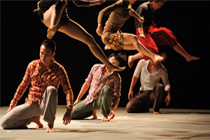
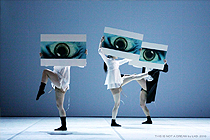
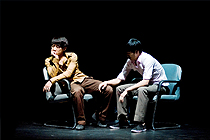
The figure who spearheaded all these programs was Cuauhtémoc Nájera Ruiz, the Dance Director of Cultural Arts Center at UNAM. The following is a summary of the interview I had with Director Cuauhtémoc Nájera Ruiz on October 20th.
The Omnipotent Dance Director, Choreographer and Artistic Administrator
Q: I''ve watched the Korean Contemporary Dance Festival, and I can''t imagine this event without you directing it. Everyone involved in the event were looking for you and waiting for your directions. Obviously, you are a professor as you are a dance director of a university, and at the same time, you seem to be an art administrator as you are operating a theater. What are you doing currently?
A: UNAM is a university, but it doesn''t consist of only professors. The professional workforce of UNAM is made up of 3 major areas of ''education'', ''research'', and ''culture diffusion.'' I belong to the Cultural Arts Center, which is in charge of culture diffusion. There are 13 fields such as performing arts, film, literature and publishing, museums, and media where each field has a director. Among these, I am the director in charge of dance.
It''s not easy to explain all the responsibilities of a dance director, but the key duties are theater operation, dance classes, and dance performances. Theater operations include coordinating dance programs of the theater and renting theaters to professional dance organizations. Dance classes are an educational program for the public. This program is very popular so as to have over 4,000 enrollments every year, and it is unique in terms of intermixing people of all ages and all types of dances. Not to mention ballet classes for children, it includes various courses such as salsa and rock ''n'' roll dance as well.
The dance performances are progressed by getting together a troupe and visiting a desired stage. Primarily we visit regional branch schools of UNAM or affiliated high schools, but we perform wherever there is a request. Because it is an open style stage, we sometimes perform in theaters and sometimes perform in parking lots and outdoors by building a makeshift stage.
|
|
| Cuauhtémoc Nájera Ruiz |
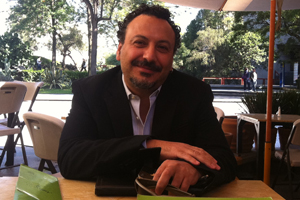
Q: Then, do you not personally teach dance?
A: I can''t teach students because there is no dance department at UNAM. Instead, I instruct at other universities, and sometimes teach dance to professional dancers. In one week, a ballet festival in which college students across Mexico will participate will be held and I plan to teach classical ballet ''Pas de deux.'' And early this year, a ballet reality show called ''Audition program for ballet graduates'' aired on Canal 22, which is public broadcasting channel affiliated with El Consejo Nacional para la Cultura y las Artes (CONACULTA) of Mexico. I worked as a director of this program, and also as a judge and a mentor for the participants.
Q: Even though the theater of UNAM is an affiliated institution of the university, it is playing the central role of dance performances in Mexico City. Could you introduce the system of UNAM?
A:There are 3 spaces for dance performances at UNAM, and they are the large theater with 700 seats, medium theater with 300 seats, and a small theater with 60~100 seats. The performance programs of large and medium theaters consist of two sections. Programs of the first half are made up of performances which UNAM has invested or co-produced. They are all premieres, and 70% of the performances are contemporary dances. Programs from the second half are made up of selected works from the first half, invitational works from abroad, festivals, and the remaining slots are given to professional dance groups.
The small theater called black-box can be freely utilized into a multi-purpose space for performances, forums, workshops, etc. This space is often preferred by young choreographers and dancers who are trying something different and new. One exotic program that is held at this theater is called ''Dance marathon.'' It is held once a month and when the theme is decided, related dancers gather and freely present their performances. The performance goes on for 6 hours, and the audiences are free to move about and watch the performance.
Admired by Mexican Dancers, the Expressive Ability of Korean Dancers
Q: Could you introduce the trend of contemporary dance in Mexico?A: I think the creativity of Mexican dancers is relatively high compared to other countries. However, this isn''t true in terms of technique. In other words, they are equipped with the ability, but it hasn''t been developed yet. I believe we have reached the point where it needs to be upgraded. One of the reasons why there was such good reaction from the audiences at the Korean Contemporary Dance Festival is because the Korean dancers were brilliant in their expressive ability and communication.
There are diverse trends in Mexico''s contemporary dance, but young choreographers in their 30''s who will be leading the dance scene prefer hyper-media performances that utilize the latest technologies. The multimedia is usually used in their dances, and sometimes they pursue interactive performances by attaching sensors on their bodies. Other characteristics include creating two extremes of movements by excluding any movement at all or as an opposite, creating very physical dance movements.
Q: If you can summarize the performance of ''Korean Contemporary Dance Festival'' up to now, what would it be?
A: Through this event, the dancers in Mexico became deeply interest in Korean contemporary dance. Personally, I am very satisfied with the outcome of this event. Some presenters are not only intending to re-invite one of the dance groups to Mexico, but also tour the performance to the U.S. and Canada as well. I was also informed that several dancers wanted to invite Korean choreographers to hold workshops or to create co-productions.
|
|
| |
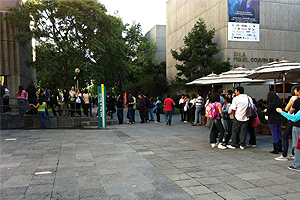
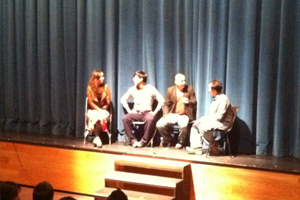
| Mexican audiences waiting for admission | Conversation with the audience before the performance | |
|
|
| |
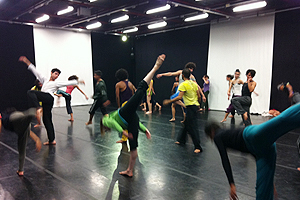
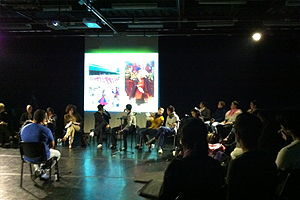
| The workshop for Korean-Mexican dancers | Korean-Mexican contemporary dance forum | |
Dance Exchanges with Mexico, the Importance of Sincerity and Passion
Q: The deputy director of Dance Exchange of Instituto Nacional de Bellas Artes (INBA), who I met at the opening reception, had told me that if I want to dance exchange with Mexico, it would be faster and more efficient to talk to you rather than the government agency like themselves. And they regarded you as the gateway to Mexican dance exchange or the shortcut.
A: I am very thankful for such expressions. I believe they put it that way because there is much more freedom to pursue dance exchange at a university institution than a government agency. The university budget can be appropriately used as the task is progressed at a university, and it’s easy to work because the administrative procedures of university tend to be simple. In addition, it is easy to work here because artists also side with the university as they say freedom to express is richer at a university institution.
Q: What would be your advice to Korean dancers who wish to have dance exchanges with Mexico?
A: I don''t think it is appropriate to talk about one concept as the preference is different according to each institution and person. As seen at this festival, Mexican audiences were moved by Korean dancers’ passion and their best on the stage. In other words, performing with passion and sincerity is more important than a special concept. I look forward to more performances in Mexico by Korean dancers in the future through INBA or UNAM. I also hope dancers from both countries can build up exchanges and create a rich network of people.
Cuauhtémoc Nájera Ruiz
Cuauhtémoc Nájera Ruiz is the dance director of Cultural Arts Center at Universidad Nacional Autónama de México. He graduated from an umbrella ballet school of National Arts Academy and was active as a soloist for Compania Nacional Danza (CND) for many years. He worked as a CND Arts Director for 7 years and was appointed as the Dance Director of UNAM in October of 2004. Because he has a rich network of people throughout Mexico''s arts and culture community and the dance scene abroad, he is considered second to none in international dance exchange.
 PREV
PREV
.JPG)
.jpg)
.jpg)
.jpg)
.jpg)












.jpg','From the past October 18th to 23rd, the Korean Con..');)


