





Creation of New Audience Pool via Media Arts
[Who&Work] Jaeho JANG, Gazaebal & N2 _ Tacit Group
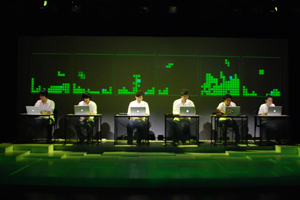
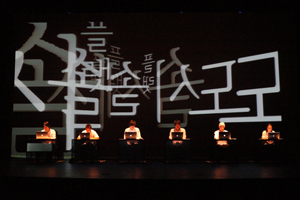
Three domestic and overseas Korean artists got together and created an audiovisual performance group, or Tacit Group, under the goal of creating new arts of the 21st century. The three members are Jaeho JANG (professor of the department of composition at the Korea National University of Arts), Jinwon LEE (media artist also known as Gazaebal), and Sangwon NAM (a.k.a. N2). Artistically inspired by digital technology, the group covers diverse genres like multimedia performance, interactive installation and algorithmic art through computer programming.
|
|
| Tacit Group |
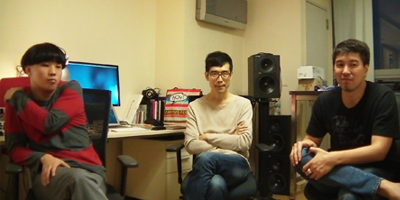
As implied by its name originally borrowed from the namesake in John Cage’s 4‘33“ , they pursue completion of the innovativeness of arts that started in the 20th century. Their work discovers the world of arts from analog and digital materials commonly found in daily life, and shows it to people in pursuit of the value of creation and the joy of commonness.
The group has marked itself as a unique media arts group in Korea. It started its career at the 10th anniversary of Ssamzie Space in 2008, and performed, for example, at the Heyri Pan Festival, the Over Music Festival hosted by the NJP(Num Jung PAIK) Art center in 2008, and the Doosan Art Center in 2009. Then, Tacit began to make inroads into overseas markets. Its overseas activities started at the Performing Arts Market in Seoul (PAMS) 2010. It won the PAMS Choice selection with tacit.perform[0]. The PAMS Choice is to credit the globally recognized shows. Then, the group performed as part of the opening show for the Aarhus Festival 2011 in Denmark.
We sat down with Tacit members and discussed their history and vision, along with other questions on their art world.
Q : Why don’t you guys introduce yourselves to us?
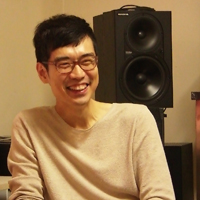
Jaeho JANG (JANG) : When I was a kid, I liked assembling micro mouse robots and computers. So, I thought of becoming a mechanical or electronic engineering major. I was learning to play piano, but music wasn’t part of the future I was dreaming of. At around the end of my middle school days, my brother recommended Vladimir Ashkenazy’s performance of Fryderyk Franciszek Chopin, and it mesmerized me. Then, I turned around and majored in composition. Among others, Igor Fyodorovitsch Stravinsky, Iannis Xenakis, and Olivier Messiaen attracted me. Their works took in mathematical elements, and it was excellent. That was how I got immersed in algorithmic composition. That attraction branched my interest into computer music, minimalism and programming. Now, I teach composition at Korea National University of Arts, and actively engage in diverse activities as Tacit member.
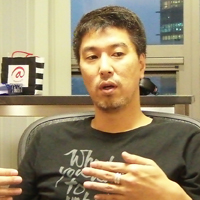
Gazaebal : My music career didn’t take the traditional, classical educational path. As a kid, I liked recording, and clipping and gluing the tapes. I wasn’t interested in music theories and composing methods. I just liked sound. In the United States, I studied theories and sound engineering, and started my career with a studio. I worked on remixing of pop music like Rain’s songs, and released a techno album in the UK. I wanted to further my study on sound-oriented works like Max/MSP. So, I registered in the MFA course on computer music technology [offered by the Korea National University of Arts]. The educational experience influenced my career and programming works. Now, I’m here as part of Tacit. I am teaching in college and other functions, and work as member of Tacit.
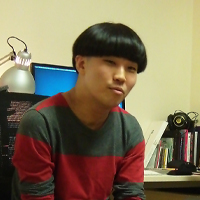
N2 : When majoring in composition of classical music, I ran into and got fascinated with electronic music works of several composers like Karlheinz Stockhausen. Then, I started writing electronic music pieces. Later, I began to work on collaborative works with media arts and contemporary dance experts. Now, I’m working on solo projects, along with Tacit.
|
|
|
| |||
|
Jaeho JANG |
Gazaebal |
N2 |
Continuing Innovative Art of 20th Century
Q : How did you incorporate diverse personal tastes and interests in Tacit and give a birth to it?
JANG : From around 2006, I wanted to form a composer group like Tacit where I could work with others. I wished to pursue not only experimental and modern music, but fun and popular music. Collaboration with other artists wasn’t durable for various reasons. Sharing this wish, I started a project group with Gajaebal in 2008. We two got together once a week, and studied and worked. We called it Tacit Day. The name Tacit came from the Italian word Tacet originally in the sheet music of John Cage’s 4'' 33". In Italian, it means silence. The piece left an indelible mark in the 20th century, and we wanted to continue the spirit. During this period, major ideas emerged and dominated Tacit’s works like Hunmin Jeongak, Game Over, and tetris.
For the 2008 performance celebrating the 10th anniversary of Ssamzie, I employed algorithmic technology. Gajaebal and other members showed interest, and I thought compute composing should be different from conventional methods. It’s like that we can’t draw a watercolor painting in oil. A new tool deserved a new method of composing, we believed. Algorithmic composition squared well with computers. Moreover, we were also interested in minimalist elements focusing not on results but on processes. We also liked a journey beyond the imaginary boundaries of composers.
Q : It’s interesting to watch use of new tools and resulting works. I’m wondering how such use affects interactivity and your creating process. How do audiences react to this?
Gazaebal : The 20th century watched numerous musical trials and a considerable advance. The new attempts had driven away some audiences, though. Of course, interaction is one of the core artistic concepts of the 21st century. But we don’t put much emphasis on interaction with audiences. Rather, we put more emphasis on the interactivity among performers, the interactivity of media with performers and humans. We endeavor to reflect as much of it as possible. In the last century, excessive experiment drove away audiences. This century, we have to create more new audiences. Various forms of interactivity will probably play important roles between works and media, and among human beings. We want to produce works that, although born via intelligence, are appreciated in the heart.
JANG : Technology has already become part of life of young guys. They take it so naturally. Encompassing it in works of arts, there seem some limitations. I guess it’s because of the nature of arts. First, positive responses from the audience are necessary. They have to feel fun and freshness. Next is the criticism by arts experts. It’s a matter of how to evaluate. Finally, I am not sure how, but we have to find out ways to accommodate various perspectives and concepts.
|
|
|
| tacit.perform[0] | |
Major Leaguer With Taste Still Lingering Outside Mainstream
Q : It’s kind of hard to define Tacit’s works. The term “multidisciplinary” seems insufficient, and the notion of media arts is inappropriate, either. Music and sound play too much of a role. From the perspective of conventional genres classification in Korean arts community, where do you guys stand?
Gazaebal : These days, I often joke, “I live a major leaguer’s lifestyle. But my taste seems still in the minor.” My personal music career started around the Hongik area which is home to active indie musicians. So bounded by the artist’s insistence on something new and experimental, I thought I wasn’t able to immerse myself in non-mainstream works, either. But I would not label myself as commercialism-oriented. I just hope to do what I want to do, free of standardized art forms, and attract new audiences. I also desire to maintain artfulness, and commercial fun and joy. Small-sized works are interesting. But large-scale works like the main opening performance of the PyeongChang Winter Olympics in 2018 are also attractive. One day, I wish I could do a large-scale technology-based media art performance.
JANG : I don’t want to lose my musical color. I want to do large-scale shows and build up our own fans who understand our world. Our works and tastes are still outside the mainstream. We want to do something that can secure artfulness and commercial success. So, lots of people can enjoy our shows.
Q : Propelled by the selection of tacit.perform[0] as PAMS Choice in 2010, Tacit started overseas tours in earnest. What did you want to show overseas, and want to get from the tours?
JANG : Going abroad will probably be an important opportunity to make new fans. Our work is like commercializing modern music. We do lots of performances in Korea. It’s kind of fun. It’s also difficult to demand promotional and other staff members of new things, and explain the process to audiences. Overseas, staff members showed great interest and friendliness. That made things easier for us. It was really comfortable. They gave full support. They didn’t seem to give much thought about breakdown of instruments and tools. That environment helped a lot.
Gazaebal : Individuals show a variety of responses and thoughts. Generally, they were open to our performance, and very responsive. We loved it. In case of Hunmin Jeongak, domestic game shows are carried out in Korean, but overseas shows are in English alphabets. They showed aggressive responses. They felt happy, and we are creating diverse versions of existing works with various game rules and media.
Process of Making Scenes and Characters
Q : Outside Tacit, you guys are still doing individual works and activities. Are there any troubles, doing both?
N2 : Completing the M.F.A. course in music and sound technology at the Korea National University of Arts, now I’m mulling over my identity as artist. I concentrate on my own emotions, working on individual works. On the other hand, I concentrate on technical and functional aspects, handling Tacit’s works. We work within limited time frames and circumstances, and efficiency commands a lot. So, we divide up roles often.
JANG : The clearer the direction is, the narrower the range of choices become in arts. We have to balance them. Capitalism leaves little room for artists. Somebody has to create some breathing soil for them.
Gazaebal : If it’s traditional arts, it would be possible to live only as an artist. For us, education is vital. Our works are to create markets and audiences. So, education constitutes part of our calling. It’s like simultaneously making scenes and characters.
Q : What do you have for the future? Would you tell us about it?
JANG : We are working on our third solo show. It will be tacit.perform[2] - structural sounds at the LIG Art Hall on December 22nd and 23rd. Five pieces will be put on stage. Except the introductory part, all the other four pieces will be brand-new. We are concentrating more on the composition for this upcoming show. It will be from six to three for channel control. For example in tetris, the blocks will not move automatically. We’ve set up some constraints. That way, the positive algorithm will be suppressed, but performers will be more highlighted.
| Tacit.perform[1] |
 PREV
PREV
.JPG)
.jpg)
.jpg)
.jpg)
.jpg)












(0).jpg','Three domestic and overseas Korean artists got tog..');)


