





Journey in Search of Artists
[Who&Work] M J CHOUNG _ Independent Producer
The Performing Arts Market in Seoul (PAMS) 2011 introduces M J CHOUNG as independent producer in its publication. Numerous other epithets can also characterize her occupation, such as festival programmer, theatrical coordinator, producer, president of a theatrical company, translator, just to name a few. She has been handling plural jobs all throughout her career, like programmer and moonlighting translator, producer in the UK, and president in the Czech Republic. Wandering nomadically from occupation to occupation, the term “independent producer” is insufficient to define her. Actually, there is not a single word sufficient to define what she does. The same is true of the genres she has been working on. She covers diverse genres like theatre, dance and physical theater, and gets involved in state-funded as well as commercially funded shows. The Korean performing arts community contacts her first to locate a British or European company or artist. Her activities, however, are not limited to the UK. It is almost impossible to confine her within a particular frame of genre or area. Still, there is a guiding light leading her, which is no other than a good performance.
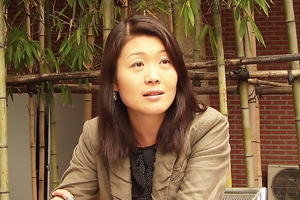 |
| M J CHOUNG |
Act 1 Chapter 1. Conceiving Dream
Going to Hansung Girls’ High School located near Daehakno in Seoul, which is Korea’s answer to Broadway, Choung liked to frequent the street. She yearned for dramas and theatrical shows, but she knew her parents would not allow it. Thus, she chose philosophy as her college major. The first thing she did in college was to join the theatre club. Looking at the alumni members of the club, she realized that few of them got the jobs related to the club activities. Thus, she decided not to follow suit. “Whatever the job title might be, I wanted to be a witness of the process of creating temporary beauty,” she says. That aspiration propelled her from Daehakno to the West End to Edinburgh and to Prague of the Czech Republic.
In addition to philosophy, double majoring in English language and literature, she met professor Jinsu JUNG in college. JUNG served major positions in the Korean theatrical community such as Director of Minjung Theater Company, General Secretary of the Korean charter of the International Theater Institute (ITI) and chairman of the board of the National Theater Association of Korea. He also played a role in foundation of ACOM Co., Ltd. During her graduate school days, she got noticed by JUNG and began to work for the ITI in her second year of the graduate school. Right in that year, she participated in preparation of the BeSeTo Theatre Festival, and that of the Theatre des Nations to be held in 1997. She recalls, “The BeSeTo Festival was good for me. It was small in size. I had many opportunities to learn from. Until the 1997 [Theatre des Nations], I toured Edinburgh, Avignon and French street theatre festivals. The tour was like a training program to become a programmer. In those days, Korea didn’t have a festival programmer. We invited programmers from Avignon to hold a workshop. I learned everything from them. Writing agreements, which work to invite, and how to pay. It was about every detail.” The Korean ITI bureau served as platform for overseas connection. Working for the bureau, she delivered requests or messages from overseas bureaus to domestic companies, and supported overseas tours in cooperation with the Ministry of Culture, Sports and tourism. She helped Minjung Theater Compnay perform Little Shop of Horrors by translating scripts and arranging foreign choreographers. From this time, her “double” life began.
Act 1 Chapter 2. Leaving for Broader World
Building up her career as festival expert and musical producer, for example, working for the Seoul Performing Arts Company as producer and the 1st Uiejeongbu Music Theatre Festival, she suddenly flew over to the UK for more study. “I kept two jobs all the time from ’94 to 2001. I worked almost 16 hours a day. I didn’t have time to look back on myself. Literally no time to think about what to do, how to live and what career to pursue as producer. No time at all. But I wanted to study more.” Then, my body bent down. Working on the Uiejeongbu Music Theatre Festival, she collapsed. The doctor warned that her immune system had weakened from overwork. Even in the face of the diagnosis, she skirted out of hospital to attend and manage major events. Watching herself in such miserable condition, she realized it was time to leave.
She studied theater and arts management at Goldsmiths, University of London. Studying was not the only thing she did in London. To begin with, she programmed for children’s theatrical company. Staffed only by her, in addition to the director, the company was run entirely by her alone from application for funds, to marketing to promotion to booking to cleaning. Despite the colorful career in Korea, she started from scratch. She recalls that her experience in London has taught a lot about the theatrical conditions in the UK. Still, she might have felt disappointed at the denial of her career and experience in Korea. “For about 6-7 year [in Korea], I worked on too many things too fast. I had no background knowledge, though. London was the first time I began to handle trivial, but important details. That experience built up my fundamentals. I learned how to approach things step by step. I also learned English. A lot. Writing funding applications and letters to government agencies required something more than what I used to speak or use in class. It was never boring. Everyday demanded a lot.”
Chong’s stay in London got Korean community closer to the city. She served as a wonderful messenger between the two communities. Her previous experiences in Korea led her to the position of independent programmer promoting the Seoul Performing Arts Festival (SPAF) and the Uiejeongbu Music Theatre festival. She met top-class British artistic directors on behalf of or accompanying major Korean figures like Myung-Gon KIM (president of the National Theater of Korea), and SPAF directors Kwanglim KIM, Jong Hun LEE and Chul-lee KIM. The meetings were not an everyday event. But they squared with her role as programmer. Continuing her role as bridge between Seoul and London, she kept translating. She mostly worked on musicals. Several musical producers asked her to help produce their shows locally in London. Specifically, she contacted artists as producer, and located works to be performed. For three years, she has been working on two pieces, and kept translating as well.
Act 2 Chapter 1. Meeting with Farm in the Cave
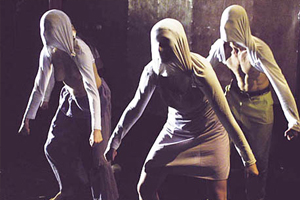
Despite her various career experiences, her encounter with the Czech company Farm in the Cave confirmed where she stood. She met the company when she was co-producing The Song of an Emigrant with Yohangza Theatre Company in Korea in 2005. The Czech company invited her over to Prague to introduce its other piece, or Lorca-based Dark Love Sonnets. “It was hilarious! I thought I wouldn’t meet such a piece for some time to come. It was for a small theater. Still, the ensemble of the performer crew was lively and I felt like we’d been practicing it for a long time together. I put it on stage at the Uiejeongbu Music theatre festival, and got lots of reactions.” This relationship furthered as the Czech company played Waiting Room in Edinburgh, and continued. At first, she wanted to help them with promotion. But it was a young company and lacked experience. She assisted it in programming and production. It was beyond her original plan. One day, the company contacted her. Suffering liver cancer, its president asked Choung to lead Farm in the Cave. To make up for the absence, she did whatever she could to help the company she cherished. Managing the overseas tour of Waiting Room, she spent half a year overseas, and the rest shuttling between London and Prague. Then, in 2008 when developing a musical in London, she shuttled back and forth three times a week. Later, she hunkered down in Prague for an entire year. “What I am looking for is the teacher in life, and the teacher in art. If I should work with artists like Peter Brook and Ariane Mnouchkine, I could happily spend my whole life supporting them. Working with the company, its potential might make me happy throughout my life, I thought.”
 |
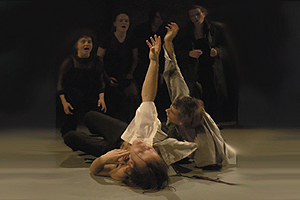 | |
| The Song of an emigrant | Sonnets of dark love |
But her life in Prague was a process of trials and errors. Cultural differences that she had not felt in London shocked her. With her double major in English, she knew about the English culture and language. But she did not master the Czech language. Czechs like direct expressions. She thought she was familiar with the company. But she was wrong. Unexpected things got in her way. “When you say ‘Good morning,’ they sometime reply ‘Bad morning.’ On top of it, as my assistant, I chose a Slovakian over a Czech applicant who studied in the UK. But Czechs, in general, look down on Slovakians. It must have looked unfavorable for them to watch an Asian unable to speak their language and a Slovakian assistant working with their government. Further, I favored English-speaking people around me. I had to. I had to be able to talk with my staff. My presence agonized a lot of people. I realized it was impossible to work among the local people without knowing the local language.” After one year, she returned to London. But the relationship did not end there. Earlier this year, the manager quit, and the company proposed to work together on a collaborative project. Thus, she visited Prague, and felt a warm-hearted welcome from the members. It was something different than before. “I don’t know how to put it. The depth of affinity was different. It was more mature. Now, we expect things to be expected, and don’t expect things not to be. I felt good about my decision to work with them again.”
Meeting between a programmer and a company is comparable to marriage. “Working with a company is like sleeping with it every day. I’m really lucky to know such a company.” Farm in the Cave served a good stop for her. But it does not seem a destination for nomadic artist Choung. She works with the company, but will soon take another path. “My venture to London and Prague was part of my search for good artists. If I had met such person in Korea, I would’ve remained here. I don’t mind going to Russia or Iceland. But I will learn the local language.” The new chapter 2 of her life is uncharged water. But coordinates shine brightly.
M J CHOUNG got her M.A. in arts management from Goldsmiths, University of London. She once managed the BeSeTo Theatre Festival, the Theatre des Nations 1997 in Seoul and the Uiejeongbu Music Theatre Festival; and, worked for the Seoul Performing Arts Company as producer. Currently living in London, she works as freelance programmer/producer of theatres and musicals. She also translates scripts and writes columns.
 PREV
PREV
.JPG)
.jpg)
.jpg)
.jpg)
.jpg)












 2011 in..');)


