





A festival that makes us love the city
[Who&Work] Kitty Ross _ Thames festival program director
The Thames Festival that opens at the Thames River in England every September is the biggest outdoor arts festival of London that attracts more than 1 million visitors. The festival, focusing on the stage on the river and outdoor stages around its, is free. We met with Kitty Ross, who visited Korea after holding the 14th festival to participate in the Performing Arts Market in Seoul.
The strong charm of the Thames Festival
Q : I heard that it has been around 7 years since you moved from a recording studio to the Thames Festival.
A : It was completely by chance that I started working at recording studio. Before I worked in the arts, I was preparing to become a nurse. In the last stage of my education as a nurse I failed by biology class and wanted to find something new. When I had to select something other than nursing I wanted to do "art" and that is how I ventured into this field. I could create my own curriculum at school, and most of the classes I took were arts, healthcare, and the social role of arts. During my studies, I developed a great interest in the social role of arts, arts and healthcare and healing programs. In the last part of my degree program I had the opportunity to work for three months at a community music organization for the mentally disabled and homeless, and the head of the organization offered me a job after I graduated, so that''s how I started to work there. I worked for around 2 years at the community music organization.
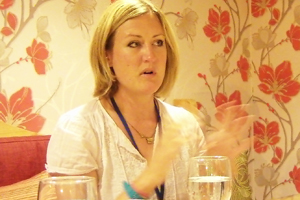 |
| Kitty Ross |
Then, I saw an ad for an Education and Outreach Coordinator for the Thames Festival. First, I liked the fact that the Thames Festival is a large-scale free event, and that it uses a wide public place. The fact that the space is open to anyone makes art more approachable, doesn''t it? These characteristics of the Thames Festival were very attractive to me. A lot of people actually participate in the Thames Festival. South Bank (the southern bank of the River Thames in central London) holds a huge ferris wheel called the London Eye and is close to museums and theaters, so it is a place that attracts many tourists. I felt that holding performances and exhibitions in the center of arts and culture tourism could make our arts and festival known not only in England but around the world, and that part made it even more attractive.
I have worked at the Thames Festival for 7 years. Now, I am in charge of appropriately programming the many pieces Festival Director Adrian Evans presents.
Change into a new space
Q : Who is invited to the Thames Festival, and how do you program it?
A : The Thames Festival is a completely outdoor festival and it uses the public spaces around the Thames. The Thames has two dies per day. It is a very big river where the water comes up to 8 meters high. Therefore, there are some difficulties in setting up the stage on the river and for the performers on the stage. Yet we still try to use the stage of the "river" as much as possible. We block the London Central Bridge, and there are installation pieces like one that wraps the entire bridge. We make efforts to change the space of London into an entirely different space.
The Thames Festival includes a variety of programs from small scale programs to large scale street performances. There is a separate stage for music. Pop stars or other famous people do not appear on the music stage. It is always open to new musicians or unique music. There is another space like this music stage, which is for social dance. It is a stage where many people can come together to dance jive, swing and tango.
Q : The international street performance group Royal de Luxe performed the large-scale outdoor performance "Sultan''s Elephant" a few years ago in London. Many English outdoor performance experts reviewed that it had a large influence on English outdoor performances, creating a hot topic.
A : Royal de Luxe is famous for creating huge pieces using mechanical equipment for their performance. "Sultan''s Elephant" is truly a great performance. It is a piece that made me look back and realize once again why I wanted to work in the street arts field. Everyone, including adults and children, were touched by that performance. The huge scale was part of it, but it is also technically excellent performance.
We cannot catch up to a performance like that of a group with a history of 20 to 30 years at once. We do not improve faster just because we can compete with them, either. However, one thing for sure is that other artists were stimulated by that performance and probably created new goals. Another strength of a large-scale performance is that the audience can share their feelings and experience with each other.
Q : What significance does the space of the Thames Festival have on the festival itself?
A : The River Thames is the vision of the Thames Festival Director Adrian Evans. Before the Thames Festival, small-scale festivals were held according to region. There were no events like the Thames Festival where the big city of London or the spaces could become one. The vision of the Thames Festival is to makes these things into one through the festival. Of course, the role of space is a big one for this vision. The river feels like it is always there in that spot, and makes people feel unity and integration. Also, we make efforts to recreate the existing space as a new space by hanging dresses on the trees, or making a very dirty area beautiful through numerous projects, so the space changes into a visually beautiful space.
Q : What do you think the role of the Thames Festival is in local community?
A : It is to make people happy. It is to make people love the city they live in and make them proud of living in London.
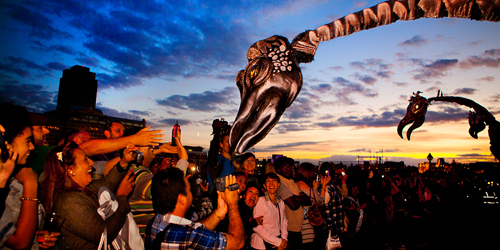 |
| Night Carnival (2010) |
Budget and authorization
Q : How do you secure the festival budget?
A : The current budget is around 1.5 to 1.6 million pounds (around 2.8 to 2.9 billion Korean won). This includes labor cost, operation cost and all other costs. The budget is set through the Arts Council England and London City, but the budget from the city is only 2-3 percent of the total budget. There is also the Trust Foundation and corporate sponsors. Half to around two-thirds of the budget is from corporate sponsors. This is the part that has changed the most since seven years ago when I first came to work at the Thames Festival. Back then, the budget from the city or government took up a large part.
Q : Corporate sponsorship or donation is bigger than government support, yet the entire festival is free? Are there areas of the festival through which you make a profit?
A : Of course the entire festival is free. We do make small profits through sales of souvenir cards, etc. The Arts Council England told us to secure a budget through a profitable structure with the festival and reduced our budget. So we do have a few small profit-making businesses, but the amount is very small as of yet. Everyone should be able to come to the festival for free, so it is difficult to conduct profitable activities to fill up the large amount we spend. We do not have any specific plans yet, but we are considering many different fund-raising methods for the festival.
Q : What are the most recent issues or difficulties of the Thames Festival and other similar street festivals in England?
A : Budget is always important and difficult. Creating a budget is especially important to conduct the project we want. It get solved easily sometimes, but there are more times when it is a difficult process. The budget related area is always a continuation of challenges.
The other problem is the issue of authorization for using a public place. It is not easy to meet with a public organization or government organization or personal owner of a place to get authorization. The Thames Festival is a large-scale event, so we have to meet with organizations like the Fire Department, the Police Department, the Transport Department and hospitals 4 to 5 times a year to tell them about the project plans and persuade them.
Q : Please tell us about activities other than the Thames Festival you are involved in.
A : The Thames Festival group has produced many small festivals. These include the Celebrating Sanctuary for refugees and refugee artists, the Coin Street Festival and Turkish Day. Unlike the Thames Festival these festivals have a clear audience and we are more like a messenger for these festivals. One of our important projects for next year is The Queen''s Diamond Jubilee to celebrate the queen''s 60th anniversary at the throne, and we are currently planning a program for the event.
Q : Do you have cooperative businesses with other festivals or organizations?
A : The Thames Festival is a member of the Independent Street Arts Network: ISAN). We are also with River City, an organization of groups that do activities in Europe related to water. There are many cultural organizations like museums and concert halls at South Bank, where the Thames Festival is held, too. The government hopes the many culture and arts organizations at South Bank that receive government funds will work together and continuously attract artists and the general public to the area. There are no related funds at the moment, but the network continues. We listen to each other''s opinions about inter-related programs and work together at times.
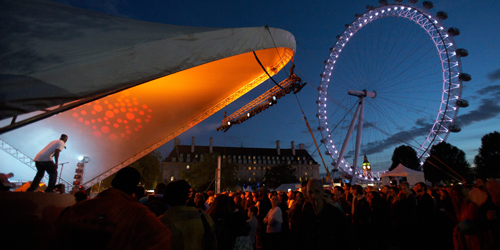 |
| Freedom Stage on Jubilee Gardens (2009) |
Cooperation for street art
Q : I heard that you visited the 2011 Goyang Lake Arts Festival, although it was a short visit. How do you think the Korean festival is different from the outdoor festivals of England? Or tell us how it felt being at a Korean festival.
A : It was an enjoyable visit with the performances and all. Above all, I thought the Korean audience was interesting. I watched to see how they react to performances and how much they enjoy themselves. I felt they were very different from the English audience. The Korean audience seems very close between different generations. In England, senior citizens are conservative (they always tell us only to softly say what is necessary), but at the Goyang Lake Festival, one old lady was very happy when a young artist suddenly jumped out during a Flash Mob performance and happily hugged and kissed audience. Seeing people attend the festival as families with their grandchildren also shows that there is a common ground that transcends generations. I think this is a power that greatly develops street art.
Q : What is the purpose of your visit to Korea?
A : For the past five years, we have introduced Korean pieces at the Thames Festival through the help of the Korean Culture Centre in London. I wanted to learn more about Korean culture and art through my visit. I look forward to smoother cooperation with Korea in the future through my visit.
Q : Is there something in particular you would like to do together with Korea?
A : I would like to create street art through cooperation. There are great street art organizations in England and Australia. If these organizations focus on cooperation with Korean organizations for around one month, I think we could end up with something new and interesting.
Thames Festival
The Thames Festival, held at the Thames River every September, is the largest outdoor arts festival of London. All the programs are free and a variety of programs are offered for participation by a wide range of people. Programs including music, dance, street art, fireworks and installation art take place in 9 public places around the River Thames during the festival. Around 570 arts organizations and artists participate in 2010, and more than 10,000 people participated in the education programs that are held year round.
 PREV
PREV
.JPG)
.jpg)
.jpg)
.jpg)
.jpg)












(0).jpg','The Thames Festival that opens at the Thames River..');)


