





Enabling Challenge and Experiment
[Who&Work] Seongjoo JOH _ Artistic Director of LIG Art Hall
[Who&Work] Seongjoo JOH _ Artistic Director of LIG Art Hall
Sitting in the center of Kangnam, the LIG Art Hall has been continuing various experimental works of diverse genres like theatre, music and dance since its foundation. Taking its operation, programming and production since 2006, its artistic director JOH was a choreographer and dancer by trade. She was the founding member of Dance Theatre ON, and the co-president of Dance Company Joepark. In addition, she participated, as artist, in the programs celebrating the grand opening of the LIG hall. Ever since taking over the role of artistic director in 2006, she has been concentrating on theater operation and programming. We sat down with her to hear about the present and the future of the art hall, which has been assisting various trials of young artists and producing experimental works.
|
|
|
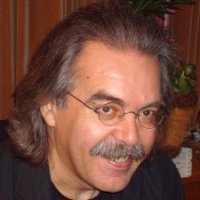
Seongjoo JOH |

"Aiming at Tailored Support"
Q: You are not an administrator. What are the merits and shortcomings you feel as field artist?
A:Actually, this job doesn’t feel that alien to me. I took charge of planning, administration and promotion before for a dance troupe and the Seoul International Dance Festival (SIDance). I didn’t find it much difficult to plan and operate performances. What troubled me most was how to communicate with the company that actually owns this hall. The owner company is a financial institution. Thus, I had to put artistic values in economic numbers. Otherwise, kind of hard to talk with them. Constant communication now smoothly and considerably helps understand each other. Other than this, more merits are there in running a theater as an artist. First of all, I understand what artists need and want more than anyone else. I also understand how works are made. I fully understand what are needed. That’s the biggest benefit I can think of. At least, I know what troubles them. So, I can practically help them. Moreover, there is a bond between artists. I am an artist as well. I listen to their stories as a colleague. It’s another merit.
Q: Your art hall produces its own pieces as well. It’s not that easy, we know. Why do you guys insist on your own production?
A: Actually, we have more support programs than ever. Institutionalized as a format, support systems are not that good in reality. What’s agonizing is artists have to compromise their colors and creations to get the help. Each artist pursues her work in a different way. Technical and production support should be different accordingly. It’s impossible one format fits all. We belong to the private sector. Thus, fairness doesn’t come first. What matters to us is how to independently and practically help them. We wanted to help them without distorting their goals. So, we decided to produce ourselves. Although not that big, we wish our hall should be the venue where artists realize what they really want. With that experience, they will get more strength and pursue their ways without compromise, I think.
Q: Your hall carries various genres. What is the ultimate artistic destination of your hall?
A: From its inception, our hall was to help young artists working in disadvantaged media or fields. We wanted to help the artists outside the mainstream. It’s hard sometimes to classify their works under the existing programs. In fact, the traditional way of distinguishing genres doesn’t mean much. Each artist pursuing her own voice and way of expression sets forth a new distinct genre, we believe. Our role is to find guys like this and to support them.
A:Actually, this job doesn’t feel that alien to me. I took charge of planning, administration and promotion before for a dance troupe and the Seoul International Dance Festival (SIDance). I didn’t find it much difficult to plan and operate performances. What troubled me most was how to communicate with the company that actually owns this hall. The owner company is a financial institution. Thus, I had to put artistic values in economic numbers. Otherwise, kind of hard to talk with them. Constant communication now smoothly and considerably helps understand each other. Other than this, more merits are there in running a theater as an artist. First of all, I understand what artists need and want more than anyone else. I also understand how works are made. I fully understand what are needed. That’s the biggest benefit I can think of. At least, I know what troubles them. So, I can practically help them. Moreover, there is a bond between artists. I am an artist as well. I listen to their stories as a colleague. It’s another merit.
Q: Your art hall produces its own pieces as well. It’s not that easy, we know. Why do you guys insist on your own production?
A: Actually, we have more support programs than ever. Institutionalized as a format, support systems are not that good in reality. What’s agonizing is artists have to compromise their colors and creations to get the help. Each artist pursues her work in a different way. Technical and production support should be different accordingly. It’s impossible one format fits all. We belong to the private sector. Thus, fairness doesn’t come first. What matters to us is how to independently and practically help them. We wanted to help them without distorting their goals. So, we decided to produce ourselves. Although not that big, we wish our hall should be the venue where artists realize what they really want. With that experience, they will get more strength and pursue their ways without compromise, I think.
Q: Your hall carries various genres. What is the ultimate artistic destination of your hall?
A: From its inception, our hall was to help young artists working in disadvantaged media or fields. We wanted to help the artists outside the mainstream. It’s hard sometimes to classify their works under the existing programs. In fact, the traditional way of distinguishing genres doesn’t mean much. Each artist pursuing her own voice and way of expression sets forth a new distinct genre, we believe. Our role is to find guys like this and to support them.
Another Creation for Creation
Q: Your hall launched the Residence-L program last year. Under it, support is given for two years. Now, three are in the program; namely, director Wha Jung KANG, composer Young-Gyu JANG and choreographer Park Young Cool. What are the qualifications to be eligible for the program?
A: Long-term, not short-term, support was in need to help artists make the best use of the space in our theater, and to pursue their own works. That was why it was designed. We didn’t solicit applicants in public. We found them ourselves among the artists. They showed their uncompromising artistic directions and beliefs. Rather than rookies, we prefer career artists who have set forth their goals and continued experiments not easily mingled in the general direction of experiment. We valued their uncompromising consistence. Among the eligible candidates, we chose the three who base their arts on physical, sound and visual media.
Q: It’s not easy to discover young artists. How do you locate them? What are the values you cherish most?
A: We conduct daily researches on active artists. In addition to our own daily research, we take more and more recommendations from those artists, producers and curators that we have worked with. Despite the career history, we greet the people who know what they want to do. Sometimes, we share their views, and other times we don’t. We, however, put away personal preferences. Instead, we reach out to those who know what they want to do. At the same time, we hope to show as many different personalities and trials as possible. Thus, when similar works are applied, we don’t introduce them all.
A: Long-term, not short-term, support was in need to help artists make the best use of the space in our theater, and to pursue their own works. That was why it was designed. We didn’t solicit applicants in public. We found them ourselves among the artists. They showed their uncompromising artistic directions and beliefs. Rather than rookies, we prefer career artists who have set forth their goals and continued experiments not easily mingled in the general direction of experiment. We valued their uncompromising consistence. Among the eligible candidates, we chose the three who base their arts on physical, sound and visual media.
Q: It’s not easy to discover young artists. How do you locate them? What are the values you cherish most?
A: We conduct daily researches on active artists. In addition to our own daily research, we take more and more recommendations from those artists, producers and curators that we have worked with. Despite the career history, we greet the people who know what they want to do. Sometimes, we share their views, and other times we don’t. We, however, put away personal preferences. Instead, we reach out to those who know what they want to do. At the same time, we hope to show as many different personalities and trials as possible. Thus, when similar works are applied, we don’t introduce them all.
|
|
| |
|
Flying Lesson (2011) |
Sound Designer (2010) |
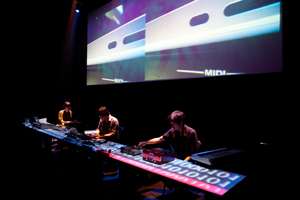
Q: This year, your hall opened another one in Busan? What’s its goals and how does it differ from the one in Seoul?
A: The LIG Art Hall is for giving opportunities to artists for experiment and creation. It’s a theater, though. Thus, we have to consider audience and locality. The Seoul hall is the optimized venue for artists, while the Busan hall is more for artists, audience and local communities. Thus, the latter is a lot different from the former. Along with the uncompromising artists, we also introduce as many artistic works focused on communication with audiences.
Q: Now, your hall publishes a quarterly Interview. What’s it for?
A: First of all, we have to advertise what works our halls host and will host. Then, we wish to initiate discussions on why these works are hosted. Additionally, we introduce artists who have not worked with us, but have their own artistic worlds or alternative spaces. The introduction will hopefully build some sort of psychological bond with those working in other places with different methods, and draw attention to them.
Q: How does the LIG Art Hall conduct global exchange?
A: Since 2008, we have worked with small-sized theaters in Japan and Canada. Under the biannual programs, a single contemporary dance is located from each of the countries, and his/her work is introduced. We are also preparing a sound art piece with the artists of the Great Britain and the Netherlands. Furthermore, we are conceiving an exchange program connecting Seoul, Europe and the Untied States in a triangle. But nothing is concrete yet.
Q: What are the biggest achievements and the biggest issue to address you have felt, running the hall for the past five years?
A: The biggest achievement is felt when people ask, "Does a big corporation really support this type of non-mainstream work?” and when fellow artists react after viewing a performance, “Wow, that work really put on stage!” We take pride in letting people know what’s generally impossible may be possible with some efforts.
We lag behind in two areas. One is community art, the topic that has emerged in our art scene ; participation program of local residents in creation. The attention and desire for community art is great. But practical know-how and precedents are seriously short. To realize community art, it is necessary to build social consensus on arts and widen the pool of those who enjoy them. In this context, premature trials won’t get us anywhere. We have to be prepared. Moreover, we are pondering how to attract participation of those who can be a partner with artists via writing in the presence of creation field.
Links
| LIG Art Hall Go
 PREV
PREV
.JPG)
.jpg)
.jpg)
.jpg)
.jpg)












.jpg','Sitting in the center of Kangnam, the LIG Art Hall..');)


