





[Who&Work] Fred Frumberg _ Executive Director of Amrita Performing Arts
Looking sturdy, Fred Frumberg is a middle-aged American. At a glance during the Performing Arts Market in Seoul(PAMS), he looked not that different from any other overseas producers. Once we introduced each other and exchanged our business cards, I got to look at him again. Written on the back of his card showing his title as executive director of the Amrita Performing Arts are his name and title in the Cambodian official language Khmer. Without any biological background or affinity to the country, he has dedicated his past 14 years to preservation and promotion of the traditional Cambodian performing arts. Knowing this, curiosity sprang up about his life. After the Asia Focus session of the PAMS ended, we interrupted him for an interview on his way to the official reception.
A: I volunteered for a UNESCO-hosted program when I worked in Europe as theatre and opera producer. It was for preserving and promoting Cambodian performing arts. Since then, I stayed there, and pursued various activities for the advancement.
|
|
| |
|
Fred Frumberg | ||
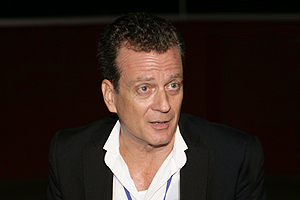
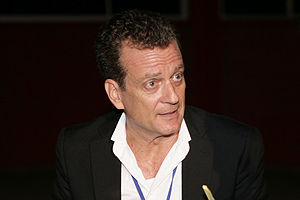
Q: Let’s go back a little bit further. How come you had flown over to Europe?
A: After college [He majored in theatre at the Temple University in Pennsylvania.], I started my career as manager. While working, I realized the huge gap between what I wanted to achieve through my career in performing arts and the actually commercialism-oriented system in the US. I kept asking myself, “Is this really what I want?” One day, I happened to work for a private opera troupe in Germany as production manager. It was fun. American performing arts are for satisfying as many audiences as possible. It’s geared up for stability, I would say. In Europe, I found out the attitude to take risks. Once I got attracted, I worked as theatre, opera and dance producer in Amsterdam, Prague and Paris.
After 10 years of working there, I became thirsty of something that could not be satisfied in Europe. I was looking for something more meaningful. Then, I got to know that the UNESCO was doing a program to preserve Cambodian performing arts. [The UNESCO designated the Cambodian traditional dance as World Heritage.] I flew over to Cambodia, and worked there for one year as volunteer. By the time, the program had already got me. I found out a true attraction in it, and decided not to go back to Europe. So, I stayed in Cambodia, and worked as independent consultant collaborating with the UNESCO.
Q: According to our records, the Amrita Performing Arts was founded in 2003.
A: That’s correct. Working as a UNESCO partner, I thought about a less bureaucratic environment. I believed it would be more efficient. At the end, I decided to found a non-profit organization, which is the Amrita Performing Arts. [Amrita is a Sanskrit referring to a mythological Indian water of eternity.] So, it is fair to say that I am its founder.
Q: What was your first impression of Cambodia? It must have felt foreign to Cambodians watching foreigners working to preserve Cambodian traditions.
A: As you know, Cambodia is a poor country. Few modern countries suffered more than this. The Khmer Rouge regime slaughtered more than 1.5 million Cambodians during a four-year period. On top of that, most Cambodian artists were executed just because its traditional arts were related to monarchism. Man, they lost so many, and the country suffered from tremendous evil. I don’t know why. But I feel comfortable in that country among Cambodians. In their eyes, I am an American, and may have been a hate figure. [The US government supplied arms to the Republic of Khmer from 1970 to 1975 till the emergence of the Khmer Rouge regime.] But they trusted and followed me. Shortly, I got on good terms with Cambodian children as well as adult citizens. The children I met in my earlier days are now grown up as the new artists leading the future of Cambodian arts.
Currently, the Cambodian government is preoccupied with rebuilding of the country. All resources are poured in economy-related areas. Restoration of culture and arts is outside its concern. The Cambodian government has no prejudice toward foreigners who make efforts to restore and develop culture and arts of Cambodia and is grateful to them.
Q: You must’ve done a lot to earn their trust. How did you approach them?
A: I should move toward them first. That way, they can rely on me. The support programs should continue. Actually, I had and still have lots of people working with me. Some of them, however, leave upon completion of a program. They seem to believe programs are one-time events. To restore the traditional arts of a country, it takes long-term efforts, time and capital. It should not be temporal in nature. Steady works are what we need.
What I do concerns restoration of culture and arts. But humans come before it. We have to talk with them, and get closer to their culture bit by bit.
Q: We know that you receive supports from non-profit organizations like the Rockefeller Foundation. How do you fund your programs?
A: At first, the foundation funded our project. But, not now. Individual donors mostly from the United States keep us afloat. Funding is reviewed every month. As head of our organization, fund-raising is one of the most important works of mine.
Q: Your work seems very meaningful. But many things may trouble you.
A: I’ve been away from my country for a long time. I miss my folks and old friends. My life, as is right now, is not easy at all. I’m 51. But I have no retirement plans. If I had wanted an easier life, it would have been definitely good for me to stay there. Now, what I do suffices enough to compensate for all the losses.
Q: What do you have to say to those who want to live like you?
A:Sharpen your goal! If it’s for personal mental satisfaction or for personal karma, take a couple of month off at the OSHO International Meditation Resort in India. You should feel the calling to better the world. And try to communicate with local folks.
In response to my silly question, “How do you think about a life as nomadic artistic producer?” he wisely answered: he goes where he is needed, and the question of “where” does not matter much to him. Those who enrich the world take a step ahead of people and keep the pace faster than them. After the interview, Frumberg went to attend a showcase prepared by the PAMS, skipping his dinner.
Fred Frumberg
Fred Frumberg is the founder of the Amrita Performing Arts, a non—profit organization dedicated to restoring traditional Cambodian culture and arts, and to advancement thereof through incorporating elements of contemporary performing arts. He is also committed to fostering of next-generation performing artists, collaboration with artists around the world, and research on Cambodian performing arts. Prior to settling down in Cambodia, he worked for 10 years as opera or theatre production manager or producer in the Untied States and Europe.
 PREV
PREV

.JPG)
.jpg)
.jpg)
.jpg)
.jpg)












;)


