





To Another Direction: a bold attempt of modern dance
[Who&Work] Chang-ho SHIN _ Choreographer of the Laboratory Dance Project
[Who&Work] Chang-ho SHIN _ Choreographer of the Laboratory Dance Project
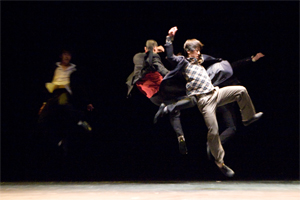
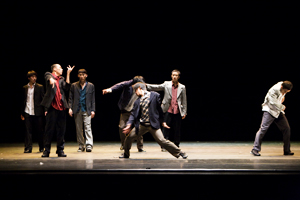
No Comment, choreographed by Chang-ho SHIN, was invited to the 79th Jacob’s Pillow Dance Festival, which is one of the first contemporary dance festivals in the U.S. There were two other contemporary dance performances choreographed by Korean artists that were invited to the festival: Are You Happy to See Me? by Mi-Sook JEON and Modern Feeling by Insu LEE. KAMS sat down with Shin, the leader of Laboratory Dance Project (LDP) who returned from the U.S. after a successful performance.
LDP, Dancing the Other Way Around
Q: WTell our readers how you started dancing.A: I got into dancing when I was 17 years old. My mother majored in ballet and I was influenced by my mother’s background. I went straight to contemporary dance instead of starting with ballet. It was my mother who encouraged me to study contemporary dance where you have more freedom in the way you move your body and more room for creativity.
I joined LDP at its startup in 2001 as a regular member after I finished my undergraduate and graduate degree at The Korean National University of Arts from 1996 to 2001. Since 2002, I started broadening my spectrum to stages overseas. I was part of Dance Company St. Gallen,which is based in Switzerland in 2005 and 2006, and that’s when I met Philipp Egli. We choreographed Patterns on Impressions together and performed at the Festival Antigel in Switzerland in February 2011. The following May, we performed at the International Modern Dance Festival (MODAFE).
Q: Tell us about LDP’s work. What are some common interests LDP’s members share?
A: LDP started out with the motto ‘Challenge the existing contemporary dance scene in a creative manner,’ and ten of us were graduates of The Korean National University of Arts. Our purpose was to put new ideas and experiments into our performance. We were ready to try new ideas even at the cost of losing a stage or getting harsh criticismfrom the audience or critics. We would put H beams from a construction site on stage, or dance in front of a huge panel of painting with our backs turned against the audience. We engaged with artists outside of Korea from the start of LDP. Micha Pruker, Iztok Kovac and Ismael Ivo are some of the artists who worked with us. Our main focus lies in finding ways to connect and relate with the audience and communicate on a deeper level through dancing. Dance performance in general has a limited audience base, and most of the time the public thinks dancing has nothing to do with their lives, that it’s too complicated. To bring contemporary dance closer to the audience, LDP is actively involved in commercial collaborations with different genres and performing for the audience in secluded areas.
|
|
| |
|
Chang-ho SHIN |
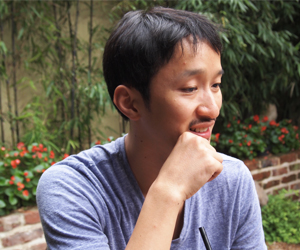
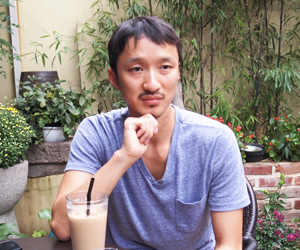
Reconstructing a Personal Experience’
Q: As a choreographer, where do you get your inspirations and ideas? A: There are all sorts of things that give me inspirations from books, newspapers and advertisements, to photography and television. It’s usually visual images that spur me into creativity. Of course I don’t directly portray the image and the story relating to the image. I start with the feeling and emotions which surface at the moment I come across a certain image, and then I put my own interpretation of the impact it brings. My personal experience becomes the motif under the concept of reconstruction of personal experience.
The making of No Comment began from a news report on TV. It was an image of a man in Iraq in the midst of war. He lost all of his family when his town was bombed. Pushed to the limit, he was sobbing his heart out. That image had a great impact on me, and I put that powerful impact into my artwork. The inspiration for a piece called Platform came from my trip to Eastern Europe. The people I met on a platform of the train station seemed to have this shared sentiment characterized as an East European gloom, which is a contrast to their bright, cheerful music. That place at that moment and the cultural emotion of light being a curefor the dark made an impression on me and is whatmade me create Platform.
Q: If the war in Iraq was where you got the motif of No Comment, is it safe to say the piece reflects your personal opinion on a socio-political matter?
A: No Comment is about the stimulus and the life force shown in the desperation of a human going through war. It doesn’t carry anti-war, anti-U.S. sentiment or any other political message.It may be important for an artist to portray the voice of his time through his work, but I lean towards a more neutralapproach, focusing on the fundamentals of human life. The same goes for religion. I plan to choreograph a piece about the stories in the Bible, but my work won’t be delivering the stories and the message on stage. I want to take the Bible as a motif and communicate with the audience on a subject that can bring out an emotional bond and leave space for individual interpretation.
A British choreographer called Lloyed Newson (the Artistic Director of DV8 Physical Theatre) has worked with a number of pieces about homosexuality and the physically challenged, raising questions on the discrimination of our society against minorities. I, too, would like to take on the role of causing people to question by reminding the audience of an issue rather than feeding them my opinion or giving them solutions.
|
|
| |
|
No Comment |
Co-existence: Sound and Dancing
Q: After showing in Portland in the U.S.A in March, the local media wrote about No Comment that “the movement is tied to the music – by the Serbian world-music composer Goran Bregovic and the London-based group Trans-global Underground….” In LDP’s work, how do you see music and choreography? A: We put stress on the music as much as we focus on the movements of the body. I would say the music and the dance is about 50:50. Music is a very important part in a piece – it is not just what backs up the choreography and the dancers, but it also leads the piece. I listen to a variety of music and a lot of world music artists. In music, I think about how I can make the audience relate to the piece with the universal concept of the coexistence of sound and movement. So I pay attention to what I hear, and if I find something I like or something I that would like to work with for my piece, I could go the extra mile to find out about the music.
Q: Can you tell us a little bit about your next piece?
A: I am working on a piece about ‘mothers’, and the piece will be on stage in 2012. I am interested in ‘Chi’ and ‘Danjeon,’ (the lower belly, one of the channels of a human body where Chi, the inner energy, passes through) and a mother’s womb where life begins seems close to the image of ‘Danjeon’. The piece is about mothers, but it isn’t a tearful storytelling type of work: I tried to express the interaction between mother and child through bodily movements. I’m still researching on motifs, and I am trying to come up with a good way to communicate with the audience on motherhood. I look at other artworks about motherhood, and I often observe how my mother acts and I pay more attention to what she says even though I normally wouldn’t listen to her enthusiastically. (Laughs)
Q: There have been many types of collaboration tried recently between different art genres.
A: LDP dancers do works of collaboration with different types of arts, but most of them are mainly focused on the movement of the body. There isn’t enough understanding about arts or media and other genres yet, but I feel the need to study to broaden the horizon of my future works.
Q: What is your dream as an artist?
A: Pina Bausch produced an artwork that has an impact that lasted through a century. I also want to be an artist that sets the course of trends and issues in the dancing community, and that is probably the dream of any choreographer. (Laughs)
 PREV
PREV
.JPG)
.jpg)
.jpg)
.jpg)
.jpg)












.jpg','No Comment, choreographed by Chang-ho SHIN, was in..');)


