





Human Body and Space: Designing the Stage
[Who&Work] Young-jun AN _ Choreographer of Physical Design Project Company
[Who&Work] Young-jun AN _ Choreographer of Physical Design Project Company
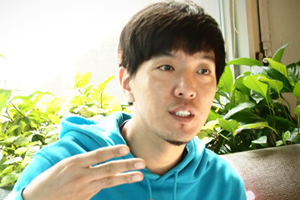
Young-jun AN is a professional choreographer, who has won many awards throughout his career, including the Premier Prix (Grand Prize) in contemporary male dance at the 2000 Paris International Dance Competition, as well as, the award for “Best Dance Performance” at the 2009 CJ Young Festival. He established the Physical Design Project Company (PDPC) in 2009; it mainly considers the human body as a tool for compositional space. As contemporary dance is usually regarded as a difficult form of art for the public to interpret, Young-jun AN eagerly creates simplicity in dance, making it easy to enjoy.
Faith in the Human Body
Q: What motivated you to start dancing?A: I didn’t think that dance was my calling when I was a child. I’d rather say that it just happened to me. I actually enjoyed painting in my childhood. I wanted to reproduce my favorite cartoons, so I practiced and I was quite good. My parents wanted me to take a private art class, but the circumstances didn’t allow me to do that, so I learned it from my middle school art teacher. When I was in high school, I learned interior design as vocational preparation. But my older cousin casually suggested that I dance because I’m tall and have a lean physique. So I started dancing.
Q: Usually people don’t just start dancing only because they are tall and have a lean physique, I think. (Laughed). What was it like when you started dancing?
A: Because I already had a lot of experience with Korean Martial Arts, Tae Kwon-do, I didn’t have much trouble getting started. I majored in dancing at university, but I hardly attended the class. Thanks to the notion that dance must be unconstrained and free, I preferred to network with people from visiting organizations because that was fun, rather than attending the school’s class. I once worked at the Trust Dance Company which is directed by Artistic Director Hyeong-Hee Kim, and usually, I spent my time like that. I don’t like to settle for what’s been handed to me. I am quite fond of finding meaning in what I do through the process of the work. I didn’t make the decision to become a choreographer at a certain moment, but I was just a natural choreographer from the start and I wanted to create things as a choreographer. Even though my vocation is dance, I have many more friends in many different fields, not just in the dancing field, and I like to interact with them. This helps my work to remove the limitations of what I can do and broadens my mind.
|
|
| |
|
Young-jun AN |

Q: You created PDPC in 2009. What was your motivation for founding it; and what is its aim?
A: First of all, as one can find the company’s meaning in its name, the concepts of “design” and “physical” are very important to me. In dance, the priority is the human body, and so dance should begin from the body. The concept of “design” came to me naturally when I was studying the arts. To me, dance is the design, the action of the human body within a certain space, and the choreographer is the one who designs it. I didn’t want to follow someone else’s method but wanted to create my own way, or path. My faith in the human body made me name it the Physical Design Project Company.
And to talk about the aim of the company, like I mentioned before, I really don’t have any special aim or objective because I’m devoted to the “process” itself without particular goals. And I also like to have new challenges, too. Because of the depths of meaning, I prefer to use the phrase “contemporary dance” rather than “dance”. In contemporary dance, anything is acceptable and you can express whatever you have in your mind. It is very raw, has no limitation, and can be done in barefoot. Those are the good points of contemporary dance. I think that contemporary dance is one of the very rare vocations that you can do in barefoot. Dancing is a language of my own expression, and I want to enjoy it. So I intentionally have the classes for the public, and choreograph musicals. However, I want to make my own work, maybe one piece per year. Since I prefer to concentrate on each step of the process, I really can’t produce work abundantly. However, people keep asking me what I have that’s new, but I think that is a little bit hasty.
Q: How do you map your project? And what kind of media helps you to do this?
A: I don’t think that any specific media particularly helps me. What I constantly think about are brought into shape through other measures. I always think about things, but many times it is not easy to give it form. Sometimes I read a book, focus on what an author felt, feel touched by it, and want to show others what’s in my mind. I have liked J.D. Salinger after I read The Catcher in the Rye. I really don’t know about Salinger, but I admired the way he looked at the world, standing at the different sides of people; and I’m trying to read other books of his. I read a book, and penetrate it to see what the author likes and what s/he thinks. Sometimes I feel like I’m a stalker. (Laughed)
|
|
| |||
|
Musical chairs |
| |||
Talking about Prying Eyes
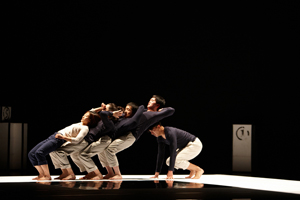
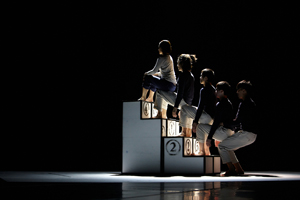
Q: Could you explain about your recent work, Musical Chairs? A: I once choreographed the dance festival while I was teaching at a university. Personally, it was really a valuable experience for me, because you usually have to work with more than ten people, and it is very rare to meet various kinds of people. Musical Chairs is originally from a ten minute project; the idea came from student group work. The name of that project was Musical Chairs, too. I looked for a chance to give shape to this work. The recent work uses an object ‘box’, but in the previous work, the dancers themselves expressed the box. Musical Chairs is on the same line of the work I have done up to now. My work Frame deals with my agony about the body. Even if modern dance is very hard and uninteresting, I want to find a way to purely express the body through it. Next work Scanning Line is a split version of frame. Streaming Out is based on the assumption that the human body is fluid, and is also a continuation of the work on Musical Chairs too.
But, Musical Chairs has additional steps on a philosophical issue: an observation of other people. Can we be sure if the judgments of people on ‘different’ things are right or not? Can we be sure that the majority’s viewpoint is always right, and can the minority’s opinion be right? When I was younger, I used to talk about existence somewhat simply. But now, I tend to talk about the other side, or hidden side, of things, and what I have known, as I find unfound meanings.
Q: When you apply the PAMS Choice, are there any countries in which you are especially interested?
A: Not really, but I have visited Europe frequently since when I was young. I dreamed of working in a European dance company as a dancer in the past, but now, as a choreographer, I just want to test myself in that area. I want to check how far my work has come, where it is. If it is not able to work in Europe, then working in Korea and bringing them to Europe will be a fine option.
Q: What do you want to deliver in the future?
A: Nothing is determined yet, but I want to deal with a light subject which also could be perceived as heavy, rather than just heavy subjects. I think social issues are still too heavy for now. I want to tell the stories which I can express sincerely. I’m not ready to handle such heavy issues. Once more, I don’t set a specific direction on my works. I want to talk about what I feel in each moment.
LINK:
| Production information of Musical Chairs GO
| Company Information of Physical Design Project Company GO
Translator: Wontae Kim, Student, Department of English Interpretation and Translation, Hankuk University of Foreign Studies
Translation Editor: Professor Ayshia E Stephenson, Department of English Interpretation and Translation, Hankuk University of Foreign Studies
| Production information of Musical Chairs GO
| Company Information of Physical Design Project Company GO
Translator: Wontae Kim, Student, Department of English Interpretation and Translation, Hankuk University of Foreign Studies
Translation Editor: Professor Ayshia E Stephenson, Department of English Interpretation and Translation, Hankuk University of Foreign Studies
 PREV
PREV
.JPG)
.jpg)
.jpg)
.jpg)
.jpg)












(0).jpg','Young-jun AN is a professional choreographer, who ..');)


