





A clown searching for truth
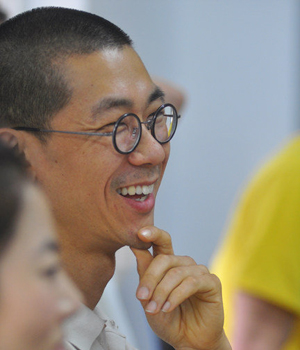
[Who&Work] Yosup BAE _ Director of Performance Group Tuida
[Who&Work] Yosup BAE _ Director of Performance Group Tuida
The Performance Group Tuida (hereinafter Tuida) is a performance group formed in 2001 through the primary members who were Korea National University of Arts classmates majoring in theater. Just as the title "Tuida" (run) suggests, they are diligently running towards their goal as they have been getting good reviews from critics and audiences since their founding. In June 2010, the members of the group and family have moved their "Creative space" and "Living space" to an abandoned school in Hwacheon, Gangwon-do, and are in the process of searching for new possibilities of theater in a regional area. Thou Canst Not Say I Did It is the third PAMS Choice work following the works of Tuida following the works Hamlet Cantabile in 2008, and The Tale of Haruk in 2006.
Putting the universe into the body of a performer
Q: I am curious to know what the secret is to creating fresh new names like "Performance Group Tuida", "Garden of Art in Hwachoen Village", and "Hamlet Cantabile." A: We are not really talented in coming up with titles. Most of the times we stay up nights and end up back to square one. Actually, good titles suddenly fall into our laps out of nowhere. After days or even months of discussions, quarrels, votes, and other random things to come up with the title, we are often still left without a decision, then one morning the title is in our hands like magic. The idea first comes from someone in particular, but at the moment it comes out everyone shouts "That''s it!" and it becomes everyone''s idea.
Q: I''ve heard that you''ve switched your focus from a physicist to creative artist and I am curious to know why you wanted to be a physicist in your childhood. In retrospect, were there any connections between physics and theater or creative act?
A: I was curious about the origins of the universe. I wanted know how the universe became filled with such darkness, and how the planets and life came to being in the midst of that darkness. It felt like I would be able to accept the life forms living on this Earth, and the awful and unacceptable reality of the Earth if knew how things came into being. I thought the source of this question would be most related to physics. And it was actually true. Physics is a very logical and empirical study. This is because the study is based in matter. But, there is a huge gap between such ideas and theories. It is like stepping-stone floating in the vast space. There needs to be a mythical imagination to connect the two. And sometimes it requires blind faith.
It is the body of a performer that I''ve set as the starting point. I am exploring this aspect with the belief that the universe is contained within the body based in matter. I believe I can get to the source if I sharpen, pacify, analyze, and train the body. From this, I wish to accept the reality of having to kill a loved one, evil condemning the good, and being unable to break the chain of death.
|
| ||
|
Yosup BAE | ||
Clown and Macbeth
Q: I heard Tuida has started the training of clown acting since the making of Hamlet Cantabile in 2005, and the artwork that was presented at the 2009 "International Clown Workshop" became the starting point of Thou Canst Not Say I Did It. Could you tell me about the process? A: Clown training began with The Tale of Haruk. The clown is a messenger that links the audience with the story. The last ten years, we have been training extensively to study the nature of clowns. During that time, we came to know Professor Eli Simon from the state University of California, Irvine, and we were able to have the clown workshop together after a few meetings. He stayed with us for a week and worked among the actors with the text called "Macbeth." This work was unique to Simon who experienced the meeting of tragedy and clown for the first time. He created scenes with stunning images through our actors. 40 minute work was shown with only 5 days of practice. Inspired by those results, I began to ask, "What would it be like to develop this into a more grotesque and gloomy artwork?" In fact, Macbeth was kind of already used up. It wasn''t exciting. Macbeth is an image of myth that was created to erase the reality, and the reality that needed to be erased was probably the people who were slain during the reversing process of power. Eventually, our interest was focused on revealing the reality to the surface, and the actors had be become clowns that treacherously dug up the truth.
Q: What was the main focus during the process of turning the workshop artwork into a performance, and how did you develop the artwork?
A: The 2nd text which we newly selected was about modern Korean history. As I was learning with the actors about the modern Korean history after the Korean War, I asked them again what Macbeth is to us now. Macbeth simply seems to have been dictator overthrown due to his desire for power. He is the Libya''s Muammar Gaddafi , Myanmar''s Than Shwe, China''s Hu Jintao, North Korea''s Kim Jong Il, Sudan''s Omar Hasan Ahmad al-Bashir, and Saudi Arabia''s Abdullah Bin Abdul Aziz. And who do we have? The string of names of our former presidents come to mind. We decided on the reality of Gwangju incident in 1980, out of all the forgotten memories within our modern history. We were able to weave the capitalism and nationalism, and free economy that were erased by mythical imagination together with the 1st text of Macbeth. We once again ask the question towards the end of work. Isn''t Macbeth to us now, actually more than this? What is this to you really? We end up returning to more personal questions.
|
|
| |
|
Thou Canst Not Say I Did It | ||
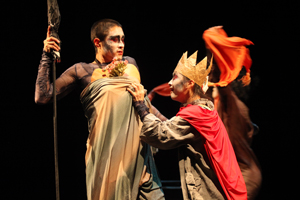
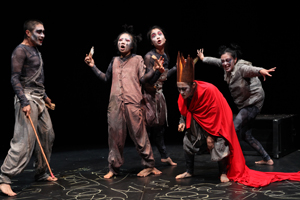
Q: The stage set, costumes, and so on were great, but there were many audiences that especially found the live music memorable from Thou Canst Not Say I Did It. I want to know how you collaborate with the creator.
A: I collaborated with Yohm Project for this work. This was our second time working together, and we create most of the music through improvisation. They are very talented musicians especially with improvisation. Sometimes, we make improvised scenes without the actual design of the scene with only a few key words, and other times we create the music through moment by moment improvisation as we view the scene. Then, we fine tune and develop the music that came from the improvisation practice. Many parts are discarded from this process. This time, we dragged the members out on to the stage in clown costumes as well. This is because the actors and they belong together since the beginning. They are not just the accompanists playing music for the actors, but they themselves are the clowns that shout out to the audience along with the actors.
Exchange, in the midst of workingmen''s trust
Q: I believe this is your first creative work since the move to Hwacheon in 2010, What kind of influence did the move to Hwacheon bring to your work? Has anything changed from before? A: Strictly speaking, this work was created during the moving process from Uijeongbu to Hwacheon. The research work was done as we were surrounded by cold concrete and noise from cars, and we moved to Hwacheon after the endless times of improvisation were finished. The summer was spent rubbing on dirt, cutting wood, and painting as we listened to the songs of cicadas and bugs. The nature viewed through the small window of the finished rehearsal room after hard labor was more pure, higher, and beautiful. The peaceful scenery, soft wind, distant and compassionate stars were keeping us safe. But, in the midst, we had to come face to face with greedy, dirty, gruesome, cruel, and cowardly nature of man. We were throwing unanswerable questions and wandered in their abyss.
The life in Hwacheon requires a new attitude. Everyday life makes you meet with the earth, look up to the heavens, observe the grass and trees, and come face to face with all kinds of waste created by man. Only then the so called play comes to life. If you can''t understand and accept these things, your mind and body will not be able to cope. Plays aren''t just about getting up on the stage. There is lack of meaning in just producing a work. I came to realize that play exists only when one can look upon the way everyday life is maintained and overcome the sight of it as another part of nature.
Q: Tuida has many experiences of international exchanges. I am curious to know what kind of meaning comes from the exchanges from foreign and not audiences within the country, and also foreign creative groups. If you can give a word of advice to artists following in your footsteps as they are just getting into international exchanges, what would it be?
A: We have been met with many foreign audiences in the past, but exchanges with foreign creative groups are fairly recent. Through the meetings with audiences from abroad, we were reevaluated. Fortunately, they have embraced us in positive light as is, without prejudice. We don''t really know the reason, but we were able to continue the play because of it. The exchange with foreign creative groups is playing an important role in Tuida''s jump into a new phase. This isn''t only limited to overseas. Collaboration with other groups within the country has the same meaning as well. This opportunity came from continuous experiments and collected creative methodology rather than the actual creation of artworks. After firmly building one''s own framework, there comes a time when that framework has to be broken down. When this time comes, in light of this similar contemplation, the meeting with other groups happens naturally as they are also going through attempts and failures in diverse experiments. Currently, we are preparing to or collaborating with Adishakti Theater Company in India, Bird Theater in Japan, Trust Dance Company, and Shimyoung in Korea. The collaboration starts with exchanging creative methods, but it can lead to co-producing of artwork if the partnership works well. What is important is that new things come into being as the existing and the different come together. This must be done within the trust of the workingmen. It must be about trusting, stepping up, and raising up from such details.
Q: What is the ultimate value or message that you would like to convey to the world through your creative activities?
A: I wish for myself to see the truth through plays. Just like the Krishna who appeared before Arjuna, I wish to see everything through plays and the life that I''ve lived.
* Arjuna and Krishna: An Indian god within the Indian scriptures, 『Mahavira』. It is a story about how the horseman Krishna, incarnation of Visnu, end up leading Arjuna to the right path through advice and counsel in order to remind him the true meaning of victory when the warrior Arjuna was in despair due to his own destiny and brutal war.
 PREV
PREV
.JPG)
.jpg)
.jpg)
.jpg)
.jpg)












 is..');)


