





Young and Stubborn Tradition
[Who&Work] Jae-hyun Chun, Director of Jeong Ga Ak Hoe
[Who&Work] Jae-hyun Chun, Director of Jeong Ga Ak Hoe
Jeong Ga Ak Hoe is a Korean classical music group founded in 2000. They have been actively performing music based on classical, Julpungnyu, traditional, and music with depth and creativity. The traditional music and original play made public through their concerts and recordings are based on the Jeong Ga Ak Hoe''s sounds coming from their unique complexity. The group is also getting great reviews as bringing breath of fresh air into the world of music. I met the President of Jeong Ga Ak Hoe, Jae-hyung CHUN, who is being cautious in every respect to become the model in integrating traditional music with modern trends.
We Challenge Because People Get Bored
Q: Would you tell us about Jeong Ga Ak Hoe? How was it born and what does the name mean?
A: Gagok (traditional Korean vocal music), Gasa (traditional Korean verse), and Sijo (traditional Korean ode) are collectively termed Jeong ga (meaning, in Chinese character, right and song, respectively). Here, the character “jeong” (正) is ethical and philosophical ideologies. We wanted to pursue young and human music, focusing on the traditional Gagok and Julpungnyu , and named ourselves Jeong Ga. Here, Jeong means not rightness(正), but heart(情) in Chinese character. Finally, we settled in the name Jeong Ga Ak Hoe which means an ensemble of Jeong ga. Still, some believe our name is old-fashioned. But we think differently. Our name does not get in the way. We believe we can still talk with people. People don’t like the traditional music much, and that discourages artists from this genre. But we have decided to stick to it in earnest. Our decision has lasted for the last ten years. But we feel we have to go a long way.
A: Gagok (traditional Korean vocal music), Gasa (traditional Korean verse), and Sijo (traditional Korean ode) are collectively termed Jeong ga (meaning, in Chinese character, right and song, respectively). Here, the character “jeong” (正) is ethical and philosophical ideologies. We wanted to pursue young and human music, focusing on the traditional Gagok and Julpungnyu , and named ourselves Jeong Ga. Here, Jeong means not rightness(正), but heart(情) in Chinese character. Finally, we settled in the name Jeong Ga Ak Hoe which means an ensemble of Jeong ga. Still, some believe our name is old-fashioned. But we think differently. Our name does not get in the way. We believe we can still talk with people. People don’t like the traditional music much, and that discourages artists from this genre. But we have decided to stick to it in earnest. Our decision has lasted for the last ten years. But we feel we have to go a long way.
|
|
|
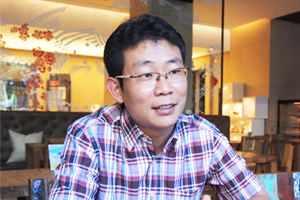
Jae-hyun Chun |
Q: What characterize your music?
A: PFirst of all, Jeong ga does not center our music. Our music is more of Gagok. The former, we believe, represents ideology and philosophy, not a genre. In ancient times, people cultured themselves through correct music, or Jeong ak. In the 50s and 60s, some preoccupied this concept, and it spun into two categories: correct music and something incorrect. Personally, it is wrong to divide ideological conflicts and classes out of music.
We liked the fact that Gagok contains lyrics. For us, Gagok sounds comfortable and needs lots of resonance. It’s kind of difficult to compare it with others. But we felt Gagok luxurious and believed we could raise our quality level through practice. We loved music so much, and thought we should practice the parts people felt boring. Jeong ga or Julpungnyu , the sound played with traditional instruments carries the pleasure of filling hollow space by performers and the pleasure of feeling and sharing their breaths.
Q: Among various traditional genres, Gagok feels boring and difficult to the public. What are your tips for appreciating it?
A: When there’s music, people basically desire to hear lyrics. When it comes to Gagok, words do not hear well. Lots of Chinese characters are in it, and that’s the problem, we think. To be able to enjoy it, we have to know about it and study for it. Some may doubt the need to study to appreciate music. We wish to say, the more knowledge you have, the more you hear, in some cases. Once you enter into this genre for sensational pleasure, we pick up more and more of it. It’s amazing. For this feature, Gagok is often termed as music of writers. It needs studying for modern people to enjoy it the way ancient writers enjoyed it.
We Challenge Because People Get Bored
Q: If that is the case, have you designed any devices in the present work Jeong Ga Ak Hoe Meets World Literature to heighten people’s desire? How do you feel about the changes occurring out of meeting with literature?
A:We conceived Jeong Ga Ak Hoe Meets World Literature to hold a cordial concert. We didn’t intend to fuse modern elements into our music. That was the uncompromising principle of ours. At the same time, we thought about how to shorten the distance between audiences and us. For example, we played the 3-line poem 11th lunar month for ten minutes as a song. In there, we inserted the word or 11th lunar month at the 11th time. But people did not pick it up. So, we added visual elements. Arranging words to the tempo, we were able to present the words in a savvy way. Compared with other literary genres, we thought we could deliver nuisance as well. Our music is not that pre-calculated. Music is for delivering emotions. Thus, we don’t tighten it up too much, and have the audience fill the unfilled room.
Playing the traditional music is the league of our own. We don’t turn it into a fusion or world music just to meet the public. If we wish to insist on our own way, we have to play our music to literature fans. This is, we believe, how we widen our horizon, doing our own music.
A:We conceived Jeong Ga Ak Hoe Meets World Literature to hold a cordial concert. We didn’t intend to fuse modern elements into our music. That was the uncompromising principle of ours. At the same time, we thought about how to shorten the distance between audiences and us. For example, we played the 3-line poem 11th lunar month for ten minutes as a song. In there, we inserted the word or 11th lunar month at the 11th time. But people did not pick it up. So, we added visual elements. Arranging words to the tempo, we were able to present the words in a savvy way. Compared with other literary genres, we thought we could deliver nuisance as well. Our music is not that pre-calculated. Music is for delivering emotions. Thus, we don’t tighten it up too much, and have the audience fill the unfilled room.
Playing the traditional music is the league of our own. We don’t turn it into a fusion or world music just to meet the public. If we wish to insist on our own way, we have to play our music to literature fans. This is, we believe, how we widen our horizon, doing our own music.
|
|
| |
|
Jeong Ga Ak Hoe Meets World Literature | ||
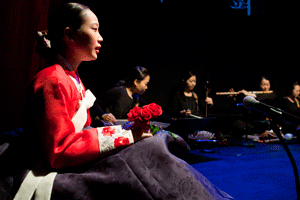
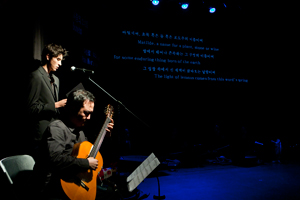
Q: How do you choose a literary piece? If you should meet an overseas piece, it would lead to an attractive international work. How do you think?
A:First, we have our own outline of stories. Within the frame, we are searching for music and poems lying within it. The same is true of overseas pieces. We look for literary works within the frame, and get helps along the search. We pick our own choices. Others can’t do it. It should be done by those who understand our musical emotions. Fortunately, recommendations have worked in some cases. When we visited Peru in 2009, we only worked with the poems of renowned Peruvian poet. It was very meaningful. Our Peruvian host was also excited about a foreign artist group working on Peruvian art pieces. It may be an example of collaboration. But the opportunity didn’t come easy.
Q: What are the key focuses guiding Jeong Ga Ak Hoe’s works? It must be agonizing between keeping tradition and modernization.
A:Thinking about how the traditional music is played, it has not advanced much. It is still a form of music to be played within a hanok (traditional house). That is why people talk about whether to change it after so many years of burial. The wind against change is strong among those who have kept the tradition sturdily. But the discussion is continuing. The unchanged form of traditional music has the capability of playing only at hanok. It is deliverable only through musical breath. So, it is inappropriate for a theater performance. Putting it my own way, it would feel like a farmer standing in the middle of an urban town in tuxedo. People tend to believe that the traditional music is outdated whatever it may try. So, we tried it in a space stripped of sound system. Then, we started looking for a small space like hanok. That’s where the effects of the music are optimal. Sound system didn’t develop for our traditional music. In addition, they are not for carrying breath. So, in our earlier days, we designed our performances without technical assistance. Then, we began to try methods, not the music itself, to meet new audiences at theaters. The delivering method met with modern music and with dance. At the same time, our music has changed bit by bit. Various interesting trials have been made. Along the way, sometimes people criticized, and others praised. We took them all in, and searched for ways to present to the public in diverse fashions. That agony of ours built up strength inside us. We will keep agonizing whether to modernize traditional music and, if so, how to do it. We also wish to communicate a lot with those who agonize over the same issues.
Links
| Production information of Jeong Ga Ak Hoe Meets World Literature Go
| Company information of Jeong Ga Ak Hoe Go
 PREV
PREV
.JPG)
.jpg)
.jpg)
.jpg)
.jpg)












.jpg','Jeong Ga Ak Hoe is a Korean classical music group ..');)


