





The Poem Written by Materialism of Body and Words
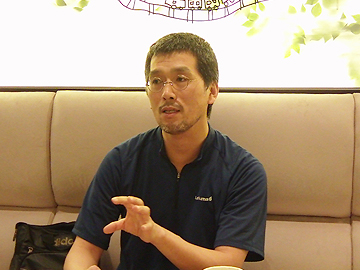
[Who&Work] Yang-won KANG, Director of DONG Theatre Company
[Who&Work] Yang-won KANG, Director of DONG Theatre Company
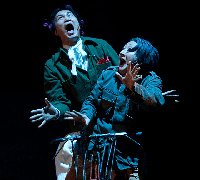
The Inspector, the drama company Dong’s adaptation of Gogol’s The Inspector. Since its first performance in January of 2010, it was chosen as one of the 3 BEST Plays of the year in 2010 by The Korean Association of Theatre Critics, and as a PAMS Choice in 2011 by the Performing Arts Market in Seoul. We sat down with director Yang-won KANG of DONG Theatre Company, who is showing the creative piece Noodle Restaurant in Sangju at the small theater in cooperation with the National Theatre Company of Korea.
The inspector is not appeared on stage
Q: How was your work The Inspector born and what are your messages in it?A: Most people think The Inspector originates from Gogol’s The Government Inspector. Actually, it originates from the version directed by Meyerhold. Meyerhold pursued the most theatrical performance, and we found out how to instantly communicate with audience. The methodology lies in theatrical performance of theatrecalism. We realized the idea in the form of a Namsadang play which is a traditional Korean performance played by an itinerant troupe of male performers.
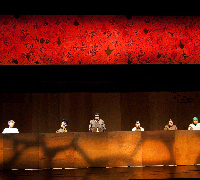
At the same time, we tried to stick to the contemporaneousness and criticism contained in the original drama. Characters’ dialogs bridge the content of the drama with our contemporary situations. But the finale doesn’t end in the form of traditional Korean festival. It takes the form of American music hall. That way, we wish to reveal the distorted aspect of our culture. No government agency or police appear in The Inspector by DONG Theatre Company. The main character is missing here. The secret agency is the “obsessing thoughts” that infiltrate into us, and control us as master.
It is important to determine which theatrical form and taster to use for communication with audiences. Sometimes, material senses become the media, while in other times rationality bridges the communication. The Inspector takes the former. We wanted to surprise and excite audience before they think.
|
|
|
Yang-won KANG |
Q: The Inspector and other works of DONG Theatre Company balance harmony between resonance of unfamiliar, restrained language and physical motions. They feel like visually expressed poems. What are the relations between body and language in theatre?
A: We focus on the material characteristics of human utterance like tone, color or degree of force. We don’t try to melt it into the characteristics of a human body, though. Rather, we try to juxtapose it with them. In other words, when language is soft, strong physical gestures come out. When words are strong, soft actions follow. It’s like that. Diverse and sometimes conflicting characteristics coexist in a human. We caution ourselves against defining a phenomenon or a character in a single word. In this context, we present a phenomenon or a character on stage from various angles, and design language and act not to correspond to each other. Interpretation? It is what audiences do. What directors do is let them find out their own meanings. This is what constitutes the core of theatrical experience, I believe.
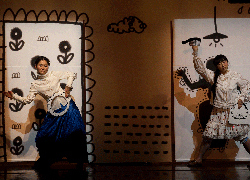
In The Inspector, language and body are used in various scenes in various ways. In the puppet play scene, actors and actresses play puppets. In this particular scene, what puppets say is originally uttered by the puppet controller. So, a single actor plays the role of the controller as well as that of puppet. To carry that out, an actress performs her body as that of puppet and that of the controller. Like this, we enjoy rhythms and tempos different from bodies.
Codesign by Director and Actor
Q: How does DONG Theatre Company direct works and what are its features?A: Our company doesn’t stick to the traditional roles of director and actor. Directing and acting crews get together, discuss and study together, and are building their common language. Still, our search is going on, and audiences feel unfamiliar from time to time. Maybe, we’re enjoying the process. We want to always meet our audiences in a fresher way, and to turn the theatrical stage into a new space. That’s what it means by fresher meeting, we believe.
We’ve named the common language “unit,” the language we are building with directors and actors. Like building a home by laying bricks after bricks, we build our entire work with units. Our unit also enables communication with audiences, and the size or the form of the unit for each piece changes. In a problem play, a few minutes of speech act reflecting a thought constitutes a unit. On the other hand, a piece of passing feeling may make a unit in a work exploring the human mind. Usually, the director proposes a synopsis, and the actors set up the synopsis as unit. Then, the director gives back its feedback. Through the circular reactions, we practice and discuss, and finally complete a piece.
We don’t think humans act on desire and will all the time. Actually, we oppose such thinking and presentation in theatrical pieces. This is what distinguishes us from the Stanislavski''s system. So, we opt for objectively describing what is shown on the surface. We don’t delve into the reasons and intentions behind human acts. The human subject doesn’t come from a concrete element in a human mind; rather, it comes through interactions and inter-influences among characters, we believe. In other words, it comes not only from power relations between two actors, but from within the world they belong.
Q: Generally, audiences receive messages and meanings of a theatre via text and plot. Your company focuses on nonverbal elements other than text. How and through what process does your company create works?
A: I think the communication between the performers and the audience is what constitutes theatre. Usually, they talk to each other. We reproduce stories in terms of actor’s force and sensation, and, while trying to figure out the dismantled stories, audiences get to understand theatrical pieces contaminated via actor’s force and sensation. In this respect, a story serves as a means of opening the bodies of audiences, and what really matters is the mutual affection between and upon the body of the actor and that of the audience.
Therefore, our rehearsal is to put all acts of the actors into existence, subsisting on force and sensation. An actor continues physical sharing with the object every minute from his appearance and to exit. It’s possible only when the object is not missed even for a second. There’s no room for returning to his internal ego or spirit. Why? Already exists in perfect force and sensation. In the end, an actor exists not within himself, but somewhere between his object and ego.
|
|
|
| ||
|
The Inspector | ||||
The living dead explored by DONG Theatre Company
Q: You have recreated adaptations of various foreign dramas and canon like William Faulkner’s As I Lay Dying, Emile Zola’s Theresa Raquin, Dostoevskii’s Crime and Punishment, Kafka’s The Metamorphosis, Jean Genet’s Les Bonnes, Franz Kroetz’s Upper Austria, and Henrik Ibsen’s Ghosts. What factors influence your choice of works?A: A couple of factors, I guess. First, we consider whether a particular work fits our style. In other words, we don’t fit style into our chosen work. It’s the other way around. We select a style and find out a work fit for that. Here, the term “style” means the tool to talk with audiences. It is the physical force in Theresa Requin, five senses in As I Lay Dying, and gestures in The Metamorphosis.
The other one is subject matter. My recent adapted pieces like The Metamorphosis and As I Lay Dying talk about expatriates. Employing the term of philosopher Slavoj Zizek, they’re about the “living dead.” I interpret this as excluded from the schools of nationalistic history and bourgeois history. It represents people belonging nowhere. In The Metamorphosis, Kafka depicts someone neither European nor Polish. Likewise, Faulkner presents a poor White man in As I Lay Dying, who is neither a slave nor a landlord. Like this, I heed those historical outliers unrecorded in history.
From the perspective of historic change and social reform, my mind is obsessed with what should be explored in the present tense. It’s like lumpen proletariat. The class was not heeded in the past and classified as proletariat. Now, it is understood as a key chain to understanding the class of proletariat.
Q: You played two pieces of your own creation this year. Mr. Sample 054 and 3 people premiered in April, and the other is Noodle Restaurant in Sangju being played at the Small Theatre Pan. Is there any other new piece in mind?
A: For a director, creation and adaptation do not differ much. Still, it is easier to work with actors and actresses, once you determine the theatrical form first. I plan on searching the origins inside ourselves. So, for some time to come, I keep creating pieces.
Q: What thoughts dominate your mind these days, and what are your plans?
A: Performing twice at medium-sized theaters, DONG Theatre Company is pondering over how to adapt its theatre and acting style to that type of theaters. First, we may have to think about how to further reduce utterance and, at the same time, to keep sophisticatedness through physical motions. Still, small-sized theaters feel more attractive. There, it is easier to directly communicate with audiences. We also plan on developing others like stage scenery, lighting and etc. to better express our intentions.
Now, we are rehearsing Three Sisters. Our internal lab named Theater Laboratory on Monday put on stage the adapted versions of Anton Chekhov’s four long dramas for the last two years. Three Sisters should’ve been one of them. We will play it at small theater.
Links
| Production information of The Inspector Go
| Company information of Dong Theater Company Go
 PREV
PREV
.JPG)
.jpg)
.jpg)
.jpg)
.jpg)












.jpg','The Inspector, the drama company Dong’s adaptation..');)


