





Discover the Masters
[Who&Work]Ok-seop JIN _ Art Director of Korea Cultural House(KOUS)
[Who&Work]Ok-seop JIN _ Art Director of Korea Cultural House(KOUS)
It was the first time for me to meet him when he had been working as a TV producer at KBS. There was a documentary film titled sori; the literal meaning of "sound" but usually includes the meaning of songs or music. The documentary was filmed to commemorate the 30th anniversary of KBS, and another concert was held at the KBS hall after the film. Many masters including shamans, dancers, and singers were invited to that concert. After the concert''s over, Jin Ok-seop, a friend of mine, and I went out to get some drinks around Yeouido, where KBS is located. We talked until the pub master was about to close the door, and finally we went back home by taxi on our own after midnight.
Jin Ok-seop is such a man: whoever that would be, anyone who starts talking about Korean traditional music and dance, he is always happy to be with him all night long. We can feel his enthusiasm, and this is the reason why he stands here so far. One said: his organs are like a well-prepared jangdokdae(Note by translater: A platform to place jars in which keeps bean sauce(doenjang) or pepper sauce(gochujang) to be matured for years.), which is always ready to speak out his enthusiasm about Korean traditional arts.
|
|
| |
|
|
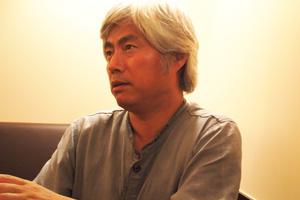
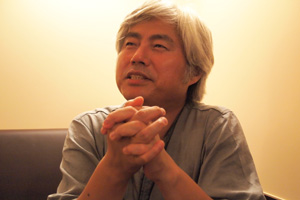
"Body? that''s jangdokdae!"
Director Jin has had so much interests on drama playing since he was a highschool student. He also learned a mask dance by advices around him. Thank to this, he got interested more on this, and happened to know more about general dance, too. He became an MC while he was serving a military duty. Still, it may be the power that keeps him in his position now, so called as "the best speaker in this field". After many experiences of MC in his college years, he enrolled to the performing arts'' academy, operated by Art Council Korea in 1990 after he finished Bachelor degree. At that time, his goal was to become a drama producer. In 1993, he started to work at Seoul Norimadang, a performing arena. However, he soon finished this job in 1995 due to tiredness of the complex procedures of paper working.
After he finished his work in Seoul, he had times to visit his hometown, Goseong. While he visited his home town, he met shamans and musicians. One day, he asked to a granny "What is body?", and the granny didn''t say like "don''t drink too much, punk!", but she answered "Body? that''s jangdokdae!". There are ganjang, wijang, sojang, daejang, and so on. That''s why it''s "jangdokdae".(The words of ganjang, wijang, sojang, daejang literally represents a human organs such as liver, stomach, small intestine, large intestine, respectively. A word of ganjang, however, has another meaning of soy sauce in Korean. That''s why the body is easily compared to a word of jangdokdae.) By the time director Jin listened to the granny''s answer, he felt like "Oh, this is the only expression I can hear from a mother who had beared a baby for 10 months. What the dance is to do with human body!" At this moment, he thought that he should hit the road go back to work right away.
In June 1995, He established Dure Theater with Mr. Kim Wun-tae, and started a performance planning in the field of Korean traditional performing arts. He used to be a producer of "Good morning Korea" at KBS during 2001~2003. After that, he opened a company "the land of festival" to produce many performances such as Here, Simcheong, People on this land, Town of dance: Goseong, Nammu: Chumchuneun cheoyongabi, Yeomu: Time, drawn on the air, and Jeonmuhumu. In 2006, He was the winner of this year''s art award by the work of Pungmul Myeongmujeon. In 2007, he wrote a book 『Noreummachi』, and it became the steady seller. Now, he works as an Art Director of Korea Cultural House, KOUS.
After he finished his work in Seoul, he had times to visit his hometown, Goseong. While he visited his home town, he met shamans and musicians. One day, he asked to a granny "What is body?", and the granny didn''t say like "don''t drink too much, punk!", but she answered "Body? that''s jangdokdae!". There are ganjang, wijang, sojang, daejang, and so on. That''s why it''s "jangdokdae".(The words of ganjang, wijang, sojang, daejang literally represents a human organs such as liver, stomach, small intestine, large intestine, respectively. A word of ganjang, however, has another meaning of soy sauce in Korean. That''s why the body is easily compared to a word of jangdokdae.) By the time director Jin listened to the granny''s answer, he felt like "Oh, this is the only expression I can hear from a mother who had beared a baby for 10 months. What the dance is to do with human body!" At this moment, he thought that he should hit the road go back to work right away.
In June 1995, He established Dure Theater with Mr. Kim Wun-tae, and started a performance planning in the field of Korean traditional performing arts. He used to be a producer of "Good morning Korea" at KBS during 2001~2003. After that, he opened a company "the land of festival" to produce many performances such as Here, Simcheong, People on this land, Town of dance: Goseong, Nammu: Chumchuneun cheoyongabi, Yeomu: Time, drawn on the air, and Jeonmuhumu. In 2006, He was the winner of this year''s art award by the work of Pungmul Myeongmujeon. In 2007, he wrote a book 『Noreummachi』, and it became the steady seller. Now, he works as an Art Director of Korea Cultural House, KOUS.
|
|
| |
|
|
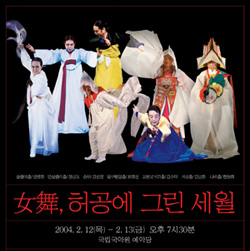
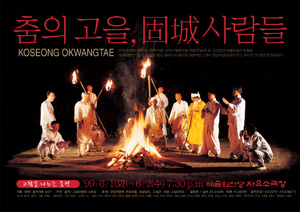
Planning Dance Master Series
Back in 2004, It reminds me such a scene that every tickets'' sold out at the National Gugak Center including the standing seats for the performance of Yeomu: Time, drawn on the air. I was also one of the audience. Finally, Lights off, and a short granny walked out from the stage right. The dance of time(drawn on the air) started just like that. I, however, doubted if she can possibly make it or not because her walking was not so much powerful enough, and her body was not straightly stood up, either. But, the story began through the every steps of her alone on the huge stage. I could feel joy by the movement of up-lifting arms, sorrow by that of her fingers, grace by that of toes beneath her skirt, and pain by that of tying a coat string up. Every one of those things remain as vivid images in my head simultaneously with her movements. All we could see was just the movements of the 80 year old woman''s dance. However, what the audience could get was more than the movement itself: that was her life, indeed. Astonishments were heard from neighbours, and a few of the audience showed tear drops. At the end of the dance, Director Jin also couldn''t but excited, the audience hailed with acclamations. Still, I remember it as the dance with a strong impression.
After that, Director Jin''s style became renowned so that the audience could buy tickets in advance. Director Jin, who sells tickets just like he sells his own blood. But he has one obvious principle: a dedicated concern for the performer comes first. No exception for the members of the National assembly nor the president. In general, R rated seats are given to VIPs. Director Jin, however, doesn''t do so because he knows the performers do not care the class of the audience, but the people who know their dance. It is really hard to dance without any chuimsae(An audience calls out some encouragements to the player at appropriate phrase endings. For example, "eolssigu"(fantastic), "jota"(good), "geureotchi"(perfect) and so on. Such encouragements to call out is called as "chuimsae".) for dancers. Therefore, the audience with good knowledge of dance usually take the R rated seats. Due to this, the former president of Korea Roh Mu-hyeon couldn''t seat in the center nor his body guards, and the same rule was adopted to foreign press or producers. Director Jin thought it''s right for the foreign reporters to see the dance and the reaction from the audience together at the same time, because that''s what the Korean dance truly is.
It was 1995, when he worked as the director of Dure Theater. He didn''t have enough budget to hold opening concerts, and no sponsors helped him out at that time. Meanwhile, he was reading a book of 『50 year history of National Gugak center』, and he found there''s no concerts'' title without any of these words: folk, traditional, contest, enjoy, and festival. So he titled Here, Simcheong as the opening concert of Dure Theater, and planned masters'' series themed by Simcheong("Simcheong" came from the pansori repertoire, one of the traditional vocal genre. This is a story about a filial daughter Simcheong in that she promised to be a sacrificial offering for the sailors'' safe cruise at the cost of opening his blind father''s eyes.) such as Ok-jin GONG''s Simcheongga, Jun-seop GANG''s Bbaengpama, Female group''s Bbaengpama, Dong-jin BAK''s Simcheongga, Seung-ho HAN''s Simcheongga, Ae-sun HAN''s Simcheongga.
After that, Director Jin''s style became renowned so that the audience could buy tickets in advance. Director Jin, who sells tickets just like he sells his own blood. But he has one obvious principle: a dedicated concern for the performer comes first. No exception for the members of the National assembly nor the president. In general, R rated seats are given to VIPs. Director Jin, however, doesn''t do so because he knows the performers do not care the class of the audience, but the people who know their dance. It is really hard to dance without any chuimsae(An audience calls out some encouragements to the player at appropriate phrase endings. For example, "eolssigu"(fantastic), "jota"(good), "geureotchi"(perfect) and so on. Such encouragements to call out is called as "chuimsae".) for dancers. Therefore, the audience with good knowledge of dance usually take the R rated seats. Due to this, the former president of Korea Roh Mu-hyeon couldn''t seat in the center nor his body guards, and the same rule was adopted to foreign press or producers. Director Jin thought it''s right for the foreign reporters to see the dance and the reaction from the audience together at the same time, because that''s what the Korean dance truly is.
It was 1995, when he worked as the director of Dure Theater. He didn''t have enough budget to hold opening concerts, and no sponsors helped him out at that time. Meanwhile, he was reading a book of 『50 year history of National Gugak center』, and he found there''s no concerts'' title without any of these words: folk, traditional, contest, enjoy, and festival. So he titled Here, Simcheong as the opening concert of Dure Theater, and planned masters'' series themed by Simcheong("Simcheong" came from the pansori repertoire, one of the traditional vocal genre. This is a story about a filial daughter Simcheong in that she promised to be a sacrificial offering for the sailors'' safe cruise at the cost of opening his blind father''s eyes.) such as Ok-jin GONG''s Simcheongga, Jun-seop GANG''s Bbaengpama, Female group''s Bbaengpama, Dong-jin BAK''s Simcheongga, Seung-ho HAN''s Simcheongga, Ae-sun HAN''s Simcheongga.
Making new pangut
Pangu is derived from a performing style of farmers'' band music. Farmers'' band plays music, mainly composed of percussion instruments, when there''s village gatherings to pray for the big harvest. Within the music, there are some acrobatic movements and solo plays of each percussion instruments such as ggwenggwari, janggu, buk, sogo, and so on. It usually runs for hours, sometimes even up to a day. To excerpt some part of it, and bring it on the stage, we call it "patgu". "pan" literally means a place or stage; "gut" means a rite or event.
Director Jin has accomplished a landmarking job on the planning business of traditional arts and dance. He''s been making ''strong'' stages for 20 years to seek for the dance masters around the country. In 2009, He showed us a totally different style of performance: Dance of the King, funded by the arts support program of SFAC(Seoul Foundation for arts and culture) This is a non-verbal dance drama in which has newly created contents and styles rather than it focuses more on dance masters like other performances that he had made. Now, we know him: whenever a master calls him, he will be there no matter what. That''s why it seems to be a huge direction-turning decision for him to a work like Dance of the King.
He noticed the main function about the musical aspect of pangut is getting diminished even though there are many performances are made by the application of percussion plays. He is still making a new pangut through Dance of the King. Now, he got more duties as not only to discover the masters, but also to seek for the new face and to invest. His pangut is still on progress. But it needs time until its completion. As we know his efforts and enthusiastic activities, it''s time for us to wait until his next stage.
Director Jin has accomplished a landmarking job on the planning business of traditional arts and dance. He''s been making ''strong'' stages for 20 years to seek for the dance masters around the country. In 2009, He showed us a totally different style of performance: Dance of the King, funded by the arts support program of SFAC(Seoul Foundation for arts and culture) This is a non-verbal dance drama in which has newly created contents and styles rather than it focuses more on dance masters like other performances that he had made. Now, we know him: whenever a master calls him, he will be there no matter what. That''s why it seems to be a huge direction-turning decision for him to a work like Dance of the King.
He noticed the main function about the musical aspect of pangut is getting diminished even though there are many performances are made by the application of percussion plays. He is still making a new pangut through Dance of the King. Now, he got more duties as not only to discover the masters, but also to seek for the new face and to invest. His pangut is still on progress. But it needs time until its completion. As we know his efforts and enthusiastic activities, it''s time for us to wait until his next stage.
Ok-seop JIN
Whose earlier careers were: Standing Director at Seoul Norimadang; Norimadnag''s director at Daejon Expo ''93; Chief of Dure Theater; A producer of "Good morning Korea" at KBS. He opened a planning company "the land of festival" and started to produce performances by the sources of Korean traditional performing arts with new view points such as Town of dance: Goseong, Nammu: Chumchuneun cheoyongabi, Yeomu: Time, drawn on the air. In 2006, He was the winner of this year''s art award by the work of Pungmul Myeongmujeon. In 2007, he published a book『Noreummachi』. He works as an Art Director of Korea Cultural House(KOUS) from June 2008.
Translated by Yu-seok KIM
 PREV
PREV
.JPG)
.jpg)
.jpg)
.jpg)
.jpg)












;)


