





Building Home, and Reading World
[Who&Work] Zin A CHOI, Director of Theatre Nolttang
[Who&Work] Zin A CHOI, Director of Theatre Nolttang
During performance of House Number 1-28, Cha-sook''s ("Cha-sook''s") on stage, a home is actually built, attracting public attention. Cha-sook''s is to be played at PAMS (Performing Arts Market in Seoul) as PAMS Choice in October. We sat down with director Zin A CHOI, who is busy preparing for the show of Cha-sook''s, and Unexpected to be played at the Seoul Performing Arts Festival.
Human networks are assets.
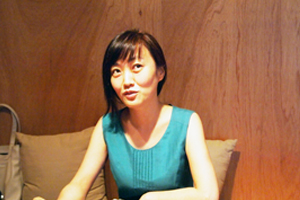
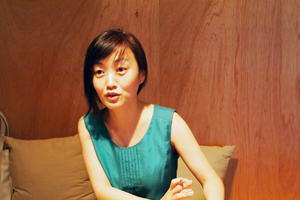
Q: How did Nolttang first get started?A: At first, I was on Yeon Woo Theater Company. Later, I got to know people working on Yeon Woo, and realized how important it is to have my own theatrical troupe. Actually, I was hesitant. It is a business to run a troupe. My folks and friends stressed the need. A director needs her own troupe to pursue what she wants, they told me. So, I found one with six other members in last December. Now, Choi''s company is registered with the Seoul Theater Association.
I worked with director Giho SON at Yeon Woo. He proposed to run a studio together. We thought it a good idea to give some name to it. That name''s become the name of our troupe. When I was a kid, I saw a kiosk. Its name meant a playing home. It was impressive. I came to think of it, and named our troupe Nolttang which means in Korean a playing ground.
|
|
| |
|
|
|
Q: What attracted you to theatre? What was the beginning?
A: I was a member of a theatre club during college. My heart got filled with something upon completing a show. I had thought I would pursue a theatrical career after graduation. I got a job and worked about a year and a half after that. Then, I joined Yeon Woo. Actually, I wanted to act. But I just got few roles. I felt standing in darkness. I wanted to know what to and how to do for acting. So, I decided to study more, and learned and took the path of being a director.
To begin with, I directed dramas of other producers a couple of times. A desire swelled up in my mind to direct the dramas of my own choice the way I want. That was how I got to write dramas, and my first piece was Not Love Story.
Q: You first started as actress. Then, switched to associated director and then to director. What motivations or inspirations does each role give you in your work?
A: Talking about good directorship, I think about two things: First, how to continuously and studious direct, and how to create good directing techniques. The people I have met through my acting and directing career are my priceless assets. Some friends bother to stride into my professional life, say, asking what drama I will work on next time. Mr. Gook Seo KI stimulates my spirit as well. He often tells me that theatrical artists do theatre as farmers cultivate their farms.
I also get inspiration from my colleagues. After viewing performances together, they leave comments like "No core in the piece," and "That could''ve gone some other ways." Their views and thoughts keep me thinking about what theatre means. I keep thinking how to get closer to the essential core.
Despair and Hope of Home
Q: We heard that you wrote Cha-sook''s while observing the actual home building process. Where do you get ideas and inspirations about your works?A: I usually concentrate on what is most intriguing and stimulating. That''s how I write. My writing starts with the question of "What was that?" I think about what I did and what I witnessed. Then, I move on to working on what was most difficult to understand. Actually I did not learn about how to write. So, my writing lacks structures and purposes. Rather, it proceeds, guessing what psychological and situational conditions underlie the events. Doing so, I try to find out answers within the writing itself. My writing materials come from what''s happening around me just as in Cha-sook''s.
Q: Cha-sook''s seems to have thrown lots to think about to people. For us, a house seems to rank on the top of our wish lists. What thoughts and meanings about home did you want to reflect in the piece?
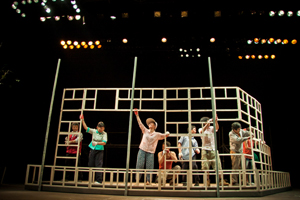
A: Frankly, the object of "home" was very intriguing to me. We often judge things from the human-centric viewpoint. When looking at them as such, they may emerge as product of harmony and wisdom. I tried looking at home from that viewpoint. That was why I reproduced the home building process in the show. I hoped to show the meaning of home as an object. Probing things over, we may have a deeper attitude toward our view and lives, when we realize how nobly things are created.
|
|
| |
|
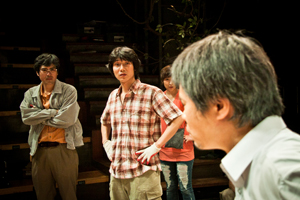
House Number 1-28, Cha-sook''s |
|
Q: Was home building well presented on stage as a process of objective looking?
A: Not really. I myself do not think that way. It''s possibly because I am too accustomed to narrative plot and dramatic development. The drama ends with the home building unfinished. Some audiences say, "Let''s finish it. Just don''t let people live in it." They still seem to look at home from the human-centric viewpoint. What I really wanted to depict was a home of despair. A home that puts itself into despair, losing one''s hope and desire. It is human desire that has created systems and structures and that pushes the home into despair. But I am grateful for their reactions. They interpret the incomplete house their own ways, and instill their own meanings in it.
It would''ve been great if I could represent the sweats of homebuilders on stage. Art works often carry the joyful achievement of working to audiences. It would be really tough to work outdoors without air conditioning.
Q: As your directing technique, you put actors in communication with audiences through documentary format, or their narration. It''s often called Choi''s unique one. Why do you choose the methodology?
A: Theatre feels like a process of communicating and sharing with audiences. Actually, I''m not good at guessing off an action. So, I decided not to make guesses. Instead, I''ve decided to believe what I see and be responsible for that. My personality seems to trigger attraction to direct narration, monolog and explanatory methods. I desire to directly capture what fantasies I have about intangible and invisible reality. One of the scenes in Cha-sook''s presents blocks and other materials being tossed from worker to worker one by one. I wished to recreate the image in rhythm. My desire to see what is invisible and to share it with audience seems to have been translated into narrations, monolog and gestures in some scenes.
Q:You have many titles uniquely outstanding. Any reason for that?
A: The title "Cha-sook''s" was "Building Home, Building Time" at the draft level. Later, I realized it should in documentary format, and pondered over how to give it the tint of a documentary. Then, objectiveness of address and number caught my mind.
Q: What destination do you ultimately wish to arrive at along your creative path?
A: Dramas exactly reflect the way the creator sees and feels the world. The way I see the world and the objects in it determines how good a drama I create. It''s what attracts people to dramas and their theatrical representation. I look deep into the world, and my efforts seem to square with what I do. I am happy for that. In life, coercion, suppression or mandatory rules exist. Under the frame, invisible emotions are unrecognized, ignored or overlooked from time to time. I want to share with audiences that agony and the hidden stories only seen through wise eyes.
Links
| Production information of House Number 1-28, Cha-sook''s Go
| Company Information of Theatre Nolddang Go
 PREV
PREV

.JPG)
.jpg)
.jpg)
.jpg)
.jpg)












;)


