





Rhythmic Space: A Pause for Breath
[Who&Work] 숨[suːm] _ Ji-ha PARK, Jungmin SEO
[Who&Work] 숨[suːm] _ Ji-ha PARK, Jungmin SEO
For the 2011 Performing Arts Market in Seoul, or PAMS, Rhythmic Space: A Pause for Breath has been selected one of the PAMS Choices. It is a work of a duo "숨[suːm]." The two members play traditional Korean instruments. Their music, however, defies the categorization of "traditional Korean music" to most of those who have experienced their music. We met with the two members, Jungmin SEO who plays gayageum (twelve-stringed zither) or a twelve-stringed Korean harp, and Ji-ha PARK who plays piri (cylindrical oboe with a bamboo body) and saenghwang (free reed mouth organ with 17 bamboo pipes).
"Beautiful music comes from self-cultivation."
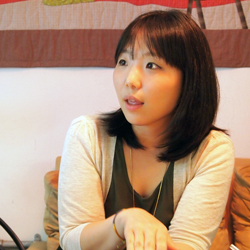
Q: When and how did you two start music careers? And please tell us about the instruments each of you plays.A: Jungmin SEO ("SEO"): I''ve been playing gayageum for 15 years. But I''d like to set the beginning of 숨[suːm] as the beginning of 숨[suːm] as the beginning of my playing it. I didn''t really love it until I started. Now 숨[suːm]. I mainly play 25-stringed one which is a modernized version of the instrument. Its deep resonance has attracted me. It''s the resonance that comes from a thick, big-echoing boxed instrument. Especially when I play it sitting on floor, the string-pushing and –snatching forces get blended in the body box, and emit deeper resonance into my body.
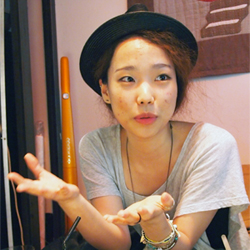
Ji-ha PARK ("PARK"): I tumbled upon piri as a kid. I got interested in it from that moment on. I attended Gukak National Middle and High School. (Gukak Middle and High School specialize in traditional Korean arts.) In the past, I would think I should''ve taken a different path. Other times, I felt myself attracted more to Western classical music due to my experience with flutes. During my middle and high school days, I didn''t understand why I had to play by the scores. The doubt sometimes led to regret over my decision to pursue traditional music. I just wanted to do music of my own, the music that can tell my stories. That was why I formed 숨[suːm] with SEO.
I mainly play the piri and the saenghwang. But the former is more difficult to play. It''s been without any modification for hundreds of years. When I play a note, Western instruments produce that note. When it comes to piris, I can''t play a note without first recognizing it. That difficult experience, however, has taught me how to play sigimsaes (melodic ornaments in the traditional Korean music). Playing the piri is like singing a song. Like other traditional instruments, players'' involvement is considerably required to play it. The more I practice with it, the wider range I get to play, I feel.
|
|
| |
|
Ji-ha PARK (Piri, Saengwhang) |
Jung-min SEO (Gayageum) |
Q: Where did the team name come from? We talked a lot about breathing, while talking about instruments before. Is it OK to identify 숨[suːm] which literally means breath in Korean with breath?
A: Park: We wanted a pure Korean name. Just a single character would be OK. When we are introduced outside Korea, I wish I could tell them soom is a Korean word. We wanted a simplest and most beautiful Korean name. We paralleled the word with its phonetic symbol out of the realization of the importance of breathing. Breathing does not simply mean inhaling and exhaling. Traditional music pays attention to the breathing of the performer, the breathing between the performer and her instrument, the breathing between performers, and the breathing between performers and audiences.
Q: Any rivalry between you two? How do you proceed with your creation and performance?
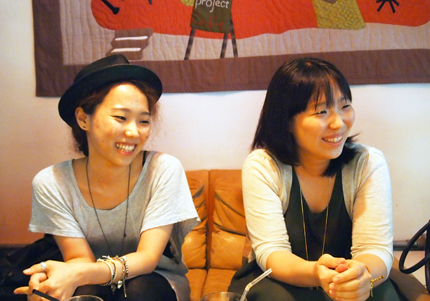
A: PARK: We don''t take each other as rival. We two play different instruments, and differ from each other personality-wise. SEO is an outgoing, aggressive musician full of ideas about performing. On the other hand, I am more of an organizer. Of course, different opinions and tricky rivalry exist. But the small difference seems to enrich our music. Now we know 숨[suːm] is not successful unless we two play along well. When we breathe with each other well, we as a team shine brightest. Experiences have taught us. We don''t beat around the bush. When we want to say something, we get straight to it.
SEO: If it''s a small competition, I''d like to make up for my shortcomings by following PARK''s strengths. "Tension for progress," that would be a more fitting term. We meet daily. But we talk about new stories and reflect on what each of us thinks and stands for. When working on music pieces, our shared thoughts and ideas emerge, and our memories are recorded in our music. We are instruments we play. So, our personalities are completely reflected in our music. Sometimes, you don''t feel something in a music piece, unless you know the creators. You don''t create good music unless you cultivate yourself.
|
|
|
|
Story Made Through Gayageum and Piri
Q: You mentioned that what you learn and experience in life is expressed in music. Do your creations reflect what''s happened in your lives?A: PARK: We are still in search for what to deliver to audiences. We do not search through insincere or inexperienced things. What we turn into music are the feelings and realizations we acquire in life. Neither do we make waste. We do it one by one. Later on, our search, piece after piece, will come out as a concrete theme, we believe.
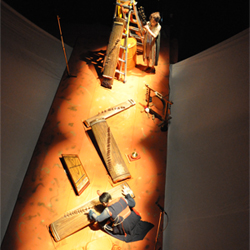
SEO: We happened to perform special shows a lot. We had opportunities to improvise performances at unusual places like clubs with unusual motifs like coalmines and wombs. We realized some different energies and synergies from those opportunities. When playing in a mine filled with coal dust, it felt completely different from playing in a studio. That experience led to creation of Ka. Sharp feelings of a coalmine linger in it. Rhythmic Space is part of the series of those experiences. Composing Innermost Encounter, we holed ourselves up in a forest with a couple of candles lit up around us. Bringing the experience back to the studio, we finished the piece. We didn''t plan much or prefer a place over the other types. We just worked off the opportunities that happened to visit us.
|
|
| |
|
Rhythmic Space: A Pause for Breath |
|
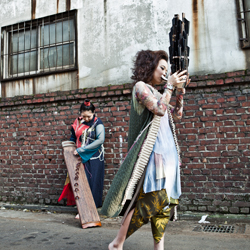
Q: What are your tips about 숨[suːm]''s music to those unaware of it?
A PARK: Despite the theme and content we instill in our music, each piece feels different from person to person. Individual interpretations and imaginations are different. That is why. We believe each listener will weave her own story when she keeps her imagination open. In the past, I didn''t think the traditional music would leave much room for individual imagination and interpretation. In fact, my musical understanding was shallow. That thirst motivated this team. Our music hopefully helps people unlock themselves and freely imagine.
SEO: People often say, "Our music is peculiar for traditional one." But we wish to tell people our stories made in music – stories made with gayageum and piri.
Q: What are your plans?
A: SEO:In 2010, we met some artists at residency in Taiwan. Due to the opportunity, we are going back there again. It''s a 4-month residency program. They are Taiwanese installation artists. We don''t know what we will do with them. But they share similar thoughts with us. Things will work out, we expect.
PARK: During this interview, we reflected on what we have done and what we will do. It was good. We have so many good people around us, helping us in many ways like costumes, dance, and producing. We thank them again, and express our sincere gratitude here. We''re preparing for an audition now. We''ll keep you posted on it. Thanks.
 PREV
PREV
.JPG)
.jpg)
.jpg)
.jpg)
.jpg)












.jpg','For the 2011 Performing Arts Market in Seoul, or P..');)


