





The World is Different when Eun-Me AHN is Here
[Who&Work] Eun-Me AHN _ Representative of Eun-Me AHN Company, Choreographer
[Who&Work] Eun-Me AHN _ Representative of Eun-Me AHN Company, Choreographer
In the Chunhyung by Eun-Me AHN, the original Chunhyung of sweet 16 became a 40 year old spinster, and in Princess Bari, the short-haired small young man did the dance of Princess Bari. Her stage performance that used to cover the area of stereotypes and dichotomies, are now geared toward recording the bodies of grandmothers in this aging society. In the new performance, Dancing Grandmothers from Eun-Me AHN Company, the ancestor characters are the mothers and grandmothers of ours who are all living is the same time period.
Body of old age, the museum of history
Q: Unlike former works, the Dancing Grandmothers portrays the everyday gestures of common old age people right on to the stage. What was the beginning point of your work?A: I first started Dancing Grandmothers in order to start a discourse so that the grandmothers can communicate with the society and enjoy the rest of their lives in this aging society and at a time where nuclear families are prevalent. Not only do we have a stereotype of grandmothers and their lives due to influences from media, but also they are the generation that have been excluded from our interest. However, in the lives of grandmothers that I was able to meet from the long country bicycle tour along with the dancers, there was nature and labor, eyes that have lived a life of transcendence, and energy ready to erupt when stimulated. Wouldn''t you say their dance is the real dance.
Q: When the grandmothers, who have been living the life of passive role assigned by the society, revealed their authentic movements on the stage, I was moved in a completely new way than watching the beautiful movements of well trained dancers.
A: This work is worthy to be called the "Parade and festival of DNA," because it is recording the individual historical gestures of each grandmother. Each individual''s history is unfolded onto the stage, and these come together to release enormous energy. Their cultural background or social class is not important. The history of the body aged into the grandmothers are in unison no matter their background or status. Their bodies are all wonderful, joyous, entertaining, and are variety of "museums" containing extraordinary history.
|
|
| |
|
Dancing Grandmothers |
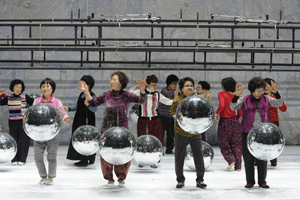
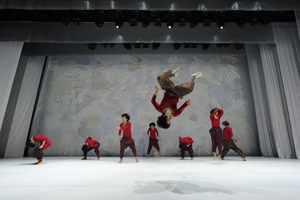
Q: Following the works Princess Bari, Rabbit is dancing, and Chunhyung, Music Director Young-Gyu JANG(member of the band UHUHBOO Project) had once again participated in the production of the work Dancing Grandmothers. I am curious to know your relationship with him.
A: It was in the early 90''s that I first met Young-Gyu JANG, the younger cousin of my friend, through the friend''s introduction. I requested editing of 10 LP records containing Wagner, pop, teuroteu, and various other genres of music to the then bass guitarist Young-Gyu JANG, and I was very satisfied with the result. Since then, we continuously had ties with each other and also visited, with an invitation, Pina Bausch Festival in Germany together. Our relationship also allowed him to expand his horizon in the field of his work. I am communicating with various different types of friends and we inspire and stimulate each other.
Q: What do you want the audience to see, feel, and understand from Dancing Grandmothers?
A: Because I clearly present the topics of my works and don''t hide around the bush, everyone can understand my work if they just let them unfold in front of their eyes. I don''t like to verbally present my work in questions and answers form, because when the nonverbal concept becomes realized or fossilized in words, it can numb the imagination. There are many things in this world that cannot be answered through logic or reason. How could words explain everything!
Q: Because Dancing Grandmothers is bringing up the topic of "aging society and body of the old aged," it seems that its purpose and activities can be expanded in various forms. What are your future plans?
A: I am planning on to create a nightclub project for grandmothers in Gyeonggi-do on Oct. 1, 2011. Furthermore, I want to make a moving nightclub that''ll travel all over the country, and create an opportunity that''ll give new and novel experiences for the grandmothers. Continuing the moving nightclub project that''ll tour the world with grandmothers, let alone the country, is in itself plenty of work.
God chose me as a dancer
Q: I''m curious to know what influences are being made to the world of art, and what topics you have been considering during your creative activities. A: The source of my inspiration comes from my daily life, and the moments of intuitive realization that stems from the experiences of daily living. Reading and the like activities are the task and process of reconfirming the things that I''ve realized. When I was in my 20s, it was a time of contemplating and establishing my relationship with the society. I was able to explore and try new things to my heart''s content because I met Mi-Suk CHUN teacher (Choreographer, and professor at Korea National University of Arts), who fully supported me. Since I hit my 30''s, I practiced being subjective and not being easily influenced by my surrounding environment. Throughout my 20s and 30s, I was aware of issues such as "tradition," "death," "identity," and "public." This is when I began to study and express such issues in my work. Through dance, I''ve been trying to express my thoughts on issues and topics in an avant-garde perspective by breaking the stereotype that oriental dance is passive, and this is why I pursue symbolic expression, beauty in space, and intense visuals.
|
|
| |
|
|
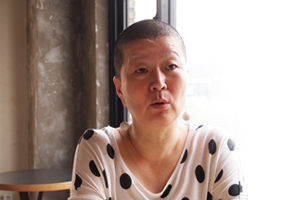
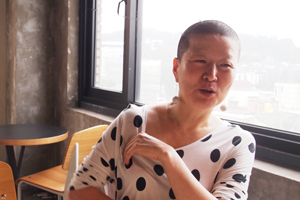
Q: What do you think is the role of artists in society?
A: The role of the artists is to raise questions and create topics of conversation of the facts that were unknown or hidden. Compare the world when the artist Nam June PAIK existed and didn''t exist. The world is different. Artists are not able to provide all the answers and methodology to the questions raised by them. However, if one of the people that had been asked such questions can induce solidarity among a group, change people''s view of the society, and create autonomous movement toward a goal, then enormous effects can be realized. Who knows what would happen after that?
Q: You have been keeping contact and working with artists of various genres within the country and abroad. What was the most memorable experience?
A: I believe meeting Pina Bausch was one of the greatest blessings in my life. It is not easy for women to take the initiative in the world of art where men have had vested rights. For 10 years, from 2000 until her passing, we had continued our relationship as artistic friends on the same side of sex.
Q: What does "the act of dancing" mean to Eun-Mi AHN?
A: Dancing is like an "oracle" to me. Dancing, in other words, is destiny.
Eun-Mi AHN, who says dancing is like an "oracle," had first started dancing at age four when she was mesmerized by the intense colors of traditional Korean dress and traditional dance. I''ve discovered her side as a mediator who bridges one side of the neglected normal people and the other side where bodies are filled with joy. This is why I am anticipating her next work which will be with high school teenagers.
 PREV
PREV
.JPG)
.jpg)
.jpg)
.jpg)
.jpg)












.jpg','In the Chunhyung by Eun-Me AHN, the original Chunh..');)


