





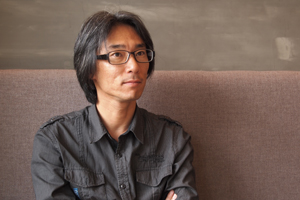
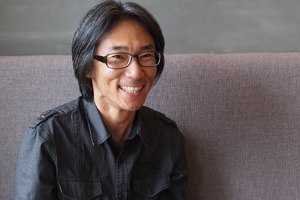
[Who&Work] Dong Hee CHO, Director of Hi Seoul Festival, Seoul Foundation for Arts and Culture
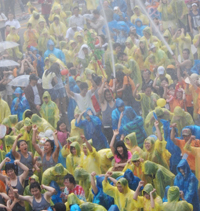
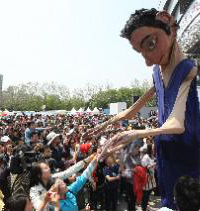
First organized in 2003 by the Seoul municipal government under the auspices of Seoul Foundation for Arts and Culture (SFAC), Hi Seoul Festival started with a format of a seasonal festival, and later took on the appearance of festival exhibition. Finally, it settled in a form of a nonverbal performance festival last May (under the directorship of Seoung-yeup LEE). This year, for example, the festival took place during the “golden” holidays from Children’s Day (i.e. 5th of May) to Buddha’s Day (i.e. 10th of May) at places like Plaza Gwanghwamun, Cheonggye Plaza, Han-river park of Yeouido.
We sat down with Dong Hee CHO, who has been in charge of organizing and running the Hi Seoul Festival since last year as SPAC director of festival planning. This year’s festival was his 7th, and all of “his” seven festivals were street functions.
|
|
|
Q: What brought you to working on performing arts?
A: I think I wanted to directly communicate with people, and arouse reactions from them. So, I took a job with an advertising agency. It was not what I had expected, though. Once day, I happened to produce a TV show about a performing arts festival. It was attractive. Image and the joy of it fanned me out toward outdoor performances and street arts. Visiting Festival international du théâtre de rue d''Aurillac by chance on a business trip, I quit my job.
Then, I went over to France to study. I got the Métiers des arts et de la culture [or master’s degree] from Lumière, and the DESS Action artistique, politiques culturelles et muséologie [or doctorate degree] from the Bourgogne University. My theses were on street arts festival, and its relations with local cultural policy and space for creation. Later, I completed my post-doctorate training at the Chalon dans la rue. During my stay in France, I happened to meet Su Taek YIM, the artistic director of Gwacheon Hanmadang Festival. The relationship drew me to a job in Gwacheon.
Q: The Gwacheon Hanmadang Festival is known for its various activities for promotion of street arts. Would you elaborate on them for us?
[Gwacheon is a city in Gyeonggi Province, and is located to the south of Seoul. It harbors various national agencies like the 2nd government complex. It also functions as the home to the National Museum of Contemporary Art and a racecourse, and houses sixty thousand residents.]
A: First organized in 1997 under the name “Gwacheon International Madanggeuk Grand Festival,” it has served the public as an outdoor performing arts festival for 15 years. I worked for it as director from 2005 to 2009. During that time, I had introduced recognizable European art pieces of that genre like Bivouac by Générik Vapeur [France], Les trottoirs de Jo’burg…mirage by Oposito [France], and Trajets de vie, Trajets de ville by Ex Nihilo Dance Company [France]. Actually, it is impossible to exactly reproduce the foreign works of street arts in the Gwacheon Hanmadang Festival . Two factors pose the greatest obstacle. One is space and the other is audience. It’s been hart warming and rewarding to usher in unfamiliar methods of expression to Koreans and to watch Korean teams change from the experiences.
The Gwacheon Hanmadang Festival runs several programs to support Korean artists with that experience. We launched a pilot program in 2004 to begin with. Now, the festival partly fund the Chuncheon International Mime Festival for its public screening and selection process. We also have offered opportunities for the works performed at the Seoul Fringe Network to be run at the Gwacheon festival. Further, we have been funding international co-productions. Sortie de Cuisine (in 2006 by a French company Ilotppie and its Korean counterpart Homo Ludens Company) and Ku-Do (in 2007 by a Dutch company Lunatics and a Korean company Theatre Momggol) are good examples.
Q: You now work for the Seoul Festival. What brought you over in Seoul? Is there a difference between the two city-funded festivals?
A: In my opinion, the Gwacheon festival’s got into orbit. Its system got to run itself now. That was why. In addition, a new change seemed necessary for the system itself.
Both of the festivals are funded by the municipal governments. They are different, though. The Hi Seoul Festival runs on a relatively larger scale. Thus, new attempts are tried. This year’s opening piece Rainbow Drops (by La Fura dels Baus of Spain) seems only possible with the Seoul festival.
In addition, the organizational nature is different. The Gwacheon festival is for the sake of festival itself, while the Seoul Foundation is for running various programs. Consequently, the Seoul organization enables cooperation with other programs. For example, the Seoul Arts Space serves as venue for workshops and creation of art pieces, and the Seoul Foundation for Art and Culture helps street artist. Moreover, unlike in Gwacheon, the municipal nature of Seoul makes it possible to attract public participation. I take pride in these.
Q: You took an active role in creation of Korea Street Arts Centre, and now serves on its chairman of operating board. What are the objectives of the center and what activities does it carry out?
A: Members of the Gwacheon festival led the center’s creation in 2009. Its ultimate goal is to promote the public understanding of street arts and to draw their recognition. Street art is not a simple expansion of performing space. It is an independent genre. The center employs various means like online magazines to promote its cause. It also influences localities and government officials to provide support for that cause.
The center is designing a program for young street artists. As a preliminary measure, the center members watch creative art performances and hold debating sessions on them. Last May, the center held a conference titled “Arts Chosen by Urban Festivals and Arts & Urban Cultural Policies.” This fall, it will hold it once more. This summer, it will conduct researches on overseas street festivals like the Greenwich Docklands International Festival.
Ultimately, the center aims at providing creative spaces. For the goal, it hopes to do a role like a street arts production center of France where it supports productions through all the year around residences, and holds a festival with the works produced from them.
|
|
|
 |
|
Hi Seoul Festival |
Gwacheon Hanmadang Festival |
Chuncheon International Mime Festival |
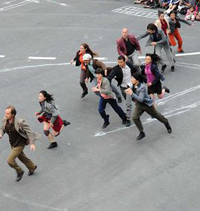
Q: What is the latest trend in the Korean street arts community?
A: Influenced by the Japanese Daidogei festival, the Ansan Street Arts Festival exudes the nature of a street clown festival. Replacement of its artistic director may usher in new changes. On the other hand, the Gwacheon festival literally focuses on street arts, while the Chuncheon festival holds some of its programs on street with the focus on physical theatre. Likewise, street arts constitutes part of the Seoul Fringe Festival. The Hi Seoul Festival began to concentrate on outdoor nonverbal performance from two years ago.
Commonly in Korea, it is often understood that street arts simply lies on expansion of indoor activities. Street arts, however, was conceived as an alternative to indoor performance. It is an independent genre. We have to think about one more thing. Madangguk(Madang means yard in Korea), the traditional Korean outdoor performance was favored in the 1980s. But the public favor faded in the ‘90s. Simply, we did not pay attention to aesthetics as much as we did to political issues. Likewise, recent works pay too much attention to purely aesthetical beauty. Street arts in Europe incorporate both political issues and aesthetical considerations.
The function of community art stands out lately as creative tendency in the Korean street arts community. Like Old Song''s Odyssey Performance Group Tuida and the Australian Snuff Puppets, Namoodak Movement Laboratory, more works are created and performed hand in hand with local communities. In the past, street arts was carried out in the natural settings. Recently, however, more and more performances are done in the urban, unorderly and ordinary environment. Think about Creative VaQi’s Let us move your sofa last year. Running the show in the middle of downtown Seoul, “Monster Downtown Girl” made headlines. Both trends, however, are not limited to street arts. The feature represents the general art community of Korea. I think it’s good. These efforts and new trials might transform the public perception of art in general.
Q: What qualifications are required of an expert planning street arts? Your own telling of merits and shortcomings may help a lot.
A: People commonly believe that large-scale street events pose danger. However, performers do not suspend themselves on wires, or crack fireworks without thorough preparation. In most cases, the performers watch similar shows in person, or seek ample advice from overseas festival organizers. They have basic knowledge and networks on how to create and run street arts. Nonetheless, festivals should bear some degree of risk. Too much attention to safety hampers artfulness. That’s why.
Bargaining power is another important factor. I mean it is important to work with and induce cooperation from government agencies, because street arts involves use of urban space and participation of the public. In this respect, we lag behind, and are constantly working on this point.
[weekly@예술경영] 국문 조동희 인터뷰 보기
 PREV
PREV
.JPG)
.jpg)
.jpg)
.jpg)
.jpg)












;)


