





Hyun Wook CHUNG , a Versatile Producer
(CEO of Sadari Theater Company and Wonder Space,
Chairman of the Korea Association of Performing Arts Producers)
(CEO of Sadari Theater Company and Wonder Space,
Chairman of the Korea Association of Performing Arts Producers)
|
Date and place: March 17, 2011, 2PM / Wonder Space Interviewed by Suna CHOE(Culture Producer) |
I met with CEO Hyun Wook CHUNG at Wonder Space in Daehangno, which was preparing to welcome spring. Sadari was founded in 1988 as a children’s theatre company and has an extensive fan base. CHUNG joined Sadari in 1996 and ever since has acted not only as its producer but developed numerous marketing programs and proposed diverse ways for creating original productions. In 2005, he built a performance hall specifically for children. Currently he also serves as chairman of the Korea Association of Performing Arts Producers. Mr. CHUNG’s cellphone kept ringing during the interview, attesting to his strong presence in the world of theatre.
Cheering on Sadari’s high-quality works and experimental spirit
Since its founding, Sadari has been active in various fields, including theatrical plays and mime, and established a strong presence. How did you end up with Sadari?
In the beginning, there were three groups named "Sadari": Sadari Theater Company, Sadari Movement Lab and Sadari Creative Drama Laboratory. The Theater Company’s art director, Hong-young YOO, and the Movement Lab’s art director, Do-wan LIM, led Sadari together until 2002, when they became independent. I joined Sadari in 1996. I simply visited the company in person and said that I wanted to work there. I liked children’s plays and wanted to find an appealing place to work. Sadari attracted me with its philosophy and style. Back then, Director Do-wan LIM was studying in France, so I only met Director Hong-young YOO. I asked him to trust me and give me three years to see how well I would fulfill my planning support duties. In hindsight, it was a dumbfounding proposition, but Mr. Yoo agreed willingly. It has already been 15 years since we met.
How did you become interested in children’s plays?
I worked briefly in theatre, but acting didn’t come easily to me. So I began looking for something I could do well. I thought I would make a good producer. Children’s plays are unpretentious and they deal with the future. I thought it was worth the effort because plays have a positive effect on children’s emotional and artistic development. Children always react honestly. I find that very attractive. Children’s plays produce future audiences, which is tantamount to helping people develop an eye for theatre and the arts. It’s like creating a foundation for distinguishing between good and bad art. But in Korea children’s plays receive little support because they don’t produce immediate tangible results. The government provides diverse artistic and educational support nowadays, but it remains shallow. I think we need more profound policies.
What did you focus on in the first three years after joining Sadari?
Back then, the immediate task at hand for the company was its survival rather than growth. We needed to create a driving force to keep the company alive, but the number of performance halls was limited and funding was an issue. That’s why we decided to perform at corporate events. We seized a chance to perform at a festival run by an oil refining company. We held a provincial tour in ten areas. After two years, the festival was scrapped, but we were able to earn money. When the Korean Cultural and Arts Centers Association was launched, we contacted regional cultural authorities to promote our performances. A few large theatres agreed to stage children’s plays, so we visited them to promote joint productions and stage our performances. Gradually, we acquired regular audiences and kept growing. At the time, our repertoire consisted of seven or eight plays. We produced many new plays as well, about five or six a year. We all worked very hard. Producing plays was good training for us. Our cast gained hands-on experience while our managers learned a lot.
Rather than prioritizing the visual, Sadari’s plays deal with children’s emotions. What is the goal of Sadari’s plays?
There are six directors in Sadari now. Some direct productions while others develop educational programs. Each has their own style. Director Hong-young YOO, for instance, likes to use diverse elements of play and mime. His works include the image play Lee Joong-sub''s Stories in Pictures
You also develop diverse programs like dramatic plays and book performances.
In the beginning, our company was categorized as an “educational theatre company”. But we eventually took out the word “educational” because many people thought of us as a company that only produced educational plays. Education is not our sole purpose. Rather, we’re more interested in making performances like playtime. That’s why we develop dramatic plays featuring physical elements, puppetry and traditional games. We continue to visit audiences, perform in theatres when invited, and provide programs where our cast can perform along with audience members.
This year, you have been preparing a Korea-UK-Japan baby drama international project. Tell us more about it?
The word “baby” refers to infants ages 0-3. Research says that our five senses develop vigorously during this period, and that artistic participation can have a profound effect on a child’s development. You may think that infants don’t understand much, but it’s the period when they shape their own world. In that respect, a baby drama is a very interesting project. I hope it will help many babies shape their egos. In terms of money, baby dramas are a big no-no because the maximum audience capacity is 30-50 people and they can’t be staged in conventional theatres. I happened to see performances that were modeled after baby dramas, but so far there are no experts in this field. But we decided to give it a try because it’s similar to our area of expertise. Exploring new fields is always fun.
We plan to carry it out in cooperation with Mr. Hishasi Shimoyama, whom I met at a Kijimuna Festa in Okinawa, Japan, and Unicorn Theatre Art Director Tony Graham from the UK. We’ve taken the first step; researching how best to do the project in all three countries. This year we will plan the structure and hold a workshop. Next year, we plan to produce the program in earnest and start rehearsals.
Cultural differences seem to apply to infants as well. What are they?
To three-year-olds, cultural differences don’t exist. Babies begin to shape their ego when they learn to talk and acquire living habits. At this age, racial and national differences don’t matter. That’s the charm of baby dramas and that’s what makes them easy to handle.
What other international exchanges have you done?
We’ve been invited to and performed at theatre festivals in Chicago, Singapore, Seattle, Hong Kong and Japan since 2000. We’ve also held exchanges with overseas children’s theatre companies on a regular basis. So far we collaborated with REM of Australia and Kazenoko Kyushu of Japan. Since we began working on baby dramas, we have been more willing to collaborate with theatre companies from other countries. Recently, we co-produced The Farting Daughter-in-law
In the beginning, there were three groups named "Sadari": Sadari Theater Company, Sadari Movement Lab and Sadari Creative Drama Laboratory. The Theater Company’s art director, Hong-young YOO, and the Movement Lab’s art director, Do-wan LIM, led Sadari together until 2002, when they became independent. I joined Sadari in 1996. I simply visited the company in person and said that I wanted to work there. I liked children’s plays and wanted to find an appealing place to work. Sadari attracted me with its philosophy and style. Back then, Director Do-wan LIM was studying in France, so I only met Director Hong-young YOO. I asked him to trust me and give me three years to see how well I would fulfill my planning support duties. In hindsight, it was a dumbfounding proposition, but Mr. Yoo agreed willingly. It has already been 15 years since we met.
|
|
|
|
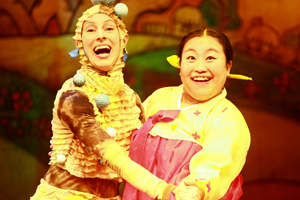
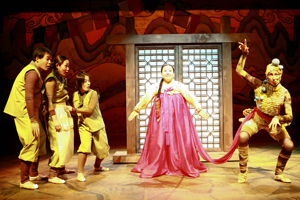
Sadari Theater Company The Farting Daughter-in-law |
How did you become interested in children’s plays?
I worked briefly in theatre, but acting didn’t come easily to me. So I began looking for something I could do well. I thought I would make a good producer. Children’s plays are unpretentious and they deal with the future. I thought it was worth the effort because plays have a positive effect on children’s emotional and artistic development. Children always react honestly. I find that very attractive. Children’s plays produce future audiences, which is tantamount to helping people develop an eye for theatre and the arts. It’s like creating a foundation for distinguishing between good and bad art. But in Korea children’s plays receive little support because they don’t produce immediate tangible results. The government provides diverse artistic and educational support nowadays, but it remains shallow. I think we need more profound policies.
What did you focus on in the first three years after joining Sadari?
Back then, the immediate task at hand for the company was its survival rather than growth. We needed to create a driving force to keep the company alive, but the number of performance halls was limited and funding was an issue. That’s why we decided to perform at corporate events. We seized a chance to perform at a festival run by an oil refining company. We held a provincial tour in ten areas. After two years, the festival was scrapped, but we were able to earn money. When the Korean Cultural and Arts Centers Association was launched, we contacted regional cultural authorities to promote our performances. A few large theatres agreed to stage children’s plays, so we visited them to promote joint productions and stage our performances. Gradually, we acquired regular audiences and kept growing. At the time, our repertoire consisted of seven or eight plays. We produced many new plays as well, about five or six a year. We all worked very hard. Producing plays was good training for us. Our cast gained hands-on experience while our managers learned a lot.
Rather than prioritizing the visual, Sadari’s plays deal with children’s emotions. What is the goal of Sadari’s plays?
There are six directors in Sadari now. Some direct productions while others develop educational programs. Each has their own style. Director Hong-young YOO, for instance, likes to use diverse elements of play and mime. His works include the image play Lee Joong-sub''s Stories in Pictures
|
|
|
|
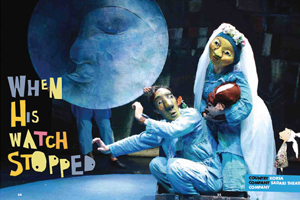
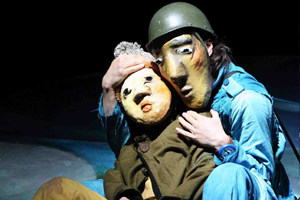
Sadari Theater Company When His Watch Stopped |
You also develop diverse programs like dramatic plays and book performances.
In the beginning, our company was categorized as an “educational theatre company”. But we eventually took out the word “educational” because many people thought of us as a company that only produced educational plays. Education is not our sole purpose. Rather, we’re more interested in making performances like playtime. That’s why we develop dramatic plays featuring physical elements, puppetry and traditional games. We continue to visit audiences, perform in theatres when invited, and provide programs where our cast can perform along with audience members.
This year, you have been preparing a Korea-UK-Japan baby drama international project. Tell us more about it?
The word “baby” refers to infants ages 0-3. Research says that our five senses develop vigorously during this period, and that artistic participation can have a profound effect on a child’s development. You may think that infants don’t understand much, but it’s the period when they shape their own world. In that respect, a baby drama is a very interesting project. I hope it will help many babies shape their egos. In terms of money, baby dramas are a big no-no because the maximum audience capacity is 30-50 people and they can’t be staged in conventional theatres. I happened to see performances that were modeled after baby dramas, but so far there are no experts in this field. But we decided to give it a try because it’s similar to our area of expertise. Exploring new fields is always fun.
*** In August 2010, Sadari held the ''Baby Drama Festa'' in cooperation with the Uijeongbu Arts Center. Some 30 children’s play experts from six countries participated in symposia, workshops and performances.
How is the preparation for the new project going?We plan to carry it out in cooperation with Mr. Hishasi Shimoyama, whom I met at a Kijimuna Festa in Okinawa, Japan, and Unicorn Theatre Art Director Tony Graham from the UK. We’ve taken the first step; researching how best to do the project in all three countries. This year we will plan the structure and hold a workshop. Next year, we plan to produce the program in earnest and start rehearsals.
Cultural differences seem to apply to infants as well. What are they?
To three-year-olds, cultural differences don’t exist. Babies begin to shape their ego when they learn to talk and acquire living habits. At this age, racial and national differences don’t matter. That’s the charm of baby dramas and that’s what makes them easy to handle.
What other international exchanges have you done?
We’ve been invited to and performed at theatre festivals in Chicago, Singapore, Seattle, Hong Kong and Japan since 2000. We’ve also held exchanges with overseas children’s theatre companies on a regular basis. So far we collaborated with REM of Australia and Kazenoko Kyushu of Japan. Since we began working on baby dramas, we have been more willing to collaborate with theatre companies from other countries. Recently, we co-produced The Farting Daughter-in-law
Opening an art center for children
Sadari gained notoriety in 2005 when it opened the children’s theatre Sadari Art Center. What kind of theatre is that?
Children’s plays are mostly staged in conventional theatres during daytime. We had to rent such venues for a long time before we got enough private investment together to build our own theatres. We originally had planned only two theatres but ended up building three – making construction payments very difficult. We still struggle to manage the theatres, but staging good-quality productions for children in a good environment is the best way to cope. We built our theatres above ground to ensure children’s safety. Many Daehangno theatres are on basement floors, limiting escape routes. We also put in a library and other facilities for children and made audience seats higher than usual at one of our performance halls. One of our theatres stages children’s plays on a regular basis, while the other two stage diverse performances in addition to children’s plays. Many people think that Sadari’s theatres only show children’s plays, but our theatres were never intended just for children’s play. We wanted to show diverse performances. In fact, filling a theatre program with nothing but children’s plays is not easy because children’s plays are in short supply. Managing the theatres on our own turned out to be a challenge, so three years later Hansol Education acquired a stake in our theatres. The name was changed to Wonder Space, but our management style hasn’t changed much.
Children’s plays are mostly staged in conventional theatres during daytime. We had to rent such venues for a long time before we got enough private investment together to build our own theatres. We originally had planned only two theatres but ended up building three – making construction payments very difficult. We still struggle to manage the theatres, but staging good-quality productions for children in a good environment is the best way to cope. We built our theatres above ground to ensure children’s safety. Many Daehangno theatres are on basement floors, limiting escape routes. We also put in a library and other facilities for children and made audience seats higher than usual at one of our performance halls. One of our theatres stages children’s plays on a regular basis, while the other two stage diverse performances in addition to children’s plays. Many people think that Sadari’s theatres only show children’s plays, but our theatres were never intended just for children’s play. We wanted to show diverse performances. In fact, filling a theatre program with nothing but children’s plays is not easy because children’s plays are in short supply. Managing the theatres on our own turned out to be a challenge, so three years later Hansol Education acquired a stake in our theatres. The name was changed to Wonder Space, but our management style hasn’t changed much.
Promoting exchanges and solidarity among performance planners
You serve as chairman of the Korea Association of Performing Arts Producers. How is the association managed?
There are some 100 people registered. Producers with more than three years experience can join. Our current members range from performance producers to PR agents. But the majority of them are engaged in production, such as CEOs of production firms and performance groups and heads of institutions and theatres. In the beginning, many of our members were CEOs, but we lowered the bar to allow more people in. The role of the association is to provide practical information and create network routes.
What are the major issues?
We have many opportunities to create a new culture and learn different management styles because of the diversity of our membership. We provide performance planners with opportunities to study abroad. Last year and the year before that, we held showcases to select and support high-quality original plays. We also hold forums on a regular basis. This year, we will hold them on a quarterly basis. The first is coming up in April, we will hold the first forum. It’s dedicated to the donation system. Last year, we held a market event in China to introduce Korean performances and hold showcases. The results were very positive. Some projects drew particular attention but the ongoing discussions are not easy because planners and producers don’t have the authority to prove they are producers legally. Our biggest problem these days is the lack of planners. There are few good planners. The situation is better in the musical market, but things are very tough in fine arts. It’s sad that there are few working-level experts because the majority of art managers work for public institutions.
What does it take to be a good producer? How do you hone your skills and recharge your energy?
A good producer must have a keen eye and a strong sense of responsibility. He or she must also have strong people and marketing skills. A good producer must have many good qualities. But the most important one is responsibility. He or she must be able to take responsibility for what he or she does. I tend to grumble a lot when working (laughs). But I enjoy what I do. I’m happy and grateful to have my job. Meeting new people and watching good performances is what gives me energy. Recently, I’ve been meeting people from other sectors because they help me develop new perspectives.
What are your future plans?
I plan to retire at age 50. I have five years left. By “retirement” I mean being less busy and doing what I want to do without being too greedy. That’s just my plan. You never know how life will turn out. My primary goal is producing high-quality performances. Sadari plans to release four productions this year but have yet to decide on one of them. Our team works in good conditions. We have strong teamwork. We can achieve anything if we work hard, which means meeting many people and building partnerships.
There are some 100 people registered. Producers with more than three years experience can join. Our current members range from performance producers to PR agents. But the majority of them are engaged in production, such as CEOs of production firms and performance groups and heads of institutions and theatres. In the beginning, many of our members were CEOs, but we lowered the bar to allow more people in. The role of the association is to provide practical information and create network routes.
What are the major issues?
We have many opportunities to create a new culture and learn different management styles because of the diversity of our membership. We provide performance planners with opportunities to study abroad. Last year and the year before that, we held showcases to select and support high-quality original plays. We also hold forums on a regular basis. This year, we will hold them on a quarterly basis. The first is coming up in April, we will hold the first forum. It’s dedicated to the donation system. Last year, we held a market event in China to introduce Korean performances and hold showcases. The results were very positive. Some projects drew particular attention but the ongoing discussions are not easy because planners and producers don’t have the authority to prove they are producers legally. Our biggest problem these days is the lack of planners. There are few good planners. The situation is better in the musical market, but things are very tough in fine arts. It’s sad that there are few working-level experts because the majority of art managers work for public institutions.
What does it take to be a good producer? How do you hone your skills and recharge your energy?
A good producer must have a keen eye and a strong sense of responsibility. He or she must also have strong people and marketing skills. A good producer must have many good qualities. But the most important one is responsibility. He or she must be able to take responsibility for what he or she does. I tend to grumble a lot when working (laughs). But I enjoy what I do. I’m happy and grateful to have my job. Meeting new people and watching good performances is what gives me energy. Recently, I’ve been meeting people from other sectors because they help me develop new perspectives.
What are your future plans?
I plan to retire at age 50. I have five years left. By “retirement” I mean being less busy and doing what I want to do without being too greedy. That’s just my plan. You never know how life will turn out. My primary goal is producing high-quality performances. Sadari plans to release four productions this year but have yet to decide on one of them. Our team works in good conditions. We have strong teamwork. We can achieve anything if we work hard, which means meeting many people and building partnerships.
***Hyun Wook CHUNG
CEO of Sadari Theater Company, co-CEO of Wonder Space
Organized overseas performances and provincial tours for Sadari from 1997
Co-produced productions at home and abroad with theatre companies from overseas
Chairman of the Korea Association of Performing Arts Producers since 2007
In 1997, launched “Festival JANG” the annual festival for experimental plays ran for four years
Since 2009, Namsan Arts Center and Wonder Space co-producing “Festival JANG”
CEO of Sadari Theater Company, co-CEO of Wonder Space
Organized overseas performances and provincial tours for Sadari from 1997
Co-produced productions at home and abroad with theatre companies from overseas
Chairman of the Korea Association of Performing Arts Producers since 2007
In 1997, launched “Festival JANG” the annual festival for experimental plays ran for four years
Since 2009, Namsan Arts Center and Wonder Space co-producing “Festival JANG”
Sadari Theater Company (www.sadari.org)
Wonder Space (www.wonderspace.co.kr)
Korea Association of Performing Arts Producers (www.kapap.co.kr)
Wonder Space (www.wonderspace.co.kr)
Korea Association of Performing Arts Producers (www.kapap.co.kr)
Ahn Sungsoo Pick-Up Group, ''life_Bolero'' 2005
 PREV
PREV
.JPG)
.jpg)
.jpg)
.jpg)
.jpg)












.jpg','I met with CEO Hyun Wook CHUNG at Wonder Space in ..');)


