





Movements Constructed upon Mimage: Architectural Imagery
IM Do-wan, producer and director of Sadari Movement Lab
CHOE Suna (cultural producer)
Having shaped a movement-based language for the stage, Korea’s 2.5 generation mime artist Im Do-wan has conducted various experiments since he founded Sadari Movement Lab in 1998. He attempts to present a theatrical language by analyzing the dramatic behaviors of characters and create “mimage” productions which combine mime and imagery. Im says, “I pursue poetic language in my productions. Stimulating the audience’s imaginary world is possible through works with poetic bodies. His productions vary in their characteristics, sometimes solemn and serious traditional plays and sometimes mimes and satirical musicals based on the quick movements of performers. Im and I discussed his new experiments, the media and how the qualities of Sadari Movement Lab intermingle.
Building a Poetic Language on the Stage, a Space of Energy Transcending Everyday Life
How did you start Sadari Movement Lab?
I started studying mime with my college friend YU Hong-young in the late 1980s. Unlike Yu who was interested in mime since college, my interest was actually in acting. But suddenly, I found myself working with him. At the time, there were not that many active mime artists, but we kept studying and established Mime Group Sadari together. As our interests expanded, Yu started a splinter group, Sadari Theater Company, focusing on children’s plays and educational productions, and I founded Sadari Movement Lab (SML) in 1998 to further delve into movements and plays. Sadari Theater Company attracted many artists who had studied children’s theater productions and educational plays, and they were involved in many good productions. There were not that many groups at the time that steadily produced good children’s plays. Also rare were groups like us that focused on movements.
How did your interest in movements and physical theatre start?
There was no concept of “physical theatre” at the time. I became interested in plays that were not text-based, but were expressed through objects, images, movements, lighting, and sound. I was influenced a lot by Dongrang Repertory Theater Company (the membership of which was mainly comprised of alumni from my alma mater). Their performances were not typical plays, but very experimental. Their language was very metaphorical and body movements were an important element in their productions. My peers were awestruck by Dongrang’s experimental productions and came to have inordinate admiration for them. We thought that we too should do something not done by conventional theatre groups, or something new wave.
Then I went to study at L’Ecole Internationale de Theatre Jacques Lecoq in France, where I learned the language of light and movement. I learned that even when a narrative text is presented on the stage I should look for the purpose and clarity of movements. So I decided not to do any conventional plays or so-called realism plays even when I returned to Korea. Realistic plays would have been a lot of fun in an era of primitive media. It would have been fun to peek into other people’s lives. But these days TV does that so well, and there are so many good reality-based documentaries and films. Is it really necessary to communicate something on the stage through this everyday language? Realism is a legitimate form of theatre, but such plays should find metaphors suited to them once put on the stage. I believe that the stage is not an everyday space, but an energetic space that transcends everyday routine. That is why different kinds of plays are needed.
SML’s first production “Between the Two Gates” is about war and death. It had almost none of the mime elements. It was more of physical theatre based on movements and images. The production featured grotesque visual images and a serious subject matter and was very experimental in nature. How would you define this first attempt?
Sadari Movement Lab, Between the Two Gates
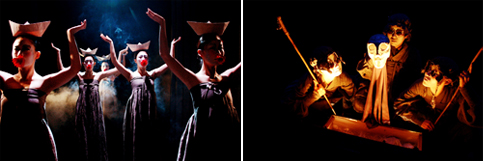
Rather than using mime techniques, it was important to utilize the movements of each element and characteristics of a material. I don’t think this production was that experimental, but many people thought it was too difficult and there were no reviews to speak of. The overarching trend of the time both domestically and worldwide was postmodernism. Regardless, I wanted to present my story in a horizontal format, instead of a vertical one. I wanted the audience to feel, not understand, the entire image. But the audience was uncomfortable with the non-narrative structure and insistently searched for a story in it. There had been many attempts like this overseas, but it was still new in Korea. Nowadays, the media is far more advanced and even some advertisements are made up entirely of signs, so people are familiar with this type of production. People thought it was hard to understand “Woyzeck” at its premier in 2000. To me both “Between the Two Gates” and “Woyzeck” were really easy to understand. Maybe people needed more time.
The Body Language of “Woyzeck” Reaches Out to the World
Your next production “Woyzeck” was applauded as a piece that harmonized movements, objects and sounds. How did you come up with this production?
Sadari Movement Lab, Woyzeck (2010)
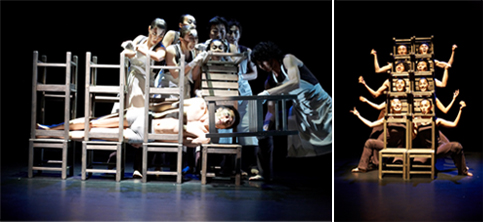
“Woyzeck” premiered at Festival Jang in 2000. [Festival Jang features the experiments of local performing artists and innovative productions by young artists. The festival ran from 1997 to 2002 and was brought back in 2010.] At the time Korea was in the midst of a pretty bad financial crisis. Restructuring and massive layoffs took place, the number of homeless swelled, and families broke apart. That is when our production of “Woyzeck” was conceived. “Woyzeck” has always been a good stage play and many directors aspired to produce it, but the story was particularly real for that time.
“Woyzeck” is written much like a film. There are numerous scenes and backgrounds, which confounded directors over how to transform the stage to accommodate the scenes. I also struggled with that problem, but then decided to use chairs as a metaphor for this play. The chairs symbolized authority and Woyzeck was presented as a man who was harassed and chased throughout his life without even a chair to call his own.
You’ve produced “Woyzeck” for almost 10 years. What has changed in the play over time?
There were many changes. In the earlier years, the play appealed to only a few fans and failed to elicit any response from the average theatregoer. Of course the play has been refined through several adjustments since then, but audience also became more sophisticated. Now they seem to be enjoying “Woyzeck.”
Actually this play is very condensed, because it has compressed movements, objects, music, lights and text. In some instances separate scenes are played out simultaneously on the stage. For example, the scenes where the doctor conducts experiments on Woyzeck and where the doctor meets with the captain are separate in the original version. But from the doctor’s perspective both Woyzeck and the captain are his test subjects. So the two scenes were not separated, but put side by side on the same stage. Woyzeck is lying on the slab being experimented on and the captain is bored to death. There are several such clearly discrepant scenes like this in my rendition. That is why people who know this play well say that my version becomes more interesting the more they see it. Even Wolfgang says that I made a difficult play easy to understand. [Wolfgang HOFFMAN, artistic director for Edinburgh Fringe Festival’s Aurora Nova program.]
“Woyzeck” gained considerable attention after winning rave reviews at the 2007 Edinburgh Fringe Festival. Since then you took the production to other parts of Europe, North America, and even South America. How was it received overseas? What do you think of the reactions?
The responses were just fantastic, getting a standing ovation 90% of the time. I could not join the performance in Georgia because of my school work, but I was told it was quite impressive. My staff had a difficult time putting on the performance, because the conditions of the theatre and the capability of the local production staff were quite poor like in Korea in the 1970s and 1980s. But the audience response after the performance was reportedly awesome. Our hosts made my staff promise to bring me their message that our production showed them the future of plays. When our producer Kyu CHOI attends overseas festivals, people there ask him whether he has seen the play, and he proudly answers that he is the one who produced it.
Space doesn’t seem very confined in our “Woyzeck” production because the play is composed largely of images. Perspectives tend to differ by theatre size, but the sparseness of the piece renders it unsuitable for large theatres. In general, the play is better suited to medium-sized venues. The performance at the Queen Elizabeth Hall in London was very impressive. The stage wasn’t that big, but the spectator section was huge. Since the hall was made for concerts, it had an excellent audio system. The dialogues and sounds were delivered very clearly.
Good overseas reviews always make me happy, but all the more so when a contemporary piece, not a traditional performance, earns positive reaction abroad. Many other young theatre companies are venturing overseas. Korean theatre is only a little over 100 years old, but I believe we are faring well and Koreans’ inherent penchant for singing and dancing is slowly shining through. Just like my predecessors in the 1980s, I want to provide stalwart support for young artists and wish that they would go out into the world with quality plays. I think directors, performers and critics gain far-sighted perspectives through this process.
Various Experiments on Movement Methods
Your “Human Comedian” is a charming comedy in which six actors play 25 different characters to invoke amusement and pathos. Then “Pursuit 100 Minutes” (original title: ‘That Guy is No Different”) was a satirical musical. You seem to have many different colors, which include physical theatre.
Sadari Movement Lab, Human Comedian
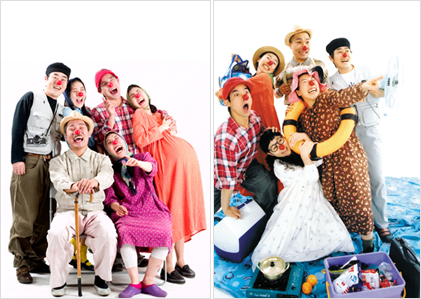
“Human Comedian” was conceived during a workshop on how quickly an actor can shift into another character. The audience may see the transformation as magic, but to actors it’s one of the vital movements that can be shown on the stage. Actors work together to develop episodes for “Human Comedian.” “Pursuit 100 Minutes” was one of those episodes, which was expanded further.
People tell me that it’s hard to predict where SML will go next, since we dabble in this and that. Then we answer them, “That’s what our company is.” I think people insist on one style because they are unable to fashion other styles. Whether it’s an actor or a director – working with diverse tools can lead to diverse outputs. I’m actually strong in comedy. But I want to try different areas, whether it is an expressionistic piece or a play about a serious issue. Sometimes I stick to one style, but it feels too inflexible and stale after a while.
You wrote the music for “Pursuit 100 Minutes.” It seems you are greatly interested in music and sound effects.
Sadari Movement Lab, Pursuit 100 Minutes
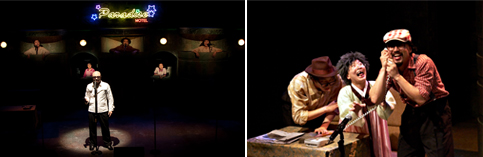
I love music. It’s my hobby. My sister majored in piano, so I learned to play piano by watching her. I also had a great music teacher in high school, who taught me guitar and janggu [double-ended drum] and music composition. I also joined a band and continued writing music. If my college had a pop music department back then, I would have majored in it. But tuition was more expensive for the college of music anyway, so I decided to major in theater. Now that I think about it, my past musical activities helped my directing, not because the experiences taught me how to compose music, but because they helped me become more sensitive to the rhythm or tempo. I came to realize that directing requires more than one talent.
The performance of “Pursuit 100 Minutes” had a lot of room for improvement. I wrote the scores for the musical and even arrangements for several different instruments, but couldn’t play the music live due to a lack of money. The sounds played in the theatre were not what I envisioned. I was so frustrated. I wish I could have a seven or eight-member band playing live music.
You talk a lot about the imagery of architectural movement. What does a stage mean to you as a space?
I think movement is also architecture. The reason I use the term “an imagery of architectural movement” is because space is really dynamic. Erecting a structure has its own rhythm and tempo. I want to bring such structural clarity and precision to the stage as well. Some pieces are hard for the audience to understand because they contain many metaphors. But the audience can discuss it and imagine a space by expanding the imagery of architectural movement and setting a basic structural space on the stage. If the stage is cluttered, flexibility is gone. Specifically defined structures don’t do anything but impart information. We can open up the audience’s spatial imagination when we use various objects without the limitation of space. And then architectural aesthetics can be naturally manifested on the stage. If aesthetic concerns precede stage production and aesthetics is blindly pursued, that play would be an empty shell without any content.
“Maids,” an International Collaboration, Combines Movement and Media
“Maids” was created by a close collaboration with foreign partners. I’m curious about the process that led to this piece.
“Maids” is a joint production created in 2009 by the Macao Cultural Center, the Chuncheon Mime Festival, and my theatre company. The production was funded by the Macao Cultural Center, and actors were auditioned and trained in Macao before finishing it as a 40-minute performance in Korea. And then it was performed again in Macao. I plan to work further on this piece with an American partner in 2011. Mr. Robinson [dean of the Entertainment Technology program at City University of New York] saw our “Woyzeck” at the New York Republic Theater in 2009 and contacted us with a collaboration offer. So we suggested working on “Maids.” We went to New York in January 2010 for about 10 days to shoot some video. We plan to return to New York in April 2011 to do some follow-up work. The piece will be presented at the Doosan Art Center in August.
The stage props for “Maids” consist of only one wardrobe and three mirrors. The wardrobe is considered a secret space for women. It contains many tales. This piece represents the unity of movement and technology. I believe it is a novel attempt in that sounds and images are used interactively.
What other projects do you want to do in the future?
I want to reenact the speed of films and commercials on the stage. Since movies are made up of videos, scenes are easily changed. One can easily move among the past, present, and future. On the stage the scenes must be visually impressive to leave a lasting impact. I want to experiment with them. Also, band mime, which expresses a film in movements, is in its nascent phase, and I want to translate it into a stage play. Band mime refers to a process of turning a movie into a movement-based stage play. For instance, the two-hour “Terminator” can be compressed into a 30-minute play composed entirely of physical movements. This is a sort of parody. How you splice in the scenes invoke different reactions.
Movement + Lab: Searching for the Language of Movement through Joint Creation
You consider “joint creation” to be a key element in production. What does it mean for you?
I named the theatre group “Lab” to represent my wish to create a play like we do research. In that respect all actors take part in completing a play together. I chose this method because I didn’t want to control my actors like puppets on the stage. I majored in theatre, so I know that it’s difficult for an actor to completely own a role when the director gives out overly detailed restrictions and instructions. A director should allow and help actors to find their own expressions. Only then can they can make the roles their own and emit energy on the stage. I don’t want them to blindly follow my directions and move unconvincingly, nor do I want to blame them when they can’t follow my directions.
We usually start working right away once we decide on a play. We start analyzing the piece by moving our bodies first and then taking apart the text. No progress can be made if we start analyzing the script with our heads. Actors individually study the script and form a consensus on how to express the piece before two or three of them make presentations. That’s how we define the characteristics of the piece, find its structure and image, and see how we can transform a given space. When they seem to be at a loss, I drop them some hints. Performers arrange rehearsals, and I refine the piece from time to time. I think it’s important for the director and actors to exchange ideas and find an optimal method rather than insisting on one’s own.
This is possible only because we have great teamwork. We’ve been working together for almost 10 years. Our founding members have grown out of the group and started working more on outside projects, so new members have been filling up the void since 2007. I think we’re in our second cycle, but older members still care about and support younger members.
How is the company run?
We have about 25 performers now, 19 if you exclude those working on outside projects. There is no production planning team in our company. Actors themselves plan our productions. But we can’t do that for our performances in Seoul, so we leave it up to a professional planning company. Unfortunately, many theatrical play planners have gone out of business and shifted to musical productions. Producer Kyu Choi of AsiaNow is in charge of our overseas performances. There are over 100 theatres in Daehangno alone and it’s a miracle that all those theatres have performances every day even though they are not making money. We are also one of them.
You are a resident arts group at a local cultural center. How are your community activities going?
We’re a subsidized resident member of Seodaemun Cultural Center for two years from 2009 to 2011. Since 2009 we have produced some plays and developed culture and arts education programs like the youth academy. Our theatre company has a good relationship with Seodaemun Cultural Center. We have made family plays for local residents and are now working on a piece based on a story from the community. We plan to present a piece tentatively called “Boddari” next June. I wanted to work on this play as soon as I read a newspaper article about it. Recently, I got to make a piece about Seodaemun Prison, a local historical landmark.
But the downside is that assistance programs for resident arts group are usually short-term, lasting only two or three years. After settling down and getting involved in local communities, the programs come to an end just when a group gets known to the community and ready to form ties with community members. More time is needed to inspire local communities and let theatre companies grow. I wish public performance venues could get more stable policy support.
What other plans do you have for this year? Do you want to take “Woyzeck” to more countries?
We have schedules in Iran in February, Japan in March, and another one in October. We’ve shown “Woyzeck” in many countries, but come to think of it, not in France. We’ve presented “Between the Two Gates” at the Mimos Festival du Mime. If opportunities present themselves, I want to do more performances in France. Also, I was able to do only one showing of the Irish contemporary play “The Walworth Farce,” so I want to do it again.
Director Im Do-wan claims to like humor and wit even though he rarely breaks into a smile. He smiles brightly at the camera, nonetheless, while voicing his disappointment at the copycat tendency in the cultural and arts world and the government’s cultural policy. “Woyzeck” garnered extensive attention within Korea when it was being spotlighted overseas in 2007. In one interview he was asked whether all the attention put pressure on him. He replied that a director cannot always do a good job so he is not pressured. “Woyzeck” was first presented in 2000. I remember him saying that nobody came to see it at the time, but he still had faith in his work. He is not the only one who wishes that people would wait more patiently with keener attention and heartfelt support until a production matures since those in the theatre industry endure much hardship to create each piece.
*******Im Do-wan
Director of Sadari Movement Lab/ Professor at Seoul Institute of the Arts
Founded Sadari Movement Lab (www.sadarimovementlab.org) in 1998
Major traditional theatre productions: “Human Comedian,” “Pursuit 100 Minutes” (original title: “That Guy Is No Different”), “The Walworth Farce,” and “The Cherry Orchard”
Major physical theatre productions: “Between the Two Gates,” “Spectrum 2001,” “Band Mime,” “4 and Line,” “Woyzeck,” “The Blind,” and “Maids”
“Woyzeck” won the Harold Angel Award and the Total Theater Award at the Edinburgh Fringe Festival in 2007 and was named in the BBC’s Edinburgh Top 10. “The Cherry Orchard,” an adaptation of Anton Chekov’s play with a Korean twist, won the Drama Award for New Concept at the 2006 Dong-A Drama Awards.
 PREV
PREV
.JPG)
.jpg)
.jpg)
.jpg)
.jpg)












;)


