





10 Years of Exquisite Harmony on Corporations and Art
LEE Hyun-Jeong, LG Arts Center’s Programming Manager
CHOE Suna (Cultural Producer)
To mark its 10 years of promoting art, LG Arts Center is sponsoring major programs this year through its seasonal brand CoMPAS and has published a retrospective compilation of its shows. The year 2000 was the start of a culture & arts industry boom, but LG Arts Center’s credits outshine the crowd of other organizations that are also hitting the 10-year milestone. The cutting-edge performance hall, funded by one of Korea’s top conglomerates, has attracted many internationally-known artists and has recently scored a series of successes by partnering with young Korean artists. With year-end celebrations turning the Gangnam streets around the Art Center into bumper-to-bumper parking lots and packing nearby subway stations with people, I visited LG Arts Center for a talk with its programming manager LEE Hyun-Jeong.
Cutting-edge, multi-function performance hall built on five years of planning
You’ve been a part of LG Arts Center since its early days, how do you feel as it turns a decade old?
Looking back, I can see that the local cultural market and our theatre have grown dramatically. Our center didn’t start with the intention of changing the domestic performance environment, but it’s true that we’ve triggered many changes. Compared to the early days, there are many competitors in the market now. We opened in 2000, but my work, our preparation and the construction began in earnest in 1996. Our chairman, Mr. Yi-jun KIM, has been working here since the beginning as well. It was his belief that a theatre can only be properly built when the person in charge of event planning and management is part of the construction team. Before we started to really prepare for our programming in 1998, I tried to find the best technology and management style. This research period was the time when I really thought about the center’s direction.
What has changed the most?
At the time of LG Arts Center’s opening, there was no performance hall for foreign performances other than major classical concerts or ballets sponsored by broadcasting or newspaper companies. That’s why we chose to hold performances that could expand horizons and entertainment opportunities. Many people assume that we put on more commercial works than the national and public theatres because we are run by a private company, but most of our performances – be they plays, dance, jazz or classical – are chosen for their artistic merit more than expected box office receipts. We also hold many musicals, but those companies have leased our facilities. We look for a broad-range of exceptional performances, and those are not so profitable. National and public theatres and festivals were probably hesitant to introduce foreign performances before because they were adverse to risk and lacked the type of system needed to discover new talent and make long-term planning.
In order to book foreign performances, you have to start negotiations at least one year in advance (two years in the case of classical performances). For our 2000 opening, we started booking are line up in 1998. Back then, few theatre groups could start planning two years in advance. Also there were not many suitably large-scale venues. Now things have changed quite a lot.
Partnering with young home-grown artists
Arranging foreign performances are mainstream for you, but lately many domestic artists are drawing attention at your center. How do you communicate with domestic artists while working?
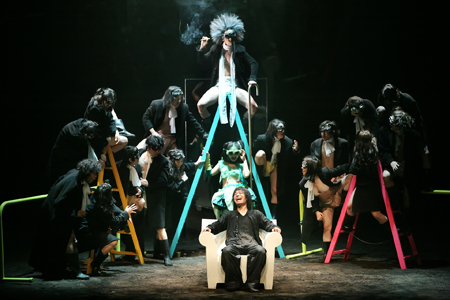
What I take most seriously when booking domestic performances is partnership. That part’s possible because we are a theatre. In the case of choreographer HONG Seung-Yeop, we’ve worked with him since our opening. The first production came out in 2001, and so far we’ve made four productions together. We meet JUNG Young-Doo through another partnership. We also started to work with director YANG Jung-Woong in 2003, and his “Peer Gynt,” produced in 2009, has gotten really good reviews. Another production by him is scheduled for 2012. We only have a theatre, no space for production. This is primarily why we had more foreign performances and why building partnerships is very important to us.
Because the annual budget is managed very tightly, we cannot lavish funds on theatrical or dance performances. Instead, we try to support them within our system, and creators feel satisfied with that arrangement. In the case of Jung Young-Doo’s production of “A Seventh Man,” we invested eight hours of preparation from morning to evening for three months. It’s not easy to find dancers able to commit so strongly to one performance, but it was a very important consideration for Jung Young-Doo. We gave him full support and only auditioned dancers who accepted these conditions. Although we only have limited options, we make as many changes as possible, like providing rooms to practice and plan in and freeing up the stage for a week of rehearsals.
We usually stage about one domestic play and one dance production a year. We do work with more local classical musicians, but I can’t say we produce musical performances. In the case of plays and dances, it takes two to three months of practicing before staging, and the entire cast and crew is fully committed to the work. We try to lend support in other areas so artists can really focus only on their work. This process allows us to exchange ideas and progress together. It’s a really important part for making good productions but also why we’re only able to produce two or three productions a year.
YANG Jung-Woong, “Peer Gynt" (2009)
LG Arts Center doesn''t cast artists through open calls. Then what’s your standard for selecting artists?
It’s not like we can avoid competition, but we need to take a lot more risks. Because our theatre is built on a quite prominent reputation, we decided that it’s better to find artists who are a good match and with whom we can make good partnerships. Some artists see us as physically and emotionally remote because we’re in Gangnam and funded by a big conglomerate, but we try to take bold chances frequently to find many different artists.
Basically, every booking is a team decision, our staff shares opinions, talks about works, continuously monitors prospective artists’ works, and considers what kind of production is right for our theatre. Through this process, we meet with artists and start the conversation by sharing mutual ideas and interests.
I agree that competition can''t be right answer all the time. What kind of artist draws your attention?
We have had many works by accomplished artists in their 30s who are starting to gain acclaim. Of course, we also work with already established artists. In the early years, we made a musical called “Do-Sol-Ga” with director LEE Youn-Taek and “Iago and Othello” with director HAN Tae-Sook. We also produced “Pillowman,” a re-interpretation of a foreign work by director PARK Geun-Hyung. Just as we introduced lesser-known but exceptional foreign artists and works, we’d like to collaborate with young up-and-coming Korean artists, like Yang Jung-Woong, Jung Young-Doo and SEO Jae-Hyung. The preparation processes and critiques have been good. We’re discussing future projects with them, and also preparing a new performance by director Seo Jae-Hyung for next year.
International exchange focusing on global appeal and future orientation
You’ve introduced many famous foreign artists to Korea, what’s your motivation?
Artists like Sasha WALTZ, Robert LEPAGE, Peter BROOK, Lev DODIN, and others that we’ve introduced were already popular but had never come to Korea before. We don’t just look for name recognition and draw, we look for artists that we ourselves really want to see. We want to see them with our own eyes and find out why they are world-famous dancers and directors. Another thing we look for is a work that shows world trends, like Derevo (“Once…” and “La Divina Commedia”), 4D ART (“ANIMA”). A UK company, Hofesh Shechter, that we introduced this year got good reviews with their “Political Mother.” They have finished just two productions in the UK but are a rising presence.
We schedule about 20 performances covering various genres each year. Our audience is passionate about art. Many have purchased year-long passes rather than choosing one or two shows to attend. They trust our theatre, so this makes us more careful about our programming. However, sometimes I wonder whether that carefulness is good in terms of encouraging variety. Initially, we just had the mindset “If we like it, we do it.” There were many unknown elements. But as time goes by, we’ve become more conscious of audience reaction. Perhaps too often we introduce new performances by artists with whom we’ve already built a relationship. Of course, introducing new works by good artists is also very important; there’s no point being hung up with only introducing new artist. But we’ve got to avoid playing it safe.
Joint productions are big now, especially at performance art festivals. What about LG Arts Center?
I think festivals and theatres have different roles. We’re also interested in joint productions, but not just for the sake of doing it. In festivals, providing spaces where artists can interact and share is very important, but theatres are more focused on presenting good work and meeting the audience.
As a different form of co-production, we premiered Pina BAUSCH''s dance "Rough Cut", an interpretation of Korea made to commemorate the Center''s 5th anniversary. We introduced her to Korea in 2000 and worked with her several times before her death. She choreographed the piece based on impressions from travels around the country she made herself in the fall of 2004. Later it was staged in France, Japan and other countries and received high praise.
Being a stepping stone for our works heading abroad is also a very important role as a co-work between art centers and artists. Thanks to Pina Bausch, AHN Eun-Mi was introduced to Germany and “Lady Macbeth,” directed by HAN Tae-Sook, was staged in Poland. Whether the work was directly made by us or not, I think we should be a bridge supporting all exceptional works that Koreans produce.
Foreign artists also appreciate us giving them a chance to meet Korean audiences. They find it tremendously stimulating. Asian audiences are different from Western, and Korean audiences are even unique by Asian standards. Since there’s a tendency for work to evolve and artists to get inspiration from interaction with different audiences, Pina Bausch began to blend many Korean things into her work: dance moves for one but also there are many cases of her using Korean music. Inspiring each other is very important. We’re continuously trying to propel these kinds of relationships.
Recently, multi-media and atypical works are gaining popularity. Can LG Arts Center adequately promote this trend with its one proscenium-style theatre?
The truth is our theatre was not born as a theatre originally. It was seen as a way to leverage idle space in a private commercial site. Facility-wise, it’s a really good theatre, but it’s true that it didn’t secure enough space to allow experimentation with all artistic ideas. It is not perfect. It was a pioneer, bringing art to what was a cultural wasteland in Gangnam.
Structural changes to embrace new cultural diversity are difficult, but performances can be modified to fit our space. In addition, our management and planning teams are open to doing all that we can with the space that we have to work with artists. For Anton Chekhov’s “Black Monk,” directed by Kama GINKAS in 2002, we empted all the seats in the 1st and 3rd floors and turned the 2nd floor balcony into a stage. We limited the audience to 150 and created spatial illusion. For Derevo’s “La Divina Commedia,” we placed a rotating stage on top of the main stage and raised the audience’s seats, so they could watch from every angle.
Effective management and audience participation
LG Arts Center is cited as a great marketing case study, who is LG Arts Center’s audience? Now many theatres are doing it, but you were among the first in Korea to use a data base and promote season tickets. Your various ticket policies have played a big part...
Many find our performances expensive because we cover many genres and also sell season passes. But we take into account market conditions first before we set prices. In fact, we look for ways to lower costs, but calculating BEP (Break Even Point) is rather pointless. Our priority is bringing in many people to enjoy the performances, and we prepare various methods to do that.
Our theatre membership owners now total 230,000 people. We run a free membership system, focusing on providing information. Those 230,000 are people who have a fairly high interest in performance art. Our members purchase half the seats. I think the other half likely comprises members as well since they may be attending as part of a group or at the invitation of non-members. There’s no official data, but I believe 70% to 80% of our audiences are our returning members. Half of annual pass holders, who see five or six performances a year, work in the art and culture industry themselves.
Accumulating and utilizing DB and the season packages are all survival methods (laughs). We are on a remote, lonely island here in Gangnam. It is not like Daehangno, where you can catch a performance on a whim while meeting a friend. Our theatre has hardly any on-site ticket sales. We’re not giving away invitation tickets either. We must focus on ticket reservations. Since we also have many foreign performances, it has to be pre-programmed. All this led to the season system and ticket packages. Since many ticket buyers are in the art and culture industry, we need to consider price. The performance, the audience and the location of the theatre – all of these factors are linked together.
Your audience-participation program LAMP has generated buzz too. How’s it doing?
It’s important to give real value to an audience, instead of being just a nominal presence. LAMP stands for “LG Arts Center Meets People.” It gives audience members a chance to meet artists, get a chance to understand their vision and participate in their working process. Once section comprises 8 to 10 sessions and lasts about one to two months. For example, Jung Young-Doo led a program where participants had to actually move their bodies to learn how a contemporary dance performance and professional choreography work. In Seo Jae-Hyung’s LAMP people learn how to actually make a musical themselves. Seo’s new musical play will premier next year.
This is a great chance to get motivated to see the work from a new angle. The good thing is that audiences who’ve participated have developed a deep interest in and affection for our artists. It was a trial to grow attendance and foster a sophisticated audience who could experience and understand art. Half of our LAMP participants came to one or more of the performances, and 30% bought ticket packages. The Artists who participated benefited from the feedback and found it much more motivational than simply putting out a piece that was developed behind closed doors and hoping for the best.
Now many cities have public performance halls. LG Arts Center still has two distinctions though: It’s privately owned and the brainchild of a corporation. What are the pros and cons of that?
The theatre’s operating costs are based on the early donation of the LG Yonam Foundation. The non-profit organization strives to return the corporation’s profits to society through culture and to promote LG’s corporate image. Because there were few competitors earlier, it was easier to accomplish this mission. Our performances were very fresh, even just bringing something new to Korea, made us feel that we had given back to society and improved LG’s image. But now the market has almost become a red ocean. In this environment, we question if our role is still valid. Can’t local governments or festivals do the same thing? Are we just adding to the competition? Such questions have helped us progress and change little by little. That’s why we’ve put more weight on introducing young artists and trying to develop beneficial programs like LAMP.
One good thing is that we have been able to stay true to our founding mission. Since we can run our operations independently from political influence or social changes, we have been able to maintain our unique color. On the other hand, since we don’t rely on what’s already been proven popular with the Korean public, realizing LG Arts Center’s twin goals of benefitting the public and generating a positive image is something that is difficult and stressful. We’re part of a corporation – we cannot afford to neglect the profitability of our benefactor. In many ways, we have more pressure to use our budget more efficiently than public theatres do. We have stability, but in order to keep it that way, we must stay really good at what we do.
|
|
|
Pina Bausch, "Rough Cut" (photo by Usrula Kaufmann) 2005 |

Fostering good producers
What brought you to LG Arts Center?
I came in December 1996. Before that, I’d worked in one classical production agency for a year and half. My first career was a totally different industry. I worked in the financial industry for four months, but I really liked performances since my university years and always wanted to work in this filed. Back then, I didn’t know what performance planning was. Few people in Korea did. Having said that, I think I’m also a beneficiary of Korea’s growing performance art industry.
What’s your main role and responsibility?
Our organization is closer to a producer system than artistic director system. I can’t say which is better, but, with us, each staff member is in charge of handling actors, dancers and classical and jazz musicians. Our members find works from each field and bring them up for discussion. As a group we decide whether it fits our theatre and how the audience will react. And then, the person who submitted the idea takes full responsibility for casting and executing that work.
I do planning for plays and dance and jazz performances myself. But for classical – even though I first came into performance planning through that genre – I defer completely to another colleague who knows it much more better than I do. I really like theatre and dance, so I put priority on them. I also do programming for jazz and world music, particularly because I really like world music.
Because it’s not built on one person’s idea, all of us try to move harmoniously to reflect all of our personalities and tastes and the color of our theatre. Although we have an approval system, our planning team’s opinions are well respected. Sometimes it feels like all of us have started to develop similar tastes. This can be good and bad. I’m a little worried sometimes about the lack of surprises. But most of the time – since we all value different perspectives and reaching consensus – I think we can still discover and promote unique talent.
To land foreign works, you must go abroad often. How do you spend your year normally?
When I first started working here, I went to many summer festivals. Summer is my least busy time. We have leased our stage to other companies then and in the other seasons I’m busy overseeing our current productions here or lining up acts for the coming year. Incidentally, it’s not like summer doesn’t matter here: Leasing the space is a good way to bring in revenue and introduce the venue to people who maybe have never seen it before.
At first everything at festivals seemed fresh and shocking. But as time went by, I saw that festivals are also just serving up the best works of the year. Like eating again and again from buffet tables, it didn’t feel satisfying anymore at some point. Now if I go to festivals, I go to ones in Eastern Europe that are not so popular or try to find works by visiting theatres that are not well known in Western Europe. Eastern European performances are more intense with strong imagery and are more often based upon literature. They have more sentimentally appealing aspects. There are many new faces as well. In the West, particularly in the U.S., as you know there are more avant-garde and experimental works. These are a little colder. I’m not saying I’m not interested in the West. Usually I often collect information from the Internet. If I get interested, I ask for materials first and then make a tour itinerary and go for an overseas trip.
What’s your role and philosophy as a producer?
When presenting and producing performances, the most important thing is to know why I’m doing this work. Having a clear mind and philosophy about what parts I need to value most and what I need to show, that’s what’s important. Good work shows various things. For example, the director’s imaginary power, new discovery in formality and sociocultural awareness. Just as a director or actor should have his or her own voice, a producer must have a distinct and clear voice.
I also want my audience to get at least one thing from seeing our work: the joy of rediscovering the inspiration they once held or of rediscovering literature. In the past, I thought if the work is good, I need to present it regardless of the audience’s interest. That’s what a good producer should do. But now I think I have developed a more objective perspective. I think it’s important to have supervision that can embrace various values, instead of insisting on just subjective value.
Just like all other performance halls and festivals, we should meet our artists and develop our performances. We’re not a repertoire theatre, nor a theatre specializing in new productions, but only when we have our own works can we have something to exchange with other theatres. I’d like to be seen as a producer at a place known for putting out exceptional works.
Someone said virtue of LG Arts Center is its originality and sustainability. I’ve got curious about their coming 10 years where good teamwork is with a representative Eui-Jun Kim who ‘knows performance and construction well’ and worked in Seoul Arts Center as the director of performance business dept. and was with LG Arts Center from early years when its performance hall was being built, and planning team head, Hyung-Jung Lee who gets abreast with Mr. Kim before we knew it.
*** LG Arts Center http://www.lgart.com
2000: LG Yonam Foundation opens its multi-function performance hall with 1,100 seats after five-years of planning and construction
2001: Named “Theater of The Year” by the United States Institute for Theatre Technology Inc. (USITT)
2009: Yohangza Theatre Company’s “Peer Gynt,” produced by LG Arts Center, wins The 2009 Korean Theater Awards the grand prix, Best Director and Best Stage Art awards
 PREV
PREV
.JPG)
.jpg)
.jpg)
.jpg)
.jpg)












;)


