





The Lyricism of Life’s Harsh Reality and Hidden Side;
Director & Playwright KIM Nak-hyung
CHOE Suna, Cultural Producer
Daehangno is usually deserted on weekday afternoons. It is a cultural zone that is home to more than 150 small theatres lining narrow alleys. The area feels bleak when the theatres are closed. The half-century-old Hakrim Tea House, where director Kim Nak-hyung agreed to meet, bears traces of history that contrast sharply with Daehangno’s modern, ornate atmosphere. Classical music plays as I look out the second-floor window at a group of 50 students here to watch an open-run performance. The door of the café opens and director Kim enters, his sunken cheeks and protruding cheekbones partially covered by his thick coat.
From actor to director – endeavors in Hyehwa-dong
Director Kim Nak-hyung began his career at a theatre club in college, but his acting began in earnest when he joined the theatre company “76.” Named after the year of its founding, 76’s unique style earned it respectable attention. Its signature performance, “Insulting the Audience,” perfectly represents the personalities of its members, who included such talented actors as KEE Kook-seo and PARK Keun-hyung. Acclaimed plays that Kim wrote back then paved the way for his career as theatrical director in 2001.
Tell us more about how you began your theatrical career.
It was a long time ago... I started as an actor, but it turned out to be more difficult than expected. I couldn’t overcome that obstacle and had health problems as well, so I began writing plays shortly afterward because I wanted to express my thoughts. Theater Lab Hyehwa-dong No. 1 only accepts people from theatrical companies recommended by existing members. The most essential element in theatrical activity is not directing but the power to produce plays. In the beginning, I formed a team with a group of my peers and later we set up the theatre company Joogjoog to perform original plays.
Hyehwa-dong No. 1 marked its 5th anniversary this year. “My Classroom,” “Star Fall,” “All Nights on Earth” – it has created many famous plays. How was it working there?
It was like a real laboratory. Like an ordinary lab that students can use after school. It encouraged competition and collaboration toward our common goals, as well as inspired creation. Back then, I worked with the performance hall in mind. For a novice, it’s better to create productions for one specific stage rather than for diverse stages, because it inspires you to change yourself, as you can’t change the theatre. When working in a given environment, you are more likely to experiment.
Joogjoog’s Macbeth” first ran at a small theatre but later moved up to Namsan Arts Center with support. How do you rate mid-size theatres and their growing popularity?
It depends on what kind of play is staged there. Some plays are meant for small theatres, while others are presented better on a bigger stage. Occupancy rates play an important role in choosing the size of the theatre, but some plays require special consideration because of their subject and other aspects, such as lighting, rather than size or extravagance. The concept of space especially matters when the plot of a play deals with the past. It requires space that has nothing to do with the size of a theatre. In that respect, the Namsan Arts Center helped us unearth new possibilities.
Warm Stories about Lonely People
Many plays that you wrote and directed personally such as “All Nights on Earth” and “Singing in the Wind” depict the lives of socially marginalized people. Their characters are rough and the endings far from happy. Nonetheless, after seeing them audiences receive a message of hope.
All Nights on Earth(Joogjoog)
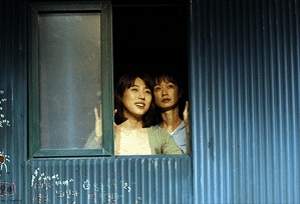
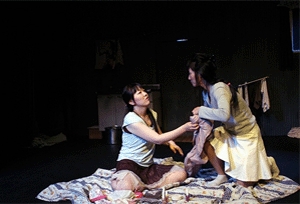
The ending of “All Nights on Earth” is different from what the general public expects. (The play was written after passage of an anti-prostitution law and deals with social violence against a prostitute.) Many people think of social issues as mere gossip and quickly forget them. I realized that even though social issues are brought up, they are rarely resolved. I wanted to talk about not only prostitution but also issues concerning social minorities. There are people who try to fight, but there is only so much they can do. We can’t tackle every single issue, and our lives and fates are often determined by new issues. I wanted my audiences to think about this when watching my plays. Rather than solving problems, I wanted audiences to think about their stance on social issues and their way of thinking. It was like a conversation between us. That’s what I keep in mind when writing my plays. I want them to be more coolheaded and logical rather than emotional. Rather than simply putting a group on display for spectators, I’d like my plays to shed new light on social issues, open up audiences’ minds and make them feel like they and social minorities are citizens of the same place and neighbors.
Despite their heavy subjects, your plays also contain humor and evoke laughter.
I didn’t want to talk about hope, be it in the endings or in storylines. Though my characters say that they can receive help from the general public, they always stay where they are, even when they search for hope. They’re always on people’s minds. The public doesn’t care where they go, whether they go by car or travel abroad. The public thinks that these people are where they belong. My plays look upbeat because of their humorous aspect. They look as if they send a message of hope, but I never gave hope.
“Singing in the Wind” is about wandering people. Its characters live interesting lives. Though it’s not a story about art, its characters write poems and play music. I still remember the line, “I can live without a lover, without work and without money. But I can’t live without music even for a single day. What do you know about music?” What message did you try to send through this play?
Music is the most primary art and the most direct story. I didn’t have much opportunity to experience music. I lived alone when I was in middle and high school. Everybody was poor back then. I think that people can develop their musical talent if they often listen to music in their adolescent years. Of course, anyone can listen to music in places where it plays. But people who have listened to music since adolescence concentrate better on music than those who have not. Not everybody can absorb music well, even though we’re all the same. Art differs from real objects but can still be understood through written explanations. Music, however, can’t be learned from books, apart from theory. Perhaps that’s why music always has spiritual light. But writing theatrical music is like creating a special element for plays. Even though I’m not talented at inserting the right music in the right scene, I think I know how to handle it, not because I know much about music but because I know well what images are used, how a production is staged and the overall mood. But I can’t guess how audiences will perceive it. In this respect, this play is largely determined by its characters rather than its subject. Sometimes music can tell more about a person than anything else. The movie “Road” features an accordion performance, which was a very simple idea. “Singing in the Wind” is about people who lose their way and wander.
Your plays also tackle the issue of teenagers, like “My Classroom.” The set of “Macbeth” also features a classroom. What do you think about youth?
Macbeth(Joogjoog), 2009
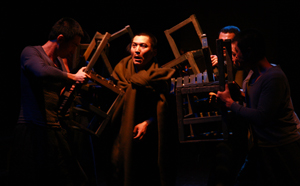
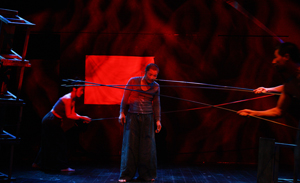
I don’t think of that as an issue of teenagers per se. The issue of school bullying has become trite, but middle and high school students continue to commit suicides. Why does that happen? Is there a solution? The more I think about this, the more puzzled I become. Is that because violence is encouraged? Or is that a result of social irrationalities, individualism and computer games? In the past, children had many opportunities to express their hidden hostility through play and exercise, but nowadays they face cutthroat competition. I don’t know the right answer. In the play, the teacher hardly ever appears. School problems are left unattended. The storyline deals not only with violence in schools but also with violence in cities. It’s an open space where no conclusions are made. It’s a deserted space that was abandoned by society. “All Nights on Earth” also deals with issues that nobody is responsible for. Society is always irrational and has holes, no matter how well-knit it is.
Yesterday high school students took the scholastic aptitude test. Seeing the whole nation making a big deal out of that, I realized how suffocated teenagers are in our society.
Teenagers are not adults yet but they’re no longer children. They’re something in between. They can’t be monitored with laws nor can they be treated as children. They are a combination of sense and sensibility, and there’s nothing we can do about that. Neither laws nor emotions can change them. It’s a period that is hard to understand.
Conventional vs. experimental plays – development of realistic texts and spiritual spatiality
You write in diverse genres, from conventional to experimental plays. The genre of your plays seems to be determined by their subject and what you want to express through them.
When I focus more on scripts, my plays become more realistic, whereas when I pursue my ambitions as director, my plays include more elements of the stage language. I always wonder what audiences like about good plays. A good play is one presented with special effort and that helps audiences feel their self-esteem and presence. It makes them think, “Ah, those are actors. They speak through the stage language, which they create through their imagination.” Impressions received by the audience from how a play is staged are more important than impressions received from the play itself. No matter how heavy its subject, a one-hour play can’t change people. It’s all about impressions that people receive from what is presented on stage. On the other hand, plays must combine their subject with form. Art is all about expression. It’s like a new philosophical perspective. That’s why I often focus on directing. I tell myself to focus on directing rather than just writing serious plays.
You must have the power to convey your messages in the strongest way because you personally write and direct your plays. Are you more interested in how your ideas are expressed on stage?
Actors on stage can express things that cannot be expressed through words alone. I want to write texts laden with such possibilities. Some movements are expressed mentally, while others are portrayed physically. I want to try both within one year. I have to develop texts and use actors’ language, because it refines things. I also want to use meaningless sounds and objectified physical feelings. Rather than expressing many things at once, I want to use improvised elements. For instance, in “Macbeth” four actors on a chair portray Macbeth’s anxiety. The scene has a symbolic and metaphorical meaning, but it also causes anxiety in audiences by making them worry that the actors might fall from the chair. Both language and objects can be neutral. I spend a lot of time studying the differences between abstract and material things. My head is always filled with thoughts about phenomena occurring in human civilization, spiritual landscapes and modern abstraction.
Recently, the theatre group Tuida presented a clown version of “Macbeth,” while the theatre company Moolee staged an experimental version of “Lady Macbeth.” Both plays are about Macbeth’s human desires. You seem to focus on the subjects of fate and suppression. What’s the reason?
Macbeth(Joogjoog), 2009
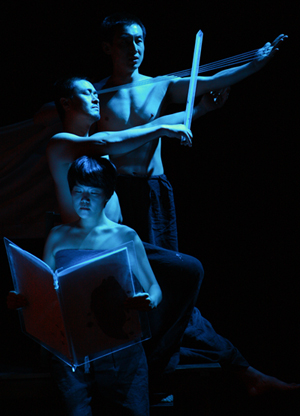
Desire and ambition drive Macbeth to commit vicious crimes. All humans possess those feelings and are ready to cross barriers in pursuit of them. Those feelings come from the deepest corners of the soul and sometimes they are expressed in a supernatural form. The final scene of the play shows the main character being dragged and looking back on his life. Though he is dragged by a ghost, it’s also him. When the ghost is put to rest, Macbeth feels like he is also dead. If you think about it, Macbeth is not the main character. The numerous supernatural elements surrounding him, whether accidentally or intentionally, are the play’s main characters. They monitor human beings. Macbeth has to fight, not against Macduff and those in power – those are just devices that help explain how human beings become trapped. He has to fight against an invisible world. I wanted to portray all the other personages in the play as supernatural elements surrounding Macbeth and existing in him. I portrayed them as a supernatural chorus that stands apart from the inner world.
People who saw “Macbeth” say they were impressed by the line, “I thought I would be able to endure this.” I was also impressed by it. What did you try to express through it?
To be honest, I took the cue from a phrase that I found on the Internet. The meaning represents Lady Macbeth’s personality. It can be said in the beginning and at the end. When it’s said in the beginning, it sounds like a proposition, whereas when it’s said later, it sounds like an ambiguous creed rather than simple repentance. It’s not simply a conclusion that one was unable to endure. Perhaps that’s why it has a special nuance. Text fills the performance space. The anxiety of a perpetrator is portrayed in a performance thanks to the text.
Experimental plays features lots of movement and objets, such as old desks, chairs, candlelight and buckets. The scratching and pounding sounds produced by actors are primeval yet they perfectly fit the mood of the play. “My Classroom” and “Macbeth” feature the images of a classroom, undergarments and a cape that’s more reminiscent of a blanket. What do they mean?
In “Macbeth,” the characters wear undershirts and ordinary pants. The characters of “My Classroom” also wore undergarments in the beginning. Like I said, it’s an element of a performance. It’s half-realistic-half-symbolic. Though undergarments don’t symbolize anything, they can tell a story. They are ragged and they’re close to the skin. That’s their meaning. Their function is to keep the body warm when it’s cold outside. That’s the concept of the costumes and accessories. Chairs and desks also have their function. But old desks carry a special meaning. It’s something between the reality and objet, between the reality and aesthetics, between the reality and symbols. It’s a raw performance that audiences can feel with their whole bodies. I wanted to protect the spatiality of Macbeth’s soul. Asian plays mostly depict the spiritual aspect through objects. Even a simple object can have another potential, which is different from dichotomy. That’s what I was interested in, and that’s why I wrote “Macbeth.”
“I want to create plays that help people understand their self-esteem.”
What kind of plays do you want to write in the future? 
I often think about the needs of the present era and how art and theatre can meet them. The theatrical world is tucked among reasonable activities, play and life. They supplement one another. Sometimes I also want to do things that I really want to do. I think there is a need for plays that stay around for a long time, not because they draw many spectators but also because they have much to say. They make audiences understand what they lose and what they miss. Things that we miss refer to contemporaneousness, while things that we lose refer to our original forms. These two aspects meet each other at the right time. I don’t know how much more I have to learn. (laughs)
There are many commercial plays in Daehangno, but real drama can’t help but tackle the subject of the human essence. What is the most difficult part for you?
Toran-geuk(Theater Lab Hyehwa-dong No.1)
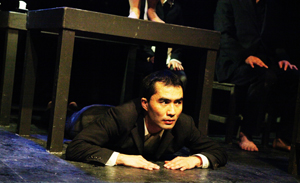
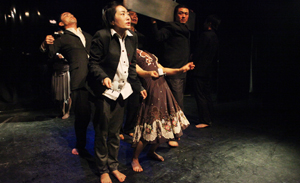
That I’m not talented enough. I’m not free. Theatrical plays are about reason and self-consciousness. The sense of identity usually disappears the moment the curtains go up, but until that moment, it continues. We have to understand the psychological aspects. Actors must look at themselves when acting. Sometimes it’s suffocating. But in the end, we must create a certain realm of life. I enjoy going to the countryside. I can’t drive, so sometimes I take the subway and travel to the final stop. Energy is recharged not by releasing but by pushing. You can’t regain your energy just by going places and having fun. It does help to boost your mood, though. That’s why people in the theatrical sector always look gloomy. They constantly push themselves. In the end, we have to tackle the neurological aspect because our reason and experience are mixed with logic. We do that on a subconscious level. We end up not with our body or mind, but with our nerves. Plays that tackle the neurological code are the right plays.
Like music and art, in theatre there is also a stereotype that you must never be wasted. It’s because of constant pushing that you regain your self-esteem and meaning. Tell us more about how you manage your company. How many members does Joogjoog have?
Not very many. Eleven or twelve. We also have three or four freelancers who have been with us for a long time. We have been together for ten years. Sometimes we envy big theatre companies consisting of 40 people. Many of our members are old. We need to find young actors. The financial aspect remains unresolved. Actors abroad can continue their careers even when they become old, but in Korea that’s not the case, sadly enough.
What are your future plans?
We’re preparing a play about the tragic poet and writer LEE Sang. It will be staged by the Hwaseong City Cultural Foundation in December to mark his 100th birthday. I wrote the script for this play, called “Lee Sang, December 12,” and will direct it. Next year, I will stage a play at the Doosan Art Center. I plan to write a new play, but I have yet to decide what it will be about. (Mr. Kim received the Doosan Yonkang Art Award this year which includes funding to produce a new play.) I hope I’ll have more opportunities to stage “Macbeth.” It seems like it was created a long time ago, but it’s been only three years and it wasn’t presented that often. I also hope I’ll get a chance to perform abroad. I had a chance to perform in Egypt and China. I wonder how Asian audiences are different from Western audiences.
***
It was already afternoon. Before we wrapped up our conversation, Mr. Kim began lamenting drafts and other materials from his early works which were destroyed in a fire. He expressed his hope that the National Archives of Korea increases funding for the preservation of artistic materials. He received some solace from knowing that even though the original materials disappeared, they are always reflected in his performed plays. He now does the best he can to preserve his work in his office.
KIM Nak-hyung, Director & Playwright
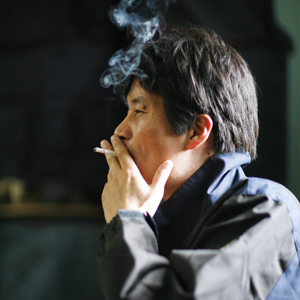
Kim Nak-hyung
Director, playwright, actor
CEO of theatre company Joogjoog, Studio 76
Debuted as director in 1999 with “Nude Women”
“All Nights on Earth” – Best Actor, Best Play, Best Korean Play, Art Award of the Year (2006)
“Macbeth” – Best Production, Best Korean Play, Best Domestic Play selected by the National Theater, Best Play at 2009 Cairo International Theatre Festival (2008)
Also wrote “Family Baguette,” which depicts the voyeurism of modern people and the world they cannot escape from; “Artists,” which is about the inner world of artists who torture themselves; and “Toran-geuk,” which is about the time and space surrounding an ordinary family.
 PREV
PREV

.JPG)
.jpg)
.jpg)
.jpg)
.jpg)












;)


