





An Encounter on Gwacheon’s Street for Sharing Art
– YIM Su-taek, Artistic Director of Gwacheon Hanmadang Festival -
CHOE Suna, Cultural Producer
Located just 30 minutes south of Seoul by subway, Gwacheon in south-central Gyeonggi Province is the country’s best-known planned community. The Gwacheon Hanmadang Festival has been held in downtown Gwacheon, where apartment and government buildings stand side by side, for 14 years. This year, the Festival ran from September 29 to October 3 with roughly 90 showings of 39 local and foreign performing arts pieces. Despite some cancellations and venue changes from rain on the Saturday I visited, quite a few performances went forward. Festival staff handed out raincoats so umbrellas would not obstruct the view of the performance, and people of all ages willingly complied. Being in the rain with the actors made me feel closer to the performers.
I visited Gwacheon again about two weeks after the festival. Things were back to normal in the open plaza next to the civic center and the small parks where the festival booths and main stage had been. After a late lunch, I sat down with Gwacheon Hanmadang Festival Artistic Director Yim Su-taek in a cozy café adorned with chrysanthemum blossoms. It was a bit chilly, but Director Yim still appeared more comfortable outdoors.
Gwacheon Hanmadang Festival, an Invitation to Street Arts in the City
Please tell us about the Gwacheon Hanmadang Festival.
The Gwacheon Hanmadang Festival was conceived at the 1997 International Theater Institute World Congress in Seoul as an attempt to promote street performances. The Korean Popular Theatre Association and The National Theatre Association of Korea Inc co-organized the first festival, then-titled ’’97 Gyeongggi and Gwacheon International Madanggeuk Grand Festival. The response was phenomenal. So many city residents came to see the programs. The lack of significant cultural events for ordinary residents and the great September weather were big factors at that time. Gwacheon officials were amazed at the public reaction and pledged the city’s full support for the next festival. The name Gwacheon Hanmadang Festival was finally set in 2003. It has grown to a signature performing arts festival with an emphasis on street and outdoor performances. Like all such festivals, Gwacheon Hanmadang Festival tries to incorporate the latest street-performance trends and future visions.
The festival started off as an event that brought amateur theater groups and residents of Gwacheon together to celebrate traditional outdoor plays. But you took on an instrumental role in shaping the festival into today’s artist-oriented performing arts festival. Why did you bring the changes in the festival’s objective and characteristics?
There were more than 100 pieces presented in the 2002 festival. Then-Artistic Director Park In-bae was an authority in outdoor plays, who tried to turn Gwacheon into the mecca of outdoor performances. So he organized different groups for various target populations, like children and college students, and helped them create their own performing arts pieces. He then invited them to the festival.
When I took over as artistic director in 2003 I uninvited all amateur groups, because I thought a performing arts festival should contribute to the growth of the performing arts genre. If the previous festivals aimed to diversify the performing arts audience, I thought it was equally important to provide an environment for artists to create high-quality works. My career started in amateur plays, but amateur theater groups can be encouraged in other ways.
Do the city’s spatial characteristics work well for the Gwacheon Hanmadang Festival?
The street performance genre suits the urban characteristics of Gwacheon. What makes it difficult for festivals is that there are many misconceptions. People often think of a festival as a loud celebration, like conventional folk festivals or tourist festivals. Gwacheon had none of those traditions. It was hard to familiarize residents with the performance art festival concept and see it through. It was unrealistic for officials in an industrialized and modern city like Gwacheon to expect the kind of communal sentiment found in traditional farming villages.
The Gwacheon Hanmadang Festival succeeded only because Gwancheon has a good environment. It’s a small city of 70 thousand, so a few aptly placed banners are enough to advertise the event. Also, the festival venue is just a few steps away from the main residential area. Well-known festivals usually take place in smaller cities, which illustrates how important the city’s size and character figure into a festival’s success. In addition, Gwacheon residents were very eager to have their cultural needs met, as they had comparatively high overall economic and educational levels.
Interest in street performances is growing, and theater groups are now trying to develop pieces for outdoor venues. What is the appeal of street arts festivals?
Their vitality. Energy is the common feature in all street performances. Performers need to shout and music has to be loud since they have to be heard out in the open. Serious and heavy materials need to find other means of communication, because large crowds usually make it difficult to concentrate. Street performances need to meet several conditions, and those conditions can be fulfilled only with lively performances. The purpose of a festival is to give the public a chance to enjoy arts, just like the festival slogan says. Moreover, it is to prove that art is possible even on the streets. In fact, there were a number of pieces that attested to that.
Street Performances: Seeking Site-specific Pieces and Experience-based Open Performances
What are the latest trends in street performances?
Today’s street performances tend to be experience-based and site-specific, which means that a piece actively incorporates the features of a space. Unlike conventional plays, with specific starting and end points, street performances opt for an open style without a beginning or an end. People wander around to see short scenes depicting one unified theme. This is the kind of work that wins people’s attention, although relevant examples were scarce at our festival this year. Another trend I noticed is that European street art features delicate intricacy rivaling that of indoor plays. This trend is especially apparent in site-specific pieces, which subtly control the lighting and audio, allowing the audience to concentrate on the play. Such plays use non-urban venues, such as a field, a closed-down factory, or an empty lot.
|
|
|
Yeon(緣)-Karma (Theatre Company Yohangza), 2004 |
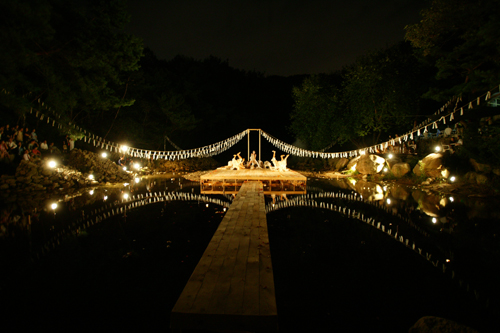
In Korea, Theatre Company Yohangza performed “Yeon(緣)-Karma” on Gwanak Mountain in 2004. It was a beautiful and impressive piece perfectly tailored for that mountain venue. Of course, it would have to undergo some changes if performed in another locale. In the meantime, Theater Momggol’s “Red Shoes” – winner of this year’s joint outdoor play contest – attempted to communicate with the audience by actually taking them on a bus. This is not an experience-based performance as in the manner mentioned above, but an extension of the conventional method of gaining experience. The audience probably has never seen a play like this before. It cannot be labeled yet, but it sure was a fresh attempt.
What’s your take on the latest trend in Korean street performances?
There’s really no trend to speak of yet. Street performances in Korea are still in their experimental stage seeking their identity. They’ve just started to understand street space and create suitable pieces. Most pieces in the past were made for indoors, which is why they looked so awkward when presented outdoors. Now many artists have studied and made good use of the outdoor space. Theater Momggol and On & Off Dance Company have showcased notable performances, and Homo Ludens Company led by NAM Geung-ho had its start in the streets, so it knows well which elements are required to produce superb street performances. Improad Badac, which took part in this year’s festival with a piece titled “The Path”, also understood the characteristics of outdoor performance venues and showed potential.
The Need to Discover New Works and Continuously Support Performing Arts Groups
The Gwacheon Hanmadang Festival has reportedly provided experimental opportunities to performing arts groups Tuida and Theater Momggol. How do you discover and support new artists?
|
|
|
Robinsoncrusom (Homo Ludens Company), 2010 |
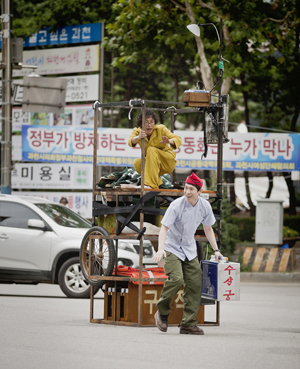
First, we sometimes subsidize existing plays. It’s nice for artists to continuously create new works, but it’s equally important to concentrate on one piece and improve upon it time after time. So we provide a three-year subsidy to promising works. “Self Portrait” by Visual Theater Company CCOT was such a case, and so was Homo Ludens Company’s “Robinsoncrusom.” I continue to support such works in the hope of not only giving them a good start, but also motivating them to present a well-made finished production.
As for the subsidies, we choose recipients jointly with the Chuncheon International Mime Festival through a public contest or individual presentations. In the latter case an artist’s portfolio becomes a good selection criterion. We tend to put more weight on the artist rather than on the work. Once we decide on the recipient, we provide him or her with an advance subsidy to get the production rolling and let the beneficiary know which festival he or she has been invited to.
|
|
|
|
Self Portrait(Visual Theater Company CCOT), 2010 |
Blossoming April (On & Off Dance Company), 2010 |
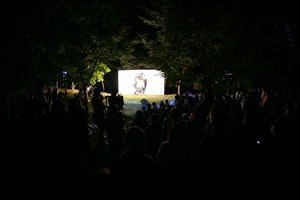
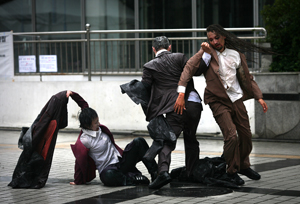
Such assistance is what drives the development of performing arts pieces. This year two pieces are slated for presentation abroad. We have recommended “Self Portrait” of Visual Theater Company CCOT and “Blossoming April” of On & Off Dance Company. These two pieces will also be recommended to Spain, which is eagerly making program exchange proposals to us.
*** “Self Portrait” of Visual Theater Company CCOT : A play about the depth of life and man by integrating painting, image, installation, live music and performance. This group was established in Israel in 2000
*** “Robinsoncrusom” of Homo Ludens : There is a living space that has been taken over by a road…Homo Ludens was established in 1999 with the motto ’’one who plays’. Based on mime, they look for new methods of body movement and its potential to discover innovative ways of communicating with their audience.
*** “Blossoming April” by ON & OFF Dance Company : The picnic of the spirits of young artists, full of challenge and defeat, disgrace and glory. ON & OFF was established in 2001 with the slogan “free movement”, and has projected this aim through dance, performance, and cultural exhibition
Joint street productions with other countries are the specialty of Gwacheon Hanmadang Festival. How do such collaborations come about?
|
|
|
|
Sortie de Cuisine (Homo Ludens Company |
Ku-do (Momggol and Lunatics), 2007 |
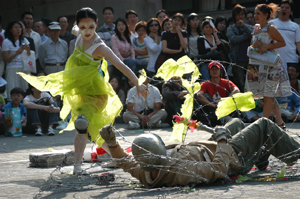
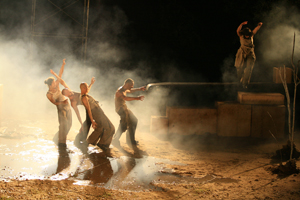
Joint street arts productions are undertaken every year. Such cultural exchanges provide us with an opportunity to understand each other’s culture more deeply. It’s also a chance to gain European know-how for street arts. The first joint production was “Sortie de Cuisine” made by Korea’s Homo Ludens Company and France’s Ilotopie in 2006. The two cultures came together to present a story about diversity, communication, and barriers. In the following year, Theater Momggol and the Dutch theater company Lunatics introduced “Ku-do,” which was about people looking for the right paths during an unfamiliar journey called life. Reviewers said Asia’s flexible mentality typified by Theater Momggol had enriched the works of Lunatics.
This year’s collaboration was a dance piece titled “Nal Boa” (Look at Me), produced jointly by Korea’s Project Wae and France’s Ex Nihilo Dance Company. In previous festivals, the productions were co-directed, but this year Ex Nihilo’s Anne Le BATARD was in sole charge of choreography, which lent coherence to the entire piece. Critics said that the dancers’ energy was overwhelming and the clash between the human bodies and the urban setting was fantastic.
Korean performing arts groups were able to grow and gain overseas experiences through these co-productions. I could see that their follow-up works were indeed different. These collaborations go on national and European tours. Giving them a chance to steadily upgrade and perform the pieces further refines the works and helps publicize Korean culture to foreign audiences. I talked to the Korean dancers who took part in “Nal Boa” this year, and I could tell that they were very excited by the opportunity. So I told them they would get my full backing if they started any new project.
The way you produced the opening piece appears to have set Gwacheon Hanmadang Festival apart from other festivals.
Most of the festival program comprised street plays, so they were the most important element. There are other Korean street performance festivals like the Ansan Street Arts Festival and the Goyang Lake Arts Festival, but few street arts groups have come far enough to allow the performances in Gwacheon to be easily differentiated. All the festivals need to work together to facilitate the growth of street arts in Korea. But if pressed to cite a unique characteristic of the Gwacheon Hanmadang Festival, I’d have to say its opening performance.
The opening program has always been a large-scale performance with 70 or 80 artists and ordinary citizens selected from workshops. Just like last year, this year’s opening piece was a collaboration between the One Grain of Sand Puppet Theater of the United States and Theater Inhyeong Eumma (Puppet Mother) of Korea. The piece was named “Gwacheon Dreams” to illustrate the hopes and dreams of Gwacheon expressed through various puppets. Every year I try to incorporate Gwacheon’s regional identity in the opening program.
|
|
|
The Prayer (Mardok Theatre Group of Iraq and HOBT from U.S.), 2003 |
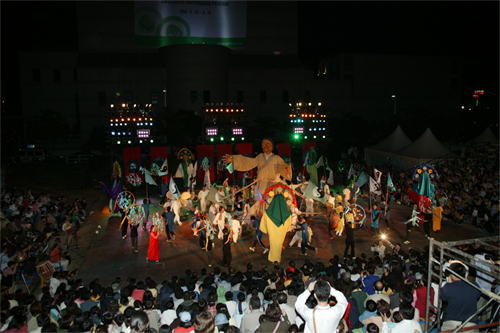
The current production method was derived from my first year here in 2003. That year, I produced a piece called “The Prayer” with HOBT of the U.S., Mardok Theatre Group of Iraq, and a cast of Korean actors and citizens. There was a very emotional element to this production. The joint endeavor between the American and Iraqi artists was presented in September, just a few months after the Iraq War between the U.S.-led coalition and Iraq came to an end. They were at war as late as in May. After the Iraq War was over I happened to come across a newspaper article in early June about an Iraqi dance troupe resuming performance at a theater where its roof was blown away by bombing. The performance was planned for the people of Baghdad who were devastated by war. I was so moved by this story. Those Iraqi artists showed what arts should do. So I decided to invite them to our festival. It wasn’t easy to bring the Iraqi team into the country. I made an arrangement for them to arrive 15 days ahead of the festival and gave them a chance to perform together with the American group in the opening program. The message of reconciliation and peace was infused into the piece. All the other opening programs since then have contained the same message of hope and involved ordinary citizens.
What is the most important factor in selecting a performing arts piece?
I have three principles I adhere to: First, the piece should have technical finesse. This is the most basic factor when selecting a piece. The second principle is how a performing arts piece reflects social issues. The piece should speak about contemporary society. The third principle is the modernization of tradition. Obviously, it’s difficult to find a piece that meets all three principles. Still I demand the first two from the candidates. Technical finesse is still being worked on, and many programs are trying to illustrate current perspectives in their own way. In 2009 Alice Kim’s “Chic” and Visual Theater Company CCOT’s “Self Portrait” were invited to France. Upon extending a second invitation to “Chic,” a French artistic director reportedly said that Korean performing arts productions have sincerity lacking in recent French performances and take an insightful look at social issues. I believe that being socially aware is vital for a performing arts work.
*** “Chic” of Alice Eunsook Kim : A performance about a woman struggling to free herself from obsessing over her appearance, beauty and materialism. Her obsession with today’s commercial culture’s is expressed with movement, restricted verbal communication, and combined realistic/non-realistic acting.
Korea Street Arts Center: A Public Forum for Street Arts
You’ve launched the Korea Street Arts Center and assumed its co-chairmanship. What kind of activities do you engage in at the Center?
The Korea Street Arts Center was launched with a general assembly in February 2009. I expected a small gathering of about 30 attendees, but had to find a larger venue in a hurry when more than 100 people signed up. Producers and artists got together for a two-day assembly to discuss various topics, such as production development, policy design, publicity, and education. Last May we opened the Street Arts Marketplace to provide an opportunity for street arts performers to come together and critique one another’s pieces. We also opened the Street Arts Creative Forum. But the problem with the Center is that the staff and I, and especially the board of directors and managers, are so busy that it’s hard to run the Center day to day. I think we should first work on the Street Arts Creative Forum.
Training producers and providing the basis for artistic creation are also instrumental in promoting street arts. What kind of plans do you have in this regard?
In terms of training personnel, people often talk about training producers, but I think there should be more street artists. People also talk about building production factories, but it would be more realistic to have a storage warehouse, because performing arts teams have to discard or give away their props after the performances are over due to the lack of storage space. Some people have even volunteered to lease space for a production factory, but a lot of facility operation and labor costs go into maintaining a production factory; we can’t just rush into it. As of now, Koreans don’t know enough about street arts to build a production factory. It’s not that easy to find a way, but we will try to do it.
*** The Street Play Center, predecessor of the Korea Street Arts Center, had played a central role in holding seminars and workshops and publishing an online magazine on street arts.
Autonomy in Festival Operation: Just as Hard to Attain as Financial Independence
The private sector has long operated independent arts festivals, but it hasn’t been that long since the central government or a local government body sponsored arts festivals and appointed artistic directors. You have been named the festival’s artistic director three times, setting a record for the longest tenure. What are the issues related to running the organization?
Gwacheon initially set the tenure for the official artistic director at two years, but the board of directors upped it to three years. In most renowned foreign festivals, artistic directors are tenured for five years. The budget is also longer, allocated for three years not one, to allow an artistic director to completely commit to a project and make long-term plans. That’s what I miss the most. The Gwacheon Hanmadang Festival adopted the artistic director system early on and granted the basis for the festival’s autonomy by establishing a foundation. It was also important to have a stable organization with experienced staff and a low turnover rate.
Our relationship with the city of Gwacheon has improved a lot, but some disagreements still remain. The city government is not fully aware of what a street arts festival is and what it should do. The municipal government should realize that a performing arts festival brings many intangible benefits, such as boosting the growth of performing arts and providing citizens with cultural enjoyment. Officials demand a lot from us, since we are fully funded by the city. We try to meet the demands if they are reasonable, but we must fight if not. So far, we’ve fought them more often than accepted them, because the demands were unreasonable. It’s really difficult to maintain the operational autonomy of the festival as much as the financial independence.
(At this point the festival operation team leader SEO Young-hee, who had filled in the interview with her views now and then, started talking.) Every time a new mayor was elected, the festival’s direction and name would change. We are still concerned about being swayed by political interests because all the artists’ skills and new experimental opportunities we worked so hard to attain may be deprived of support. I think it’s up to us to preserve the festival’s identity.
From Indoors to Out on the Streets
|
|
|
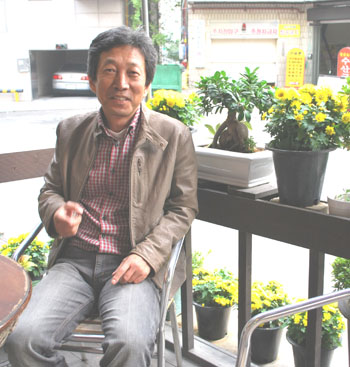
YIM Su-taek, Gwacheon Hanmadang Festival Artistic Director |
What do you find so appealing about street arts and the Gwacheon Hanmadang Festival?
I became artistic director for this street arts festival after doing indoor plays. At first, I didn’t have much interest in or affection for street plays. I even thought about changing the mainstay of the festival to indoor plays. But once I started watching outdoor dramas or street performances, I became captivated by their appeal. Subsequently, I removed all indoor plays from the festival program a few years ago, and turned the festival into an all-out street arts festivity. Street arts take down the barriers separating life and arts and provide ordinary people with an opportunity to experience artistic fantasy and shock. The power of street arts comes from the unrestricted expression and communication carried out in public and providing a venue for that power is the basic role Gwacheon Hanmadang Festival should play.
Frankly, after I became the festival’s artistic director, I had tempted and even threatened young artists to switch to street plays. I’m the reason why many artists are now performing in street plays. It would be absurd if I left to do something other than street arts. I would be very satisfied if I can continue to make valuable contributions to the street arts genre. I’m not going to be the one to leave Gwacheon and street first.
Don’t you want to do some personal projects? What kind of projects would you like to do?
Of course I want to do my own projects. But I still have to focus on my role as artistic director, so I really don’t have the time. If I ever did a personal project, it would have to be a street play, since I can’t do an indoor play when I’ve told everyone else to do street plays (laughter). I want to do a monologue drama. I could just travel from one village to another with all my props crammed in a car and perform on the street. The project should be serious, yet humorous as well. Just like a spoonful of sugar makes the medicine go down easier for children, there should be something really appealing to the audience. I want to do some of my old children’s plays: “Grandfather’s Pocket” and also “Mouse Hunting (Rozznjogd)”. My earlier work “Theater Maker (Der Theatermacher)” also got good reviews. Come to think of it, these are all monologue dramas or multi-character plays that end up with only one character doing all the talking.
In closing the interview, Director Yim is said that he’s very straight forward, sometimes to the point of being radical, and sure about what he likes, which makes other people uncomfortable. He admitted that he is not perfect, but said he can’t stand artists who only pine after love, staff who are not passionate about street arts, citizens who won’t make an effort to see a play at a venue even a little way off, bureaucrats who think festivals should be loud touristy attractions, and corporations stingy with cultural contributions. But perhaps the secrets to his solid career lie in his willingness to get angry and fight for what he holds dear and his strong belief that sticking to principles would eventually be rewarded with trust.
*** Gwacheon Hanmadang Festival
Having started with the name ’’97 Gyeongggi and Gwacheon International Madanggeuk Grand Festival in 1997 co-sponsored by The Korean Popular Theatre Association and The National Theatre Association of Korea Inc. Gwacheon Hanmadang Festival has introduced theater plays, mask dances, outdoor plays, shamanistic rituals, and various other forms of performing arts at outdoor venues in Gwacheon. Discussion on the concept of outdoor performance prompted a name change to Madang-Gwacheon International Performance Art Festival in 1999 and the festival made many new attempts. Since then the festival underwent two additional name changes while taking shape as a bona fide street arts festival. At the time when the mainstay of outdoor performances consisted of Korean traditional entertainment such as samulnori, mask dance, or outdoor dramas, Gwacheon Hanmadang Festival served as the starting point for Korea’s own street art culture, which attempted to add modernity to age-old tradition.
*** The Gwacheon Hanmadang Festival Foundation
The Gwacheon Hanmadang Festival set up a fund in 2000 for the autonomous operation of the festival secretariat and registered it as a foundation in 2003. The Foundation is staffed by six full-time workers. The Street Play Center, predecessor of the Korea Street Arts Center, had played a central role in holding seminars and workshops and publishing an online magazine on street arts. In addition to the Gwacheon Hanmadang Festival, the Foundation runs the Children’s Festival commissioned by the city of Gwacheon, Sansa(Mountain Temple) Music Concert, Saturday Stages, and other projects.
Gwacheon Hanmadang Festival http://www2.gcfest.or.kr/
Gwacheon Hanmadang Festival Foundation http://gcfest.or.kr/main.html
***Yim Su-taek
Artistic Director, Gwacheon Hanmadang Festival (2003 – present)
Co-director, Korea Street Arts Center (2009 – present)
Director, The Seoul Theater Association
President, Theater Company Yeoreum
Producer, translator, adjunct professor at the Hankuk University of Foreign Studies
Director of “Theater Maker (Der Theatermacher)”, “Glass Menagerie”, “Grandfather’s Pocket,” “Mouse Hunting (Rozznjogd)”, “Idiot Shin Dong-seop” and many other plays.
 PREV
PREV
.JPG)
.jpg)
.jpg)
.jpg)
.jpg)












;)


