





HONG Sung-yop, Artistic Director of the Korea National Contemporary Dance Company
Interviewed by CHANG In-joo, dance columnist
Hong Sung-yop, director of Dance Theater ON, was appointed the inaugural artistic director of the new Korea National Contemporary Dance Company on July 28. A long-standing aspiration for professional dancers in Korea, the National Company was welcomed as a crowning achievement for Korea’s five-decades of contemporary dance. Naming the Company’s first director was a long, arduous process that took the Ministry of Culture, Sports, and Tourism nearly a year, so Hong’s selection has come with congratulations and high expectations.
Who is Hong Sung-yop?
Hong realized that he was not cut out to be an engineer after only a semester in Kyung Hee University’s Textile Engineering Department. He did eventually graduate with an engineering degree but enrolled in dance classes whenever he could. Even though he started dance much later than most, he showed exceptional talent and won the grand prize at the Donga Dance Competition in 1984, just two years after taking up contemporary dance. He went on to study in the Graduate School of Dance at Kyung Hee. There, he and his classmates took part in many contemporary dance performances choreographed by distinguished alumni.
Hong abruptly joined Seoul’s Universal Ballet Company to become a ballerino. It was his first job as a professional dancer, and he said he did it mainly to learn how a professional performance group operated. He quit ballet three years later and went on to establish Korea’s first private contemporary dance company in 1993. He choreographed some 20 dance pieces over the next 18 years. His works include “Byeok-o Geumhak,” based on LEE Oi-soo’s novel, “Horn”; “AhQ,” based on “The True Story of Ah Q” from China; “Cyber Africa,” sponsored by LG Art Center; “Shadow Café,” “More than Two Shadows,” “Red Buddha,” “Déjà vu” and “A Dog Watching the Moon,” which were all invited to the Biennale de Lyon; “Blood in the Eyes of the Horses”; “The Fifth Part”; “Snow White”; and “13 Scampers”
Armed only with passion for dance, Hong has presented sensational works in Korea’s barren dance landscape. His appointment as the leader of the Korea National Contemporary Dance Company (KNCDC) must have triggered a flood of memories from his eventful past. On August 13, I met with Hong, who was busy preparing a unique launching ceremony, and asked him about his thoughts on his past, present, and future.
 |
|
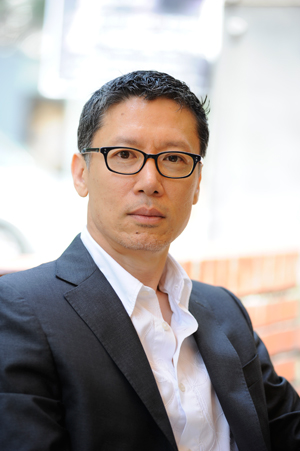
HONG Sung-yop, Artistic Director of the Korea National Contemporary Dance Company |
Korea already had a National Dance Company and National Ballet Company, but no National Contemporary Dance Company. I congratulate you on its establishment, especially at a time when Korean dancers are making names for themselves on the global stage. You must have some special feelings and thoughts about serving as its inaugural artistic director.
Actually, I have so many things to do that I don’t have time to feel anything. There were moments when I was suddenly overcome with emotions, but they were fleeting. I know there is much work to be done, so I feel pressure. Also, I’m now in the process of closing down my beloved Dance Theater ON because I can’t lead both a public dance company and my own private dance troupe at the same time. It saddens me very much, because I was very involved in the studio’s design and construction. But I chose to take down the dance studio myself because it’s for a greater good. I decided to think only about the future and leave my regrets behind.
Everyone must be interested in the new KNCDC’s direction. What are your plans?
My first and biggest dream during my three-year term is to create an environment in which dancers can focus only on dancing. I also aim to discover and train new talent by founding a “choreographers’ club.” Only the most promising workshop pieces will be staged. I will initiate a process in which dancers can overcome the rigidity of the Korean dance world as well as experiment with and nurture their ideas. A supportive physical environment must be created in order for dancers to put on well-thought-out and polished performances. There must be practice studios, dancers, and, most of all, a group of choreographers who can share and critique ideas. Unfortunately, Korea has yet to provide such an environment. This is why I’m trying to shape the KNCDC into a place that nurtures younger dancers.
My second dream is to narrow the gap between Seoul and provincial areas through dance. I will present established works by Korean dancers to audiences in smaller cities. If contemporary dancers put on more performances in smaller venues, other dance disciplines in Korea are also likely to become more accessible to the public. I will prove to those who consider contemporary dance too difficult that it is more enjoyable than any other art form.
Thirdly, I will work hard to take Korean dance to the world. Some leading Korean performances have been highly applauded abroad but failed to achieve much success because their globalization attempts were not very organized. The KNCDC plans to develop various repertoires and introduce them to appropriate markets worldwide, so people can make their own judgments.
The dance company has been established, but there are no dancers. What does this mean?
That means that there are no resident dancers in the company, unlike other conventional dance companies. Similar to overseas contemporary dance companies, the KNCDC will audition dancers for individual projects and the selected dancers will be contracted by piece and receive practice and performance pay. This is an unfamiliar system, which has caused some people to worry that dancers will not be getting enough chances to perform. But I plan to put on smaller performances on a more frequent and continuous basis, which will lead to more dancers taking part in more projects than under the resident dancer system. There will be as many as 200 dancers working and performing all over the country in a season. They will be reviewed time and time again, and their steadfast effort to hone their techniques will help them grow as dancers. I plan to hold an audition at least once every two months so talented dancers will be financially stable enough to make a living without working other part-time jobs. Given the current deplorable situation for dancers in Korea, these are unbelievably great conditions. On the other hand, incompetent or lazy dancers will be weeded out even before they set foot on the stage. They will experience what being a professional dancer is all about. I want an artist, not a technician. As professionals, my dancers must have the ability to express their dance philosophy with their bodies.
How will you audition Korean dancers who are not used to auditioning for parts?
When choosing dancers, I will respect the choreographer’s opinion. I will do away with the ills of the Korean dance world where school and regional ties rule. Any dancer who thinks that his or her dance style is a fit with that of the choreographer can audition. As I’ve said, I plan to hold an audition at least once every two months to show that the doors to the KNCDC are wide open, but obviously only to those with skills and talent.
I heard you are planning a special launching ceremony. Can you tell me more about it?
Since it’s a launching ceremony, there will be a founding declaration. The stage will be covered in grass and the presenter will invite about thirty first- and second-generation contemporary dancers onto the stage. They will take their shoes off and join the declaration of the Company’s launching. The reason for going shoeless is to symbolize the spirit of contemporary dance, which is to dance barefoot and freely, and to show that our long-standing prayers for a contemporary dance company have been answered at last. I expect a round of dancing when those thirty dancers come down from the stage.
I want to ask you about the general situation for Korean contemporary dance. What was the biggest difficulty in your 18 years as the leader of a private dance company? Other private dance groups likely face the same predicaments.
The biggest difficulty was a financial one. Dancers were called for practice from 11 in the morning to five in the afternoon. Although I couldn’t pay them regular salaries other than performance fees, I think they were paid in rigorous training to become professional dancers. Over the past few years, I taught contemporary dance in high school to pay for the studio rent. Fortunately, it gave me enough financial stability to focus on choreography. We were also lucky to have been chosen as the recipient of a state subsidy, which allowed dancers to focus on dance as their primary career, not their secondary job. Before, they had to make ends meet by working part-time jobs at coffee shops or forgo pay altogether for a chance to express their love for dance. There were times when I ran out of food as I was working on a piece. But once that piece was completed, I immediately began thinking about the next one. I think I’m made for this job. I have built quite a sizeable repertoire. This is what I find most rewarding.
How would you rate the level of Korea’s contemporary dance?
There are many Korean choreographers highly recognized overseas. The problem is that there has been very little state assistance for dance performances to go abroad and choreographers lacked the ability to pioneer new foreign markets. It’s impossible to show the world great dance pieces if no administrative support is available to present them on a regular basis. Fortunately, however, the dance field has recently begun to adopt a marketing structure with the help of art administrative experts. I believe now is the time to rearrange the existing repertoires and venture out to the global stage.
Do you have any advice to young dancers?
Despite having enormous talent, many young dancers don’t have a sense of direction or responsibility. This is not something I can give them. They have to think hard about it and explore their identities on their own. I may be able to provide them with some guidelines, but I don’t think I can be all that helpful as their mentor. My job is to build an environment that facilitates creative works. So I hope they do their part by training and shaping themselves into great dancers.
 PREV
PREV
.JPG)
.jpg)
.jpg)
.jpg)
.jpg)












;)


