





OH Sung-hwa, Director of Seoul Fringe Network
: Promoting Young Performing Artists and Artistic Exchanges in Asia
Interviewer: YI Su-hyun
(Producer, Production Group Yeou, Zac)
Sometimes words lose their original meanings and become proper nouns. In the Korean performing arts sector that happened when the Seoul Fringe Festival became known simply as “Fringe.” It stands apart from other performing art festivals in that it has a distinctive goal and constantly strives to create venues of communication for independent Korean artists.
This year, the Seoul Fringe Festival, which has been held mostly around Hongik University, is preparing for the next decade in its history. We met with its director, Ms. OH Sung-hwa, to talk about the festival’s achievements over the past 12 years and its future direction.
 |
|
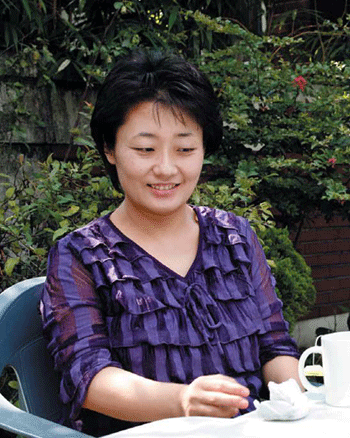
OH Sung-hwa, director of Seoul Fringe Network |
Please, introduce the Seoul Fringe Network and the Seoul Fringe Festival.
The Seoul Fringe Festival was founded in 1998 as the “Indie Festival.” Back then, it was a festival for independent artists who needed to express themselves. They were artists from diverse genres such as indie music, dance, theatre, film and art. But later, it evolved into a festival of performing arts. The Indie Festival got off to a great start in 1998 because it was the talk of the town and received extensive media coverage. We thought that the festival had a good chance of becoming a regular event because at the time interest in low-brow, non-mainstream culture was high. When we were looking for similar overseas festivals to use as our benchmarks, we learned that fringe festivals were like communities of artists and that at the Edinburgh Fringe Festival anyone could introduce their work. That was our role model for a free-spirited fringe festival in Korea and that’s how we promoted the Indie Festival. In 1999, we scrapped all the selection criteria so that anyone could freely participate in the festival. At the 5th Indie Festival in 2002, we renamed it “Seoul Fringe Festival.”
The Seoul Fringe Network is the former Independent Art Festival Center. Its name was changed to bolster its role in supporting independent artists and promoting exchanges among them. One of its missions is to foster collaborations among independent Asian artists.
Tell us about the Seoul Fringe Network’s main projects.
The Seoul Fringe Festival is the network’s biggest project. Currently, it is establishing an organization to promote independent art by adopting new performance planning methods from artists who we meet at festivals. While the fringe festival serves as a platform, the fringe network is aimed at intensive and progressive collaboration with artists through performances. One of the past examples is the Next Wave Festival. Many artists who we meet at fringe festivals have a hard time finding performance organizers despite strong ideas and potential. That’s why we provide them with support in terms of planning and organizing. Secondly, the Seoul Fringe Network’s mission is to connect artists. The network’s office is called “F+” and its mission is to provide artists with space, such as rehearsal rooms for independent artists, small presentation rooms, warehouses for storing tools, and kitchens for cooking. In other words, the office helps artists build a community by providing studio and living spaces. By doing so, F+ helps artists communicate and hold exchanges. Thirdly, we operate the online webzine “Indianbob”. We launched it in 2007 because we wanted the right critical culture to promote independent art.
How did you come up with the concept of “independent Asian art” in international exchanges?
Back in 1998, the Indie Festival dealt mostly with Western performing arts because there was plenty of information about it. Interest in Asia in general was relatively low at the time, and Asian artists hardly ever held exchanges with one another. Many critics say that it was the Seoul Fringe Festival that first brought up the issue of “Asian exchanges.” In terms of planning, we had to select the right areas and focus on them. We received much help from the Hong Kong Fringe Festival, which provided us with valuable advice and connected us to networks. We wanted to promote international exchanges in order to find the identity of Asian culture. We made “bringing independent artists together” the festival’s goal. There was little information on other Asian cultures and their differences despite their geographic proximity. Thanks to the Hong Kong Fringe Festival, we joined a network of independent Asian art, which included artists from Taiwan, Malaysia, Singapore and Macau.
 |
|
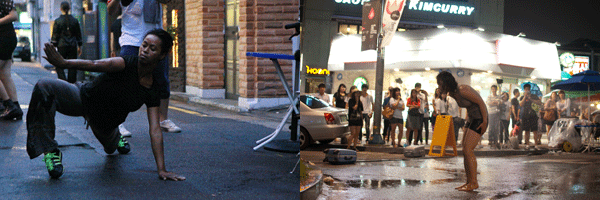
ET AUSSI DANCE COMPANY, USD Modern Dance (2010 Seoul Fringe Festival) |
Why focus specifically on Asia?
Many other organizations hold exchanges with America and Europe. They have the financial means and information to do that. So there is no need for us to do the same. Through exchanges with independent Asian artists we’ve learned what we have in common with other Asian people and what makes us different. Exchanges among Asian artists remain an important issue. It has been less than ten year, so we will continue doing this for another decade. When our festival was just founded, it dealt with diverse genres, including film and art. But after it became a performing arts festival a decade ago, all other genres were eliminated. The same applies to international exchanges. There are many interesting sources in Central and Latin America and in Europe, but right now our efforts are focused on Asian exchanges. We pursue not just high-quality works in international exchanges, but research into artists as well, because once you get to know an artist better, you naturally become interested in his or her works.
What is the future of Asian exchanges and collaboration?
The Seoul Fringe Network holds international exchanges by inviting independent Asian artists to festivals. This three-year project, counting this year, is carried out in selected cities. In 2010 it was held in Taiwan, in 2009 in Bangkok and for 2011 we have chosen Malaysia. Our current international exchanges are small in scope. They’re held in the form of invited performances and method-sharing workshops. We also help artists visit one another and share information. Someday we want to submit an official application for Asian artists. Unlike in Korea, not all artists can participate now; only those who match the concept of the project. But I’m sure it will become an open contest. We’re discussing the best methods and timing for the project.
Tell us more about your “post-fringe festival” project, which was launched in 2009.
More than 300 teams usually participate in fringe festivals. The number of artists alone reaches thousands of people. All teams and artists are different, which means that they all need different partnerships. It is imperative for festival organizers to understand what artists want, so they can help them develop relations. The first method is entering the art market. Fringe festivals feature both indoor and outdoor performances. Our representative indoor project is “Project Bigboy,” which we are carrying out in a joint effort with the Doosan Art Center. Its purpose is to support promising artists who display their skills at festivals. We help them meet partners who can provide them with space and financial support. The other method is an outdoor project that we have been carrying out jointly with the Gwacheon Hanmadang Festival. It deals with street artworks. Both the Doosan Art Center and the Gwacheon Hanmadang Festival realize the importance of fringe festivals for nurturing new talent and have high hopes for unearthing promising artists. We are also trying to come up with ways to bolster external cooperation.
 |
|
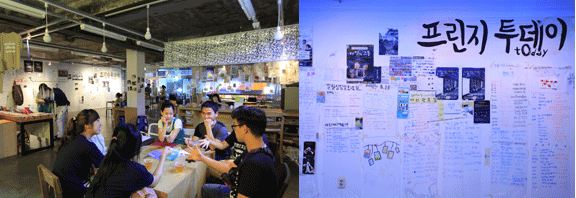
Festival Center of Seoul Fringe Festival |
What is the “post-fringe” project?
We personally produce and manage this project. For a fringe festival, it is essential to establish a rapport with artists. The “F+Playground” project, which we’re carrying out at the moment, was launched exactly for that purpose. It is a “house party” project that helps artists who want to see the process of creating original productions introduce their works at “F+.” We invite spectators who are interested in fringe artists to make friends with them by sharing meals and watching their works. We present both audiences and artists with an opportunity to discuss productions in the most sincere way, thus helping spectators and artists hold close exchanges. Thanks to spectators who share their honest opinions about artists’ cherished works, artists become stronger. That’s how the Seoul Fringe Network strives to become a people-oriented network that meets the demands of reality and helps build partnerships. The Seoul Fringe Festival must be able to stimulate artists. It must become a planning group that inspires artists to communicate, motivates them and helps them grow.
What are the goals and tasks of the Seoul Fringe Festival and the Seoul Fringe Network?
Our biggest task is overhauling our organizational management. The Seoul Fringe Festival is a public festival, while the Seoul Fringe Network is a professional planning group that supports independent artists. We have to come up with ways to manage and separate these two different entities in the right way. For instance, can we make the Seoul Fringe Festival a “cooperative” where artists live and work together? Thirteen years ago it was launched as a festival of artists who wanted and needed to meet with one another. But what can it be today? Can artists join this entity, participate in its productions and management and conduct free activities that defy bias and authority? Because the festival started as a community of artists, it absolutely needs basic goals. A “cooperative” is what we came up with. On the other hand, the Seoul Fringe Network should be a more flexible and fun entity. We’ve been thinking a lot about the roles of the festival and the network. Only the fringe art sector can create this kind of community that is neither public nor private. It acts as a mediator of public interest.
Last year, we launched the Art Creation Workshop. Its purpose is to help independent artists share their artistic theories with the public and educate the public about art. The workshop includes classes for low-income people, meetings with people undergoing treatment for alcoholic addiction, drawings, mime and theatrical plays. That’s how art becomes a part of everyday life and encourages theatre-going. It has been a while since art became an essential part of private education. Such workshops must serve as opportunities to enhance public access to art and creation. It is also important to ensure the substance of art workshops. We began inviting artists to our workshops three years ago. We believe that our workshops encourage the public to approach art and make it a part of their everyday lives as well as develop interest in artists and their works. In the long run, we will create a virtuous cycle of promoting art education, publicizing performances and artists, and encouraging more people to come to theatres. Fringe art is more about public participation rather than just about art itself.
Seoul Fringe Festival http://www.seoulfringefestival.net/Eng/
 PREV
PREV
.JPG)
.jpg)
.jpg)
.jpg)
.jpg)










;)


