Performance Group Tuida:
Running with the Spirit of Nature
|
Interviewees: Director BAE Yo-seop and
Planning Director KIM Deok-hee
Interviewer: CHOE Suna
|
|
Performance Group Tuida has earned the trust of both critics and audiences since its establishment in 2001 with its search for a new theatre language that utilizes puppets, objects, and the human body as creative tools. Besides introducing a new mobile puppet musical theatre format, it also took a biting look at social ills with its 2009 piece, “Alice Project.” The group moved from its home in Seoul to Hwacheon in Gangwon-do in May of this year. Performance groups such as Huyong Performance Arts Center and Potato Flower Studio have already successfully turned old derelict school buildings in that province into their creative homes. Hwacheon’s local government provided Tuida with an abandoned school building, which the group named Tutbat (small vegetable garden). It is evident that the members are diligently tending to Tutbat’s care. Even in the early morning hours the planning team was busy at work and a physical training session for performers was already in full swing. I met with director BAE Yo-seop and planning chief KIM Deok-hee in the newly renovated guesthouse.
“We live near the earth, the source of all life, and cultivate theatre plays just as farmers raise their crops. We hope to see the meaning of resistance and the healing power inherent in plays through this process.” |
- Q: It couldn’t have been easy for a theatre group to move to a rural area when most cultural groups are concentrated in Seoul. How did you come to move to Hwacheon and what were your thoughts?
|
|
|
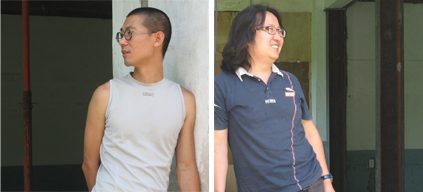
(left-right) yo-sub.Bae / duck-hee.kim |
Bae: I first thought about moving away from Daehangno while doing an extended run of a performance piece in 2005. I suddenly felt very alienated, thinking, “What do we hope to gain from this place?” If the idea of moving had been just a vague concern before, it became a concrete target then. (Daehangno is Seoul’s main theatre district with 150 small theatres.)
After we moved to Hwacheon, our thoughts about how we’re supposed to live grew more detailed. One was how to meet with the audience. The nature of a performance varies depending on who it is for. Most of our audiences before comprised people who enjoyed and knew much about theatre. But now our pieces are not only for those who see plays for simple pleasure, but also those who need them for different reasons. Since 2007, I’ve come to see the potential of theatre as a tool for education and therapy. The idea is akin to Boal’s play therapy, and we took to it quickly.
Another reason for the move was that we needed to be closer to our philosophical goal. I’ve always hoped that what we convey through our plays could be closer to our real lives. But I have always had this indescribable feeling of alienation. It may sound obvious now, but I thought the space we occupy was very important in this. Human lives have been driven by civilization, but, whether we want to or not, we need to go against the forces of civilization and be closer to nature. By doing that, my life and my plays have come to share the same values.
Kim: My work in the city felt very consuming. I thought about what I’d be doing in five years and realized I’d probably be doing the same thing. Mundane existence in the race to survive was very draining and seemed to deplete the performers’ energy. I was despondent over the thought of being harried and the need to repetitively sell our works to maintain the theatre company. Aside from pursuing our dream or an ideal, I thought we needed to find a realistic solution. This was a question of survival for us, a possibility to continue performing.
Bae: As with many different art forms, survival methods have changed continuously for theatre plays throughout history. We may be alone on this, but I think it’s about time that a new method of survival emerged, free from capitalist calculations. Not to say that survival comes from living a life removed from and totally unrelated to capitalism, but from opposing it and overcoming it.
The hardest part about living in the city was the lack of a sense of community. I was oblivious to this at first, but found it very difficult to live with as I grew older. When I was young, I remember doing something with people around me, but now I rarely see that. I don’t even know who my neighbors are. This is what we have to rediscover.-
-
-
-
-
- Nature-friendly Plays
- Q: “Tale of Haruk” is your company’s signature piece and has generated considerable interest. What made you create a play for children that uses objects and puppets as the main method of expression? “Nature-friendly play,” that’s an impressive term.
Bae: Early on we put on performances that were like fairytales or children’s plays. “Midsummer Night’s Dream in a Box” and “Sweet Story in a Book” required little space, so we took them on the road to remote islands or put on outdoor performances. The use of objects or puppets became a way to find our direction. It evolved into a method needed to enhance performers’ training. But using objects and puppets generated a lot of waste after each run. I wanted all the materials to be recycled and returned to their former states. This is how the plays became nature-friendly. We use everyday materials and props and recycled products. It was a simple idea at first, but it began to touch our lives and profoundly change our attitude about life.
“Tale of Haruk” was not intended for children. Still, it’s been called a family play. Our pieces are best received when the audience is a strong mix of adults and children because they can share their feelings. Parents typically just send their children alone into the theatre to save having to buy expensive tickets for themselves. This piece is different because adults and children tend to enjoy it together. In that respect, it can be called a family play.
Kim: People define us as a theatre company specializing in productions for children and then go on to say that our plays are too difficult to understand. But it’s the adults who don’t get them. Children understand the contents on their own terms. I think adults have a kind of prejudice about how children think. We used to say that our specialty is not plays for children, but as I talked to more people, I realized that plays for children are just as important and must be made well. We now have play therapies, educational program, and a hands-on experience program for children. I believe there are many different channels like educational programs, theatre plays, and performances through which we can communicate with children. We even talk about becoming more specialized for children.
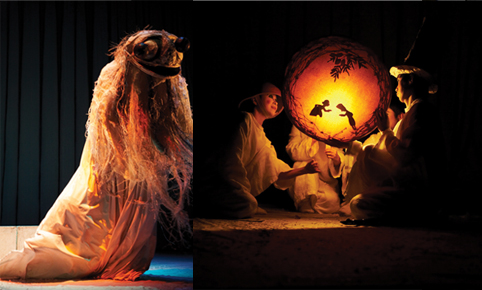
*** “Tale of Haruk” is based on a Korean myth and features masks and puppets. Performance Group Tuida’s second production, It’s about the profound love parents have for their children. Finely crafted props, imaginative puppet movements, and five musicians using props to perform music and make comical actions add vitality to the piece. It won the best production, best script, best art production, and best performer awards at Seoul’s 2002 ASSITEJ Festival. The play is still being performed at home and abroad and most recently has won the best production and the young critics’ prizes at Russia’s international Theatre King Festival in 2009.
|
Rediscovering Actors through Puppets and Objects
|
- Q: I’m amazed and even a little freaked out when I can read emotions in puppets or objects. Also the performers are very physically active. How do you go about making such a production?
Bae: I think about what goes on between the performers and the puppets. How the puppets act is not the only important thing. I focus on how they relate to other elements. I believe that’s the key. I focus on how performers change as the shapes and types of the puppets differ, whether the actors perform through the puppets or show their individual selves outright and how the acting method is affected when the relationship between the two change. These come before all the technical considerations. Puppets not only come in human forms, but sometimes are very simplified and even formless. We first started off with puppets, but gradually evolved to include the concept of objects. As I concentrated on the relationship between the objects and the performers, I began to pay more attention to the performers themselves. I need to understand what’s going on with the performers before interacting with outside objects and adding new expressions.
Kim: You may only see them as objects or puppets, but they’re actually extensions of actors and their acting. This is why the performers are so important and why we run training programs for them.
Bae: Our company has a definite idea about our performances. The performers behind the puppets become the characters we want to present, and the performance style varies depending on the closeness between the performers and the puppets. In some sense, the body of a performer is not just “me” but an object that “contains me.” When that object or performer becomes a character in the play, it thinks about what “I” means and how far a gap exists between the person and the character in the play. We consider those points to be crucial. Our concept is very different from the way performers generally empathize through what is known as the Stanislavski method. We maintain distance and don’t become those characters. Our belief about why that is so meaningful and how that’s possible is manifested in the puppets’ performance, and our actors are trained to maintain that framework.
What people call a realistic play is just a small part of theatre drama. But people tend to think that that’s all there is in theatre. That’s why all other performance methods, like traditional Korean plays or pantomime by clowns, are considered unfamiliar or strange. We try to incorporate all these methods. In a way, it has to do with the acting style embraced by Brecht. He was inspired by the acting methods of the East.
When we were in India for a tour in July, we saw a performance. It was a modern play based on a traditional story, but it wasn’t all that different from our preconception. Traditional tales are more universal than we thought. It’s just that what has been passed down has not been accumulated systematically or unified convincingly. I think what we have learned physically over time is more common and universal.-
-
- Alice Project- Three Keywords
|
- Q: “Alice Project” showed something new in many aspects. It was applauded for the mobile outdoor dome, being a puppet musical and tackling a social issue.
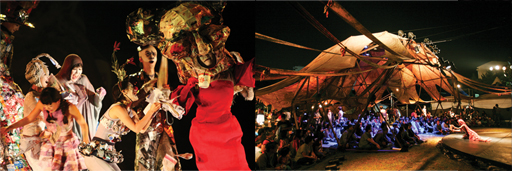
Kim: I thought about putting “Alice Project” on a mobile stage in the beginning. One of the difficulties of putting on a play is space constraint and limited facilities. One way to go about it is to disregard all these limitations like the traditional Korean folk plays staged outside in a public square. But I pondered the idea of a changeable space, a mobile theatre that can be set up anywhere. With the help of many friends, I was able to make a dome theatre. For “Alice Project,” the dome was sometimes used as a stage and sometimes as spectator seats.
Bae: I plan to keep on using the mobile dome theatre. They have been prevalent overseas since the 1970s, and a campaign to build mobile domes is still underway in the United States. I was encouraged by that and Mr. JANG So-ik’s mobile theatre provided me with much information, which helped me design and produce the mobile dome stage.
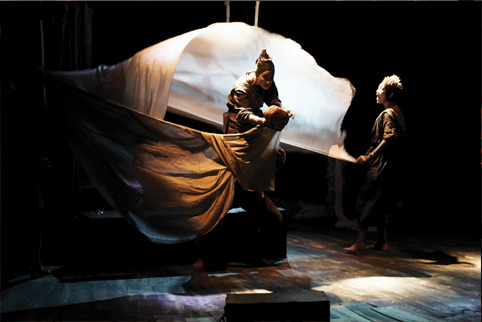
I wanted to include more of our world views in “Alice Project.” Past productions tried to find the meaning of universal values through myths and ancient tales. This play questions the contradictory reality of here and now. The story begins with the suicide of a 10-year-old girl who grew disillusioned. She enters Wonderland and begins to have questions about her existence.
This play had different production methods. Actors were instructed to depend more on their internal resources for this play. Previous scripts contained 80% of the information, but the script for “Alice Project” only provided 30%, and the rest had to come from the actors themselves. So, performers played a more active role in the training and creation of the play. We tried this method because I thought we had been relying too much on words.
-
Our 2009 piece “Clown Macbeth” is a more developed form of this attempt. It had a script, but it was rarely used. Actors chose a concept or a theme fit for a particular day and decided to add or take out certain scenes. Texts or dialogues can be added later on, but each scene was basically made up of how actors thought about a given situation. I think our actors thought it was more fun this way. Rather than having certain tasks fixed in front of you, creating and processing the impulses you feel at the moment provides a greater sense of achievement.
*** “Alice Project” is Performance Group Tuida’s second puppet musical. Based on Lewis Carroll’s “Alice in Wonderland,” it satirizes the irrationalities of the real world. It is a fairytale, albeit bitter and grim, with large masks and puppets and live music, all staged under a big dome structure erected outdoors. (Performed as a best outdoor performance at the 2009 Chuncheon Mime Festival and the Gwacheon Festival) -
-
- Adding Experience to Imagination
|
- Q: Actors and director must work harder together for this kind of production.
Bae: It requires much more basic training. There is what we call a movement meditation in our daily training program. It allows you to observe, become aware of, and adjust yourself to, as well as create something out of, your relationship with others. It’s a sort of improvisation lesson based on basic body movements, and it’s learned before self-expression. There is also a clown training session, which teaches a special way to encounter the world. This also comes from within, but everything that takes place when meeting an audience is actively incorporated into an actor and improvised on stage. We also carry out a very strenuous physical exercise, because some athletic skills are required. Another improvisation training has to do with language, sound, and body movements. Actors have to come up with impromptu responses to changing stage elements, such as the tempo, extent of energy, and the use of time. Improvisation training in dance has been expanded to sound and language.
|
- Q: I thought clown training and improvisation were similar concepts for you, but it turns out that they are a bit different.
Bae: There are stages of development. It’s still a work in progress, but “Hamlet Cantabile” is a production based on these methods, and our future production “Clown Macbeth” is likely to be so as well. The premier of “Clown Macbeth” is scheduled for September at Momjit Theatre in Chuncheon, and it will continue at Guerilla Theatre in Daehangno in October.
Kim: The puppet musical series represents the methods and various experiments we were working on. “Hamlet Cantabile” in 2005 was the first one in the series and “Alice Project” was the second. The third is planned for next year or the year after. “Clown Macbeth” is a clown show, which is a separate area from the puppet musical series, but it is based on the clown workshop.
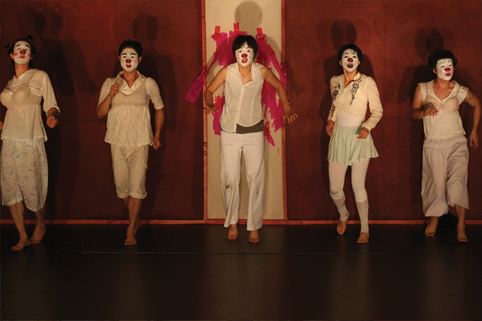
*** “Hamlet Cantabile” is Performance Group Tuida’s first puppet musical, depicting Hamlet’s life and death in a humorous and talkative manner by using masks and puppets to tell the tale of the Danish prince. The internal emotions of Hamlet, Gertrude, and Claudius are expressed by large face masks. Clowns act out and sing about all the characters in Hamlet with face masks, a wagon, a coffin, a wheeled box and flowers. Looking sometimes grotesque and sometimes comical, they comfort the dead by listening to their stories and send their spirits off with a shamanistic funereal rite. (Chosen as a PAMS Choice in 2008.)
|
Overseas Exchanges: An Extension of Relationships
|
- Q: I heard that you are working together with an Australian puppet troupe to prepare for a performance based on a local Hwacheon story. What does Lake Paro mean to you and what kind of questions will it pose to the two companies?
Kim: The biggest project for next year is a joint outdoor musical with Snuff Puppet of Australia. The name of the project is PPP for People Puppet Project. The story will be based on the accounts of those who survived the flooding of Lake Paro. The Australian team will work together with local community members, and we will join them for production. A local regional survey is underway now, which will be followed in phases by research, community work, and community-based production. The final outdoor puppet musical will be unveiled next May. Local residents will continue to take part in this production, and I believe that process is vital.
|
- Q: How did the overseas exchange project take place?
Bae: “Tale of Haruk” was performed mostly overseas and so was “Sweet Story in a Book.” “Hamlet Cantabile” continues to receive invitations from abroad ever since it was shown at PAMS, but it has yet to be performed overseas because of such issues as stage prop setups. But we plan to take it overseas, starting next year.
Responses from foreign audiences for “Tale of Haruk” have been just amazing. I don’t know exactly why there is such a difference between domestic and foreign audiences. I think foreigners, especially older people, find the Korean elements in it very appealing.
|
- Q: What are some of the most important elements in overseas performances for Tuida?
Bae: We go abroad to perform two or three times a year. In the past, I used to think of the trips as an opportunity to see how other people put on productions and operated theatre groups, rather than engaging in active exchange. But I started to feel that something was missing from just showcasing our productions. I was the one who first proposed an artists’ workshop. I made the same proposal for a workshop at this year’s performance in India. The Indian organizers were reluctant at first, but, seeing our enthusiasm, they advertised the workshop and arranged a venue. So I was able to hold a three-hour workshop on the relationship between objects and actors’ bodies for local performers. The workshop was titled “Objects and Movements,” which started off by exploring your own hands before choosing an object of your choice and then moved on to working with real objects. They thought the workshop and the process of sharing this acting method was a fresh and worthwhile attempt. Thanks to the workshop, we began to earnestly discuss the possibility of a joint venture. We could actually feel its potential with our bodies, not only our heads. When we visited Japan in July, we made puppets with local residents and took part in the parade for a local festival.
|
|
|
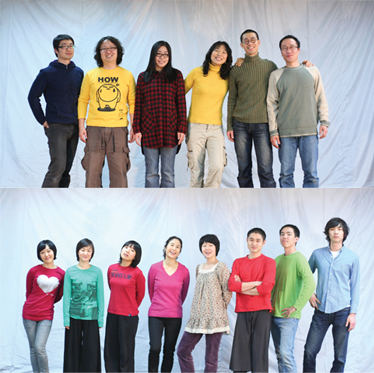
(top-bottom) staff / members |
|
Performance Group Tuida Running toward a New Decade
After lunch in the guesthouse, we walked around the old school yard with our fragrant coffee. I heard a performer singing pansori as a part of the vocal training for a musical. There are now only two buildings here – one for the office and studio and the other for the guesthouse - but a theatre and a prop production shop should be completed sometime next year.
Hitting its tenth anniversary next February, Tuida is gearing up for a new decade from its base camp in Hwacheon. The group’s goals – “evolving plays,” “the theatre of resistance and healing,” and “community-oriented plays” – will be fulfilled gradually and take concrete forms in front of our eyes.
Performance Group Tuida (www.tuida.com)
Performance Group Tuida was founded in 2001 by five graduates of the Korea National University of Arts School of Drama, who were intent on creating “open plays,” “nature-friendly plays,” and “drama on the move.” Tuida means “run” in Korean and shows their commitment to hard work, their determination to act with their hearts, enrich their lives with joy, and inspire others in order to take down the barrier between the stage and the audience. Tuida purposefully takes a long time to produce a piece: writing their own scripts and creating their own stage design and music. The group’s signature productions include “Midsummer Night’s Dream in a Box” (2001), “Tale of Haruk” (2001), “Sweet Story in a Book” (2002), “Ddochaebi Play” (2003), “Hamlet Cantabile” (2005), “Grandma’s Shadow Box” (2007), and “Alice Project” (2009). |
| |





 2010-08-27
 PREV
PREV
.JPG)
.jpg)
.jpg)
.jpg)
.jpg)











 Please note that e-mail addresses published on this website must not be collected through electronic mail collecting programs or any other technical measures without proper and prior approval. Any violation of this rule will be subject to criminal punishment under the Information Communication Network Law.
;)


