Experimental Spirit of Classical and Traditional Plays
- YANG Jung-Ung, Theatre Company Yohangza -
|
June 25, 2010
Interviewer: CHOE Suna, former co-director of the Seoul Fringe Network
|
|
Founded in 1997, the theatre company Yohangza is dedicated to creating one-of-a-kind productions that focus more on the sensible positioning and movement of actors than verbal aspects. The Korean title of its debut production, "Yohangza," perfectly reflects the company’s constant exploration of new things and a willingness to take on bigger challenges (Yohangza means Voyager). By blending the details of Western classical plays with Korean traditional elements, Yohangza strives to discover new theatrical methods that appeal to diverse audiences.
 |
|
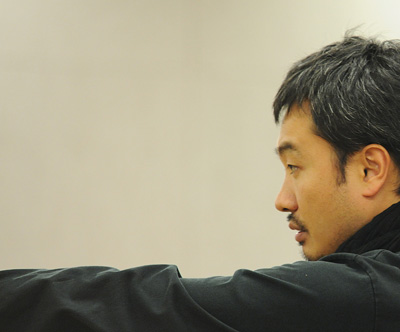
YANG Jung-Ung |
Yohangza drew the spotlight as a theatrical styling company in 2000 when it staged "The Chairs," which features restrained images and emphasized dialogue. In ensuing productions, such as "Children of Earth," "Daughters of Earth" and "Karma," the company drastically reduced verbal lines and enriched the plays with Korean sentiment and aesthetics. The plays "Mi-shil," "Hwan (illusion, based on Macbeth)" and "Sang-sa-mong (Dream of Lovesick)" depict people’s obsessions, desires, destruction and love through poetic lines and practical use of historical figures. "A Midsummer Night’s Dream" and "Twelfth Nights" subtly blend Korean sentiment into Shakespeare’s plays, while "Good Woman from Seoul" is a musical that represents Yohangza’s unique style by exploring the meaning of life. "Karma," for its part, received the grand prize at the 2003 International Festival for Experimental Theatre in Cairo, while "A Midsummer Night’s Dream" was invited to be staged at the Barbican Center in 2006. The same year, it received the grand prize and the Audience Choice award at the International Shakespeare Festival in Poland.
The 2009 plays "Hamlet" and "Peer Gynt" represent Yohangza’s simpler yet more insightful theatrical style. They drew particular attention to Yohangza and raised expectations about its future works. We met with Yohangza Director and CEO YANG Jung-ung, who recently returned from the group’s late June tour of Taiwan with "A Midsummer Night’s Dream."
 |
|
A Midsummer Night’s Dream |
|
- Q. What does Yohangza pursue?
- A. As our name suggests, we strive to publicize Korean theatrical plays by traveling the world and presenting our plays to an international audience. Our company continues to evolve by discovering new methods that blend modernity with traditions. To Yohangza, visiting new places is the most inspiring experience. We often hold workshops and perform with other theatrical groups, and watch productions staged by other companies. We receive inspiration not only from performing but also from meeting with new people in big cities and in rural areas.
Though we don’t have a clear definition of "classical drama," many of our plays deal with classics. Classics present us with universal questions about human nature regardless of time and space. They are the reason we never cease to study classics, because their profoundness has been accumulated over a very long time. But we don’t focus solely on classics. We study contemporary arts as well. We pursue plays that deal with the spiritual aspect in line with our preferences. That’s our color and style.
- Q. What traditional things does Yohangza pursue and how did you become attracted to them?
- A. Theatrical plays help people discover their identity. They help them understand where they belong and what historic meaning their lives have. They also inspire people to think about the past, the present and the future and better understand the clashes between traditions and modernity. Things that I can do well, that only I can do, and that I must know well have much to do with creativity. Everything begins with the ambiguous question, "Who am I?" That’s why traditions require much thinking and need to harmonize with modernity despite continuous clashes. Yohangza’s goal doesn’t lie in reenacting Korean traditions. Rather, we seek to shed light on things that have always existed in the lives of Koreans. That’s why we decided to include shamanism in "Hamlet" and old folk tales in "A Midsummer Night’s Dream." Every gesture, sound and object used on stage represents us.
 |
|
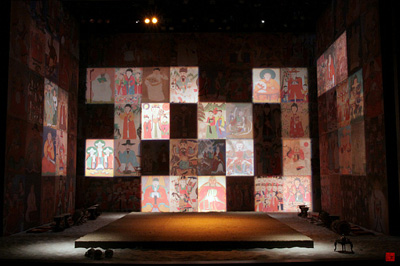
Hamlet |
- Q. "Hamlet" debuted at the 2009 Seoul Performing Arts Festival and blends Korean shamanism into the script, contemporary stage setting and costumes, and accompanying music. It depicts revenge, conspiracy, conflict and madness through shamanism. What is the meaning of Hamlet and shamanism in this play?
- A. Since the moment we started working on "Hamlet," we saw the prince as a resentful Korean character. We wanted to portray him through shamanism at least vaguely. That wasn’t just my idea. I know that many people had tried portraying Hamlet through shamanism, including Master KIM Jung-ok. Because shamanism is not anyone’s exclusive property, it looks different when portrayed by different people. I didn’t hesitate much before incorporating the elements of shamanism into the play because I was always interested in shamanism and because ours is a Korean play.
Shamanism is about harmony and spiritual relief. All personages in this play harbor resentment. Hamlet sends the message of harmony and spiritual relief by reuniting the deceased with those who are alive. The play is performed on a simple stage decorated with rice, a shrine and images of gods. All these objects are usually used in shaman rituals. Rice, in particular, symbolizes both life and death and is believed to connect this world to the world of the deceased. The play itself is a ritual, which is none other than shamanism. One of our mottos says that theatrical plays are a ritual. In that respect, "Hamlet" is a perfect ritual.
The way we see tragedy and death is different from the way they are seen in the West. That’s because we believe that people can relieve their resentment and start living again. The final scene of "Hamlet" is about spiritual relief. Because this play is a tragedy that deals with spiritual relief and shamanism, its theme and form are eternal. I think I’ll still be directing this play even when I turn 60. Costumes used in the play represent modern life. Shamans wear their traditional garments, while ordinary people wear black mourning clothes. Hamlet, for his part, wears a white training suit, which is quite ironic. He tries to look cool and calm, but he genuinely mourns his father’s death. In Korea, mourning clothes are traditionally white.
|
- Q. "Peer Gynt," which debuted at the LG Art Center, made headlines for its innovative staging. It received the grand prix, Best Director and Best Stage Art awards at the 2009 Korean Theater Awards. What is "Peer Gynt" to Yohangza?
- A. We were destined to produce "Peer Gynt." It’s the most free-spirited play among the works of Henrik Ibsen, the "father of realism." The original play consists of five parts written as dramatic poems and lasts more than six hours. But our version lasts only two hours. We had many trials and errors staging this production because of the enormous costs and the large scale. We reduced its scale and replaced images but we tried our best to keep the plot as close to the original as possible. The issues of redemption and self-discovery raised in "Peer Gynt" are the questions that Yohangza has been trying to find answers to.
Staging this production, which has been going back and forth between reality and fantasy for 50 years, must have been difficult. The main characters in your version have been transformed from people living in the 19th century into people living in the present era. Rather than reenacting the adventures from the original version, you focused on the characters. You also installed a mirrored wall on the stage and used soil as the main objet d’art. The scene where Peer Gynt takes off his clothes to reveal his true nature was the most impressive to audiences.
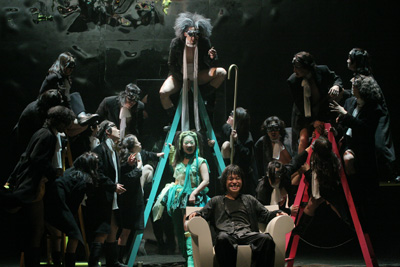
Time and space coexist in one place on stage. Rather than presenting them in a realistic way, we wanted to show their symbolic meaning. We were able to produce an image-based play by omitting many original elements and underscoring the symbolic meaning of things. We held numerous discussions and practiced a lot to make sure that the cast and the production crew were on the same page. We wanted to convey the meaning rather than focus on scale. The mirror reflects the insecure nature of human beings, while the soil symbolizes the origin of life.
 |
|
Peer Gynt |
|
- Q. Yohangza’s version of "Peer Gynt" was reproduced into the performance "Ouija" at the 2010 Festival Bom. It was co-directed by Catherine Sullivan and Sean Griffin. As the director of the original play, what do you think about this production and what potential does it have?
- A. I think this production will have both short- and long-term results. But the results will be different for the cast, the theatre company and the directors. Yohangza’s goal is to find the Korean identity and our future direction through cooperation with artists from other countries. As directors, Catherine Sullivan and Sean Griffin have focused on the visual aspect and included elements of film, playwriting, sculpture, art and photography in their works. Their directing style is very similar to that of Yohangza in that they constantly question stereotypes, pursue new things and have a similar attitude toward art regardless of genre.
It was yet another chance for us to realize that artists on the other side of the globe have the same way of thinking and similar work styles. Working with them was fun and the results were good. We can develop this production further in the future or produce a different one. We can also create something new with artists from different genres. Our members have benefited greatly from this production because they don’t have much opportunity to collaborate with foreign artists in Korea.
That must be the reason you’re highly lauded for your versatile talent as a theatre, dance and opera director.
I directed Alban Berg’s opera "Woyzeck," which debuted in Korea at the LG Art Center, as well as Lim Jun-hee’s opera "Match Made in Heaven" and the musical "Carmen." I also wrote and directed "Simcheong" for the Universal Ballet. It might be just my preference, but I am dedicated to the realization that theatre is a comprehensive art. I am interested in diverse genres, including literature, fine arts and visual and auditory arts. I enjoy working with artists of different genres. Though I am dedicated to one genre, which is theatre, I am very interested in art as a whole and very ambitious when it comes to art because I’ve been exposed to art since a very young age. It’s exciting for me to try new things and discover unchartered territories despite all the anxiety, tension and fear. It’s very meaningful.
 |
|
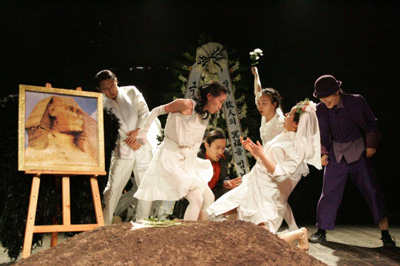
Ouija |
|
- Q. "Karma" and "A Midsummer Night’s Dream" are Yohangza’s best-known plays. They have been staged in many countries. What makes their depictions of physical aspects of the human body, diverse images and the beauty of Korea so special?
- A. We staged "Karma" in 2002 and "A Midsummer Night’s Dream" the following year. We worked hard back then, performing at many domestic and overseas festivals. "Karma" gained wide recognition in 2003, when it received the grand prize at the Cairo International Experimental Theatre Festival. It’s an image-based play dealing with the issues of life, death, birth and human philosophy. "A Midsummer Night’s Dream" depicts a love story between a nymph and a human being. It features Korean songs and dance. It’s a very compact and simple production without any major changes. It’s a story about universal human values, and its form has remained up to date even after more than ten years. Nevertheless, we learn from this play each time we present it on stage. We staged it ten days ago in Taiwan. Each time, the cast faces different demands and learns something new from the audience. Both the production and our company grow in unison and share everything together.
Yohangza’s plays are known as "image-based." But their scripts contain many poetic lines full of overtones. Conveying the linguistic nuance of "A Midsummer Night’s Dream" to foreign audiences must be a very tricky task.
We staged this play without surtitles in Edinburgh, other parts of the UK and in Latin America. But most of the time we do use surtitles. The atmosphere of the play differs depending on whether or not there are surtitles. But regardless, it’s easy for us to convey the meaning of the play through gestures and body language. However, the language of the play does have a special meaning. The meaning of words is also very important. I don’t think that image-based plays must contain zero lines. We live in the era when boundaries are increasingly blurred. In fact, sticking just to one thing is impossible nowadays. People may think on a subconscious level that adhering to one thing is admirable and awe-inspiring, but nothing in this world is of single nature. We just fail to realize that. That applies to art as well.
|
- Q. As the director and CEO of your company, you must feel enormous responsibility. How do you envision the future of Yohangza?
- A. We’re going to face bigger tasks in the future. From day one, theatre has been a minority art, but it keeps intensifying. Theatre is becoming more commercialized. We’re facing many difficulties. The government’s inconsistent cultural and funding policies are also a problem. On the other hand, as a director and CEO I think a lot about what spiritual and artistic questions we can pose for our audiences and what we can share with them. I also think much about ways to share our thoughts among our members. In that respect, our senior members CHUNG Hae-kyun and KIM Eun-hee, who have been with Yohangza since its founding, help me a great deal.
|
- Q. You can share your ideas with your staff while discovering new productions?
- A. As the leader, I am the one who chooses the majority of our productions. But sometimes our actors suggest productions and lead play reading. We recently staged "Lithuania" and "Molly Sweeny." We often hold debates led by our senior members to discuss what plays to present to our audiences, how to present them and what kind of discourse we need. We invited outside directors to direct "River of Time" and "Sorrow.Or" They are examples of plays that are hard to stage on a regular basis. We continue to unearth and train new directors. "The Life and Death of Marylin Monroe," which will be staged next week, is directed by the up-and-coming director CHO CHOI Hyo-jung. In doing so, we try to find new ways.
|
- Q. What are Yohangza’s future goals and aspirations?
- A. Pure art is gradually losing ground, while the influence of mass media keeps growing. We want to continue to explore the issues of humanity, society and theater in the most serious way. On the other hand, I hope that we will have nothing to worry about and be able to enjoy art because government policies related to art don’t change often. Devising long-term goals with regard to art is not easy these days. We have many plans, but we can’t spend much time studying new things. We need to come up with new methods. This year and next we will stage "A Midsummer Night’s Dream" and "Hamlet" in Korea and abroad. In October we will stage "Peer Gynt" because it has been picked as a PAMS Choice this year. Next year or the year after that, we will stage it at the LG Art Center. Next week, we will release our new play "The Life and Death of Madonna." We have also been staging small programs in small theaters run by 5 directors in peer group and at play readings. We want to expand our repertoire and try a large-scale production.
 |
|
A Midsummer Night’s Dream |
|
- Q. What do you personally want to try?
- A. My childhood dream was to be a film director. I was very impressed to see a one-minute foreign movie produced with an iPhone 4G. I want to film a movie about everyday life with a small camera. This year, I want to write something. I used to write plays before. I began accumulating ideas four or five years ago, but I didn’t have time to write because I was too busy as a director and CEO. I want to finish my unfinished writings and start writing something new. One of my writings is about the Korean War and Korea’s national division. I have been working on it for a long time. Another story is about a famous film director, a relative of my mother, who passed away during the Japanese colonization. I want to write about the desperate and tragic life of an artist, and I hope to meet a director who will direct my script.
|
| |
| |
| |





 2010-07-07
 PREV
PREV
.JPG)
.jpg)
.jpg)
.jpg)
.jpg)











 Please note that e-mail addresses published on this website must not be collected through electronic mail collecting programs or any other technical measures without proper and prior approval. Any violation of this rule will be subject to criminal punishment under the Information Communication Network Law.
;)


