A Release into Nature and Art The Chuncheon Mime Festival
- Art Director Yoo Jin-gyu -
|
June 4, 2010
CHOE Suna, former co-director of the Seoul Fringe Network
|
|
Many Koreans say summer begins with the end of the Chuncheon International Mime Festival, and true enough, the road to the Mime Festival is lined with the season’s most vivid shades of green. Five days after the end of the festival, I met with its art director, Yoo Jin-gyu. Chuncheon, population 250,000, is the seat of the provincial government of Gangwon-do and is 90 minutes from Seoul by car or train. Well known as a tourist town, the city is located in a beautiful valley surrounded by mountains with a river running through its heart. Chuncheon has always held the image of a quiet, green city, close to Seoul but far enough away to avoid its urban sprawl. Many now see it also as a city of culture, thanks to its various art festivals, such as the Chuncheon Puppet Festival and the Chuncheon International Theatre Festival, along with its mime festival. The mime genre is now a large part of the community, giving the city a unique energy.
 |
|
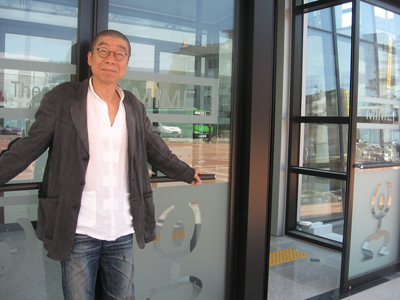
Art Director Yoo Jin-gyu |
A 1968 performance by German Rolf Scharre marked the introduction of modern mime in Korea. This performance inspired many new mime performers, groups and their performances on into the 70s. After a fallow period in the 1980s, the Korea Mime Festival, was established in 1989 at Seoul’s Gonggan Sarang. Mimes founded the Korea Mime Council in the same year, and Chuncheon MBC invited them to relocate their festival to Gangwon-do, where it became known as the Chuncheon Mime Festival.
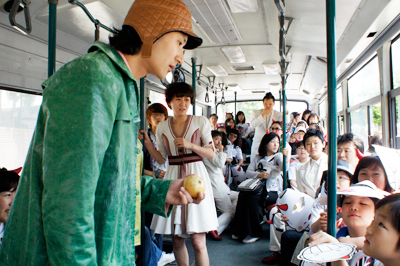
This year marked the festival’s 22nd year. From May 23 to May 30, 90 Korean and 10 international teams from six countries took part. Estimates have the festival attracting 130,000 visitors. Four acts were officially invited as indoor performances. They include Gecko Theatre Limited’s “The Overcoat” (UK), the performers depict the desires and solitude of modern man with live sounds and dynamic movements; Ville Walo & Kalle Hakkarainen’s “Odotustila” (Finland), a piece representing the new circus with harmonious visuals, magic and juggling; Patrice Thibaud & Phillipe Leygnac’s “Cocorico” (France), which is about the joy of mime expressed through body movement and music; and Nottle Company Theatre’s “The Return” (Korea), a satire on the ideology of power. Thank You Tezuka’s “Mime Comedy” (Japan) and Fire Bandit’s “Fire Performance Art” (Japan), which were officially invited outdoor performances, dazzled the audience with innovative moves. Until two years ago, comprehensive genres were reportedly the trend, including free participation pieces, but recently more pieces focus on archetypal body movements. Momggol’s mobile performance was a contender for best outdoor performance and was also very notable.
 |
|
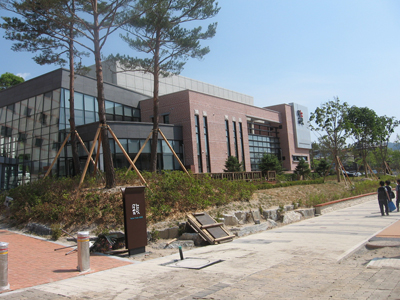
Festival Theatre MIME | |
- Q. The Chuncheon International Mime Festival has a relatively long history compared to other Korean art festivals. What kind of festival is it?
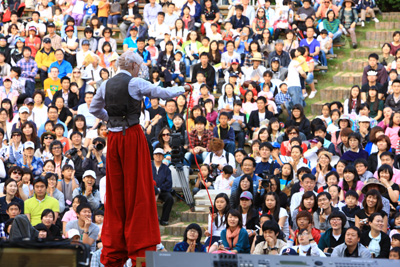
- A. The festival’s s aim was to introduce Korean mime and its artistic value to the world and gain recognition as a respected performance genre. With every year, international exchanges became more active, and there was a turning point when it became a true international performance art festival. In the late 1990s, as mime began to find its place, the genre came to focus on its quality as a festival archetype; a form of theatre. That’s how Dokkebi Nanjang was started. Dokkebi Nanjang is a revival of the traditional Korean spirit of festivities found in all-night festive events such as ancient exorcisms or the celebration on the first full moon of the lunar year. Various performances, installation art, and workshops take place outdoors, alongside performances of mime, dance, music and theatre. The open structure and brilliant performances of Dokkebi Nanjang have become representative of the Chuncheon Mime Festival, offering artists and viewers a release into nature and art. Recently, the program focuses on creating a basis in mythology to create a closer connection with the community.
- Q. How are performance pieces and artists selected?
- A. Programs are divided into indoor performances which are more about artistry, and street performances and nanjang (traditional public performances) which are more about festivities. On weekdays, we create “a festival in the city” where visitors can see artistic theatre performances, and on weekends, we create “a festival in nature” where audiences can enjoy public performances surrounded by the beautiful nature of Chuncheon. There are officially invited performances and performances that are freely participating. Officially invited performances are selected from Korea and overseas, depending on the theme of festival. This year, three foreign performances and one Korean performance were selected on the basis of four criteria: Is it contemporary, timely and trend setting with audience appeal? Mostly domestic artists compete to be one of the free participation performances, but recently there has been an increase of foreign applicants. Meanwhile, we keep doors open for amateurs, as well. This kind of opportunity allows anyone to take part in the festival and pursue artistic interests, expanding the realm of mime performances. Modern art continues to become diversified and create new trends, prompting the art of mime to evolve. We conduct programs to uncover young artists trying new ideas based on body, movement and image. Such programs include the Dokkebi Awards for young artists; our contest for modern reinterpretations of Gangneung’s Gwanno mask theatre; our outdoor performance contest, jointly held with the Gwachon Hanmadang Festival; and the “Search for Asian Movement,” which seeks new performances based on Korean and Asian traditions.
 |
|
Dokkebi Nanjang_Rob Lok (USA) |
- Q. The Chuncheon International Mime Festival is about performance art based on body, movement and image. Boundaries between genres of modern performance art are rapidly disappearing. How will the mime genre define its characteristics?
- A. At first, the members of the Korea Mime Council based their performances on the mime concept with which they were most familiar. With more active exchange with Europe and other countries, we discovered new and more modern forms. Of course, there is traditional mime in Europe, too, but it was the new trends that caught our attention. It is also the underlying spirit of the Chuncheon International Mime Festival to aim for new things rather than only maintaining what is. As this happened, we needed a new language that could embody our issues. We tried categorizing our art into modern mime, objet mime, and visual mime, but in the end, we opted for body, movement and image. While this was happening, domestic performance art festivals started taking on a non-verbal trend. The Gwacheon Hanmadang Festival began accommodating large-scale, non-verbal outdoor performances, and the Seoul Performing Arts Festival also expanded into the realm of mime, and these changes made us reconsider our identity. What is mime? What is theatre? What is dance? Genres like theatre, dance, mime, music and literature each have their archetype which cannot be broken down any further. There may be deconstruction, fusion and transformation of genres, but archetypes don’t change. The Search for Asian Movement is also based on this kind of thinking. International exchange made us rethink the identity of the Chuncheon International Mime Festival. Mime began in Europe, and Europe is still the leading body in this art field. However, all nations have mime heritage, although it may not be recognized as “mime.” We believe that preserving our tradition, modernizing it, and giving it a global place is the way to co-exist with mime festivals in Europe. Through the Chuncheon International Mime Festival, we wanted to introduce Asian traditions which have the archetype of mime, or works based on these traditions. However, this was not an easy task. Nobody has taken the care needed to preserve what we can call the archetype of our mime, and there’s not much interest to carry it on into the modern age. We feel a sense of urgency because the archetypes are starting to fade, and we need to preserve them.
|
- Q. Mythology is also a very important element in your Festival. How are myths significant?
- A. Originally, festivals are gestures of the human race’s offerings, and they had a structure of myth. Mythology is not about creating something new, but excavating hidden history and stories. We did a modern interpretation of Chuncheon’s Gongji fish legend and gave new mythical meaning to realistic notions of space, earth, Chuncheon, the Gongji stream and Gongji fish. Unrealistic notions also play important parts each year in the form of water gods, fire gods, fiery mountains, Kkebi (festival characters created as a part of the Dokkebi Nanjang), and Udamari (the Kkebi’s imaginary village). We wanted to bring out the original stories and sentiments of the community, develop resources unique to Chuncheon, and create a story of life that all can share. The gut (shamanistic ritual) that opens the Nanjang also embodies Korea’s traditional notion of festivity. We believe that a gut is a form of communication with the heavens that has been forgotten by modern man. Earnest hope and prayer have the explosive power to bring participants of a festival together.
 |
|
Guerrilla performance_Momggol |
|
- Q. What are things that are considered important in the course of international exchanges? What have been some of the results over the years?
- A. The festival is now more than 20 years old and has grown incredibly, scale-wise. In this year’s festival, we had about 250 volunteers who were mostly local students and citizens. Some participate through academic-industrial cooperative projects, and others come in on their own to help with the operation and promotion of the festival. They are also the most important audiences of the festival. The festival takes place not only in indoor theatres, but also on the streets in the form of nanjang, and in schools, hospitals and welfare facilities. This is to expand contact with the locals. Most of the theatre goers are Chuncheon residents, and it is very natural to see them take part in and enjoy the festival. The greatest thing they take away from all of it is the pride that they feel about living in a city of art and festivity.
|
- Q. How is the festival funded?
- A. The festival operates on public funding and other forms of support. We receive public funding from the Ministry of Culture, Sports and Tourism, the city of Chuncheon, and Gangwon-do Province. The Chuncheon International Mime Festival is one of the rare performance art festivals led by non-governmental organizations; our public funding and corporate sponsorship is relatively small. We have a difficult time because there aren’t many companies that take interest in local art festivals. However, we are seeing a continuous increase of private sponsorship. We hope that the citizens and companies of Chuncheon take interest and become more involved in supporting the festival.
 |
|
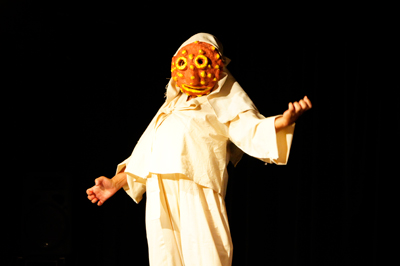
Search for Asian Movement_Mu Se-chung, Leper Dance |
|
- Q. The festival just ended. What are your plans for the future?
- A. We spend the month of June balancing our sheets and evaluating. This helps us assess the year’s results and set the direction for the following year. A major project will be the operation of the Festival Theatre Mime (Momjit), which opened doors this year. The Chuncheon International Mime Festival has exerted considerable effort to build a creative space for mime, and we have emphasized the importance of the city’s support, as well. The success of the festival helped us gain city support for the construction of this theatre. It features a black box-type hall with 150 seats, rehearsal rooms, café, and office space. Festival Theatre Mime (Momjit) will operate according to the aims of the festival, as well as offer its space as a production theatre, educational theatre and festival theatre. Once we transfer all the activities which used to take place in Mime House, we may be able to conduct creative residency programs in the old facilities. The process for international exchange for next year’s festival begins in July or August. We plan to begin competitions for domestic performers in October. We have a meeting of the Asia Mime Federation at the end of the year in Hong Kong. In November, we have “Moving Space” which is a creative residence program now in its third year. It is an opportunity for artists from Korea and abroad to spend a week together to share creative methods and ideas. Artists who work with movement, sound, and visual art come to participate and share new types of work that many are unfamiliar with. In December, we are planning a “workshop festival” which brings together various forms of physical workshops.
|
|
Yoo Jin-gyu
Yoo began his career in theatre, entering the theatre company Aejeotto, in 1971. In 1972, he introduced his first mime piece, “The Falsely Accused Thief,” and in 1976 began his private work with “Expression of the Body.” He strove to uncover Korean-style movement and held various performances through 1983. After his “Beautiful Person” series, he felt he had hit his limit and left the world of mime to move to Chuncheon and breed cows. He returned to the stage in 1998, bringing resurgent energy, and has been with the Chuncheon International Mime Festival ever since. He took on the role of art director, when the Chuncheon International Mime Festival organized an operational committee in 1994.
Aside from constantly reviewing the vision of the festival as its art director, he continues to introduce his line of work as an artist. Through “Yoo Jin-gyu’s Movement,” his experiments to discover distinctly Korean moves continue. His representative piece “Empty Hands” is a modern interpretation of the archetype of Korea’s traditional sacrificial rites and shamanism and has been invited to the MIMOS festival, the International Mime Art Festival in Poland, a mime festival in Mongolia, the International Mime Festival in Belgium, and the London International Mime Festival. In 2009, he introduced “Yoo Jin-gyu’s Red Room,” the first of his “room series” based on Korea’s five traditionally vital colors. This year he plans to continue the series with “White Room.” |
www.mimefestival.com
The Chuncheon International Mime Festival |
| |
| |
| |





 2010-06-30
 PREV
PREV
.JPG)
.jpg)
.jpg)
.jpg)
.jpg)











 Please note that e-mail addresses published on this website must not be collected through electronic mail collecting programs or any other technical measures without proper and prior approval. Any violation of this rule will be subject to criminal punishment under the Information Communication Network Law.
;)


