





Where the Portrait of the Past and the Fantasy of the Future Merge into Phenomenon
[Festivals/Markets] The 43rd Festival d’Automne à Paris Review
The Festival d’Automne à Paris (Paris Autumn Festival), which celebrates its 43rd anniversary this year, is one of the major representative European performing arts festivals that takes place in Paris, France for a four-month period from September through December. It enjoys a massive stature and scale, as it introduces art works from around the world, encompassing a wide variety of artistic genres ranging from theater, dance, visual arts, performance, and music to cinema. Approximately 150,000 visitors come to see the festival annually. This Parisian celebration was first conceived of by the modern art collector Michel Guy during the presidency of Georges Pompidou in 1972. Michel Guy took on the responsibility as the first director from 1972 through 1990, followed by Alain Crombecque (1992-2009), and Emmanuel Demarcy-Mota who has been the current general director since 2010. Seeing only three directors during its 43-year existence, the festival has maintained a firm sense of identity and objective and has been managed and developed stably up until now.
Michel Guy, the founder of the Festival d’Automne à Paris, once said, “The Festival d’Automne à Paris started with the objective to become a field for cultural exchanges that cross national boundaries, and allow access to creative works.” As such, the Festival d’Automne à Paris is becoming a crucial historical index for international contemporary arts, and it set itself up as a field for unhindered experiments, in which new art forms can be discovered and developed. This year, the festival features 54 works produced by about 50 productions from 15 different countries. They will be performed in 43 venues in Paris and in the île-de-France region from September 4 through December 31.
A Portrait of the Artist as a Young Man Who Discovered New Art Forms
Every year, the Festival d’Automne à Paris focused on reflecting the global artistic currents and introducing new trends through various programs in each genre. Lately, it has placed a particular focus on discovering and excavating new art forms. As the festival has existed for almost half-century, it aims to move beyond its traditional role of inviting and introducing works in the performing arts, and to become the index that can present new directions for the contemporary arts. This new goal cannot be satisfied by merely discovering and supporting young artists who have the potential to grow. It can be initiated by looking closely into the artists who have already created new art forms by means of taking constant risks and unrelenting experimentation.
The special portraits of a number of artists, which has become part of the festival’s ongoing series since 2012, shed new light on the artists, whose pursuit and realization of unique art forms made a huge impact on the contemporary arts scene since the 20th century. The “Maguy Marin Portrait” marked the beginning of this feature series in 2012, by presenting the work of the artist who created the concept of total dance-theaterer. This was followed by “Robert Wilson Portrait” in 2013, showing the latest piece and many other signature works by Robert Wilson, who is representative of the Theater of Images. This year, the special portraits feature the works of Romeo Castellucci, William Forsythe and Luigi Nono, three distinct figures in theater, dance, and music genre respectively. These three artists are considered to be masters in contemporary arts for breaking down the existing forms and conventions in their respective genres and creating their own vocabulary and aesthetically fulfilling artistic forms. Through the portraits series, one can examine the creative process of the artists who have become the seminal figures in their fields, and get an idea of which direction they are headed in their future works.
|
|
|
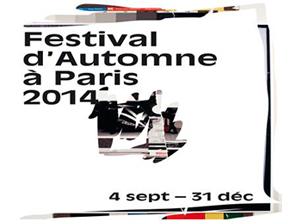
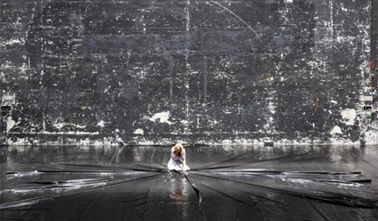
| The official poster for Festival d’Automne à Paris 2014 | Romeo Castellucci’s <Schwanengesang D744>© Christophe Raynaud de Lage |
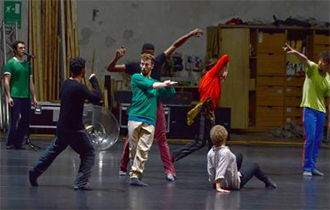
Among them, “William Forsythe Portrait” will be presented at nine venues to unfold six of Forsythe’s works — the artist who has created a new trend of modern ballet with his innovative choreography that articulated the movements of the body, one of which is the opening piece, <Limb’s Theorem>, a renewal of his repertoire premiered in 1990. <Legitimo/Rezo>, a solo piece conveyed by Jone San Martin, a dancer who has worked with William Forsythe for many years, is a good gateway to getting an understanding of Forsythe’s work. According to her, the dancer’s body required by Forsythe is like the rules of a language. Articulation of movements or gesture can be likened to the process of deconstructing a language, combining words and meticulously structuring a sentence. She renders an immediate account of Forsythe’s gestural language by explaining what rules it followed to construct and deconstruct each part of the body to form a sentence.
If <Legitimo/Rezo> gave us an idea of what Forsythe’s artistic form has been up until now, his latest piece <Study #3> gives a glimpse of where the artist might be headed from now on. In <Study #3>, dancers take turns to step in front of a microphone installed on stage and vocalize and expand their monologues in their own fashion. While the monologue is in progress, the other dancers create movements that correspond to the syllables and rhythm of the voice. It seems that while Forsythe’s previous works concentrated on dividing the body movements into the smallest unit and reorganizing them, his interests have expanded to include the diversity of sound and emotions expressed through voices in the realm of movements. As such, the special portrait allows the audience to intimately explore and encounter the artists’ works, who have already invented some kind of original art form.
Both the “Romeo Castellucci Portrait” and the “Luigi Nono Portrait” are two-year projects, which will continue through next year, to present, respectively, the work of Romeo Castellucci, a theater director whose radical, shocking methods have provoked human anxieties and even unsettled human minds, and the work of Luigi Nono, a composer of contemporary music, who founded the Darmstadt School. The former will feature Castellucci’s recent works created over the past two years, such as
|
|
|
| William Forsythe’s <Study #3>ⓒUmberto Favretto |
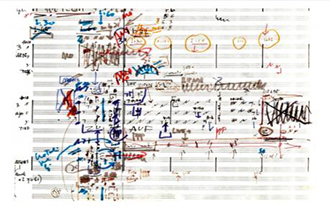
Luigi Nono’s sketch for Risonanze erranti ©Ayants droit Luigi Nono |
The portraits of the three aforementioned artists are not merely retrospective shows of their specific art forms. They also ruminate on the diversity of contemporary art forms and possibility of discovering new vocabulary by featuring the works of the masters, who ultimately succeeded in creating new art forms by persistently and indefatigably weaving their own languages. The festival focuses on their constant efforts to take risks and pursue groundbreaking experiments, and the fact that this is still an ongoing process for them. Director of the Festival d’Automne à Paris, Emmanuel Demarcy-Mota stated that, “The artists help us challenge and change ourselves, constantly presenting us with new ideas, making us doubt and question... As producer or co-producer, the festival plays a central role in the creative process, in the quest for artistic expression, and in the multiplicity of art forms; it is committed to diversity.” This year’s festival not only brought in the works by young artists who created their own vocabulary and unique art forms as the crucial part of the program, but, along the same line, paid attention to the artists from a wide range of backgrounds.
A Fantasy of the Artist as a Young Man Who Seeks to Discover New Art Forms
This year’s festival program includes many familiar and eagerly-awaited names. In addition to the artists featured in the aforementioned portraits, and the artists who have already earned international recognition such as Robert Wilson, Maguy Marin, Philippe Quesne, Bertrand Bonello, among others, the list also includes several performance groups that created quite a stir in Korea when they were introduced at Festival Bom and Seoul Performing Arts Festival. Théâtre du Radeau, She She Pop, Young Jean Lee, Jérôme Bel are some of the names that come to mind. These groups are young artists who are also relatively well-known in Korea, as they create works through various experimental methods.
However the one to watch in Festival d’Automne à Paris 2014 is none other than Sylvain Creuzevault, Vincent Macaigne and Julien Gosselin, ones who are viewed as the new artists that will lead the future of performing arts in France. They are 32, 36, and 26-years-old respectively, emerging as the new names in the performing arts scene acclaimed not only for vigorously creating daring pieces, but also for grasping and incorporating intense philosophical thoughts into their works. They share the common characteristic of presenting new art forms through their works, in which those art forms correspond perfectly with what they are trying to say/convey.
|
|
|
| Théâtre de la Ville, the venue for Vincent Macaigne’s work |
La Colline-théâtre national, the venue for Sylvain Creuzevault’s work |
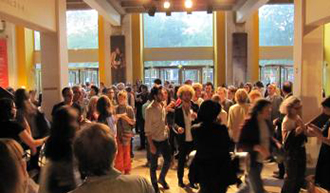
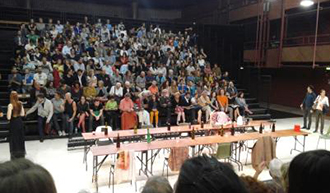
Sylvain Creuzevault’s <Le Capital et son Singe (The Capital and its Monkey)> is based on Karl Marx’s 『Capital』. He viewed the theater as “a political space” and tried to find a narrative and theme still valid today from the forgotten work, 『Capital』, such as class struggles and materialistic obsessions, and chose comedy as the genre with which to convey his story. In fact, this play was serious and convoluted from beginning to end, but at the same time, extremely entertaining. While there was bloodshed going on one side of the stage, there was something hilarious happening on the other; one space was both a murder scene and blissful wedding hall. The entangled story of chaotic mess unfolded on stage along with the stage props displayed in confusing disorder. This three-hour comedy of convoluted narrative, which received acclaim from the audience, was created in a collaborative creation process by the director Sylvain Creuzevault and the actors.
Vincent Macaigne, on the other hand, is a stage artist, who is, at the same time, a movie director and famous actor in France. As an artist whose works and activities are not confined by one genre, he presented a modern adaptation of Fiodor Dostoevsky’s 『The Idiot』 called <Idiot! Parce que nous aurions dû nous aimer (Idiot! Because we love would have loved us)>. He not only worked on the dramatization and directing, but engaged in creating the concept for stage design. The work is shockingly violent, brutal and, simultaneously, destructive. A 2-meter-tall tower of soapsuds on the stage of Théâtre de la Ville; actors performing their roles slipping on and digging themselves out of the massive lather; and the audience who climb the stage towards the bubbles without any inhibition — no one and nothing stopped any of them. Soapsuds, dirt, blood, and water flooded the stage and spilled over to the audiences’ seats ceaselessly. The actors ranted and raved in the merciless bombardment. And the packed audience responded with a standing ovation to this new style of acting and shocking stage, which were created by Macaigne.
Julien Gosselin’s <Les Particules élémentaires (The Elementary Particles)> is a stage adaptation of the novel with the same title by Michel Houllebecq. He stated that “The play was not born pure from its origin. It began by putting a wide variety of things such dance, poetry and songs all on one plate,” and determinedly integrated diverse elements in his works. A screen placed on stage, an instant screening of video-recorded acting, dancing and singing by the actors and avant-garde style of acting — Gosselin’s provocation on stage is nonstop.
|
|
|
| Sylvain Creuzevault’s <Le Capital et son Singe>ⓒD.R |
Vincent Macaigne’s <Idiot! Parce que nous aurions dû nous aimer>ⓒPhilippe Delacroix |
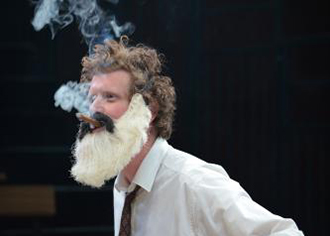
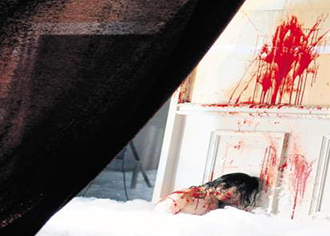
The reason that these artists receive attention in France is not only for their discovery of new art forms. They are also recognized for their potential as a new generation to become something even more spectacular. They need to venture out and experiment until the new forms that they just discovered become their unique language, and the festival is willingly providing the stage as the laboratory for their experiment. In addition, the festival organizers encourage the audience to watch their works, to witness with one’s own eyes the fantasies of these young artists as they unfold, as this itself is an experience of partaking in the creative process.
Moving Beyond the Field of Exchange, to the Laboratory For Artistic Experiment, and the Space of Generational Exchange
The Festival d’Automne à Paris has been transforming itself to move beyond its traditional role and identity as the field of exchange, in which the audience could access a number of works by artists of diverse nationalities, and expand them to become a laboratory for artistic experiments. It is adding an experimental aspect to its existing popular and artistic aspects, which came about over the long history of the festival. In addition to the masters in contemporary arts, a diversity of emerging organizations, and artists who are recognized in France, the festival introduces works by artists from a wide range of backgrounds such as the choreographers Marco Berettini and Alessandro Sciarroni, visual art creators Matthew Barney and Jonathan Bepler, and a composer and movie director Bertrand Bonello.
What is even more promising is that as the festival fervently supports the works by emerging artists, and it is exposing their works to the audiences to the fullest extent. The festival has secured loyal fans throughout its long history, the majority of whom are middle-aged. Introducing a number of works created by the new and emerging artists can hopefully attract a trendy, youthful crowd to the festival, which may present a solution to the issue of relying too heavily on one age group of audience. In fact, this year’s festival saw many works being sold out during the early pre-sale period, and people swarming to buy any remaining extra tickets on-site. The new shows by the young artists, which have been advertised extensively, were completely sold out, giving a preview of the festival’s success.
|
|
|
| Odéon, the venue for Robert Wilson’s work | Audience waiting for the performance |
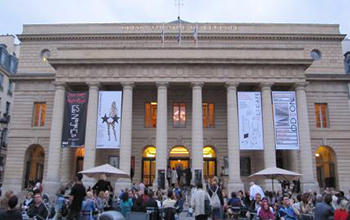
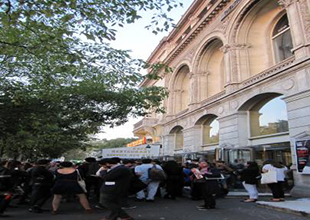
This change occurred quite swiftly, ever since Emmanuel Demarcy-Mota took on the position as the General Director. He has engaged in numerous projects to expand the bases for arts as well as to discover new art forms. The decision to expand the venues, which had once been concentrated in Paris, to the neighboring region of île-de-France and to stage numerous works a couple of times in different venues can also be understood in this context. The Festival d’Automne à Paris is making a successful transformation into becoming a laboratory for new artistic experiments, as much as it has successfully served as the field of exchange for international performing arts, introducing and circulating a wide variety of works. Perhaps the greatest strength that drove the Festival d’Automne à Paris to live on as long as it did is this spirit of adventure, which does not allow it to be content with preserving the status quo, but constantly pushing it forward to willingly take on new challenges to create change.
ⓒFestival d’Automne à Paris Website
 PREV
PREV
.JPG)
.jpg)
.jpg)
.jpg)
.jpg)












.jpg','The Festival d’Automne à Paris (Paris Autumn Festi..');)


