





Latin American ‘Cultural’ Bloc and Argentina
[Festivals/Markets] Review of Escena70-Mercado de Artes Escénicas de Buenos Aires
Latin American Trading Bloc, Latin American Cultural Bloc
Whenever I attend some event held in Latin America, one thing that stands out most distinctly is the language. As Spanish is spoken in almost all countries, except Brazil in which Portuguese is spoken, people rarely have any difficulty communicating with one another by using either Spanish or Portuguese, depending on what their native language is. Although it is the product of Latin America’s painful history, as a Korean, it is quite amazing for me to see so many people from such a wide variety of national backgrounds communicating through the same mother tongue. And that’s not all. Citizens of Latin America can cross borders to neighboring countries without a passport. This is another unfamiliar experience for a person who came from the nation located on a peninsula surrounded by the sea on three sides and blocked by the Military Demarcation Line to the north, which makes it impossible to cross the border by land.
In that sense, it is only natural that members of the Union of South American Nations (UNASUR) share a strong solidarity. And the solidarity shared by this trading bloc is now extending to the cultural industry to establish a powerful cultural bloc in Latin America. For instance, La Red (The Net) de Promotores Culturales de Latinoamérica y El Caribe, the network of Latin American cultural promoters, is expanding its areas with its member institutions located in eighteen Latin American nations, including Argentina, Brazil and Chile. The first Cultural Industries Market of the South (MICSUR), which was held in Argentina this year presented vast possibilities of integrated networking among the member states of Common Market of the South (MERCOSUR). At its center is Argentina, making constant efforts to play the leading role within this massive cultural bloc.
|
|
|
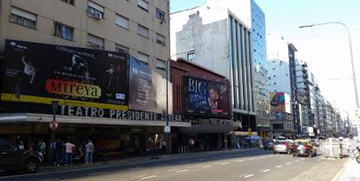
| The theatre district of Corrientes Avenue, Buenos Aires | Corrientes Avenue ⓒAdeline Jimenez |

Buenos Aires Theatre Complex, the Center of Argentinian Performing Arts
As a federal republic, Argentina has cultural administrative offices established both in the central government and local governments. Among them, the Ministry of Culture of the City of Buenos Aires runs numerous programs and spaces with a much higher budget allocated to cultural affairs than those of other local governments. Naturally, cultural and artistic activities in Argentina are concentrated in Buenos Aires, the nation’s capital, whose scale is reflected in its infrastructure for the performing arts. One indicator is the number of theatres or performing arts facilities located in the city. According to the data provided by the Cultural Information System of Argentina (SinCA) run by the ministry of culture, the number of performing arts facilities in Buenos Aires is 287, while the number of them in Seoul estimated by the Ministry of Culture, Sports and Tourism and Korea Arts Management Service in 2013 is 352. The contrast becomes more apparent considering that the number in Buenos Aires is over 80 percent of Seoul, while the size of Buenos Aires is just one third of Seoul.
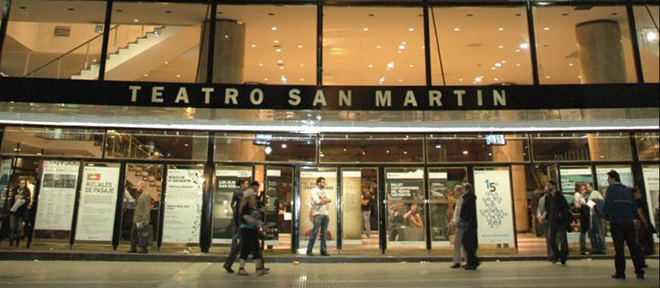
At the center of Buenos Aires’ rich cultural infrastructure is the Corrientes Avenue, which is referred to as the Broadway of Latin America. Among them, the Buenos Aires Theatre Complex (henceforth ‘CTBA’) located in the Corrientes Avenue, plays the pivotal role in the performing arts scene of Buenos Aires. It is a theatre complex affiliated with the Ministry of Culture which comprises five theatres including the San Martín Theatre, Sarmiento Theatre, Regio Theatre, and so forth. They are utilized for a wide variety of cultural art events from play, dance, music, puppetry to film screenings and photo exhibits.
|
|
| Outside the San Martín Theatre in the Buenos Aires Theatre Complex ⓒEscena70 |
Performing Arts of Buenos Aires Creating Connections with the World
From October 6–8, “Escena70-Mercado de Artes Escénicas` de Buenos Aires (Scene70-Market of Buenos Aires Performing Arts)” was hosted by CTBA. This was a one-time event that took place on the occasion of 70th celebration of the San Martín Theatre, held in collaboration with the RedLat Colombia and Circulart, the Colombia-centered network of Latin American cultural promoters and the music market based in Colombia, respectively. This event, which began with an opening address by Alberto Ligaluppi, Director of CTBA and Octavio Arbeláez Tobón, Director of Circulart, was comprised of two simple main programs, Business Rounds and Artistic Exhibitions.
For the Business Rounds, 51 programmers from 21 nations participated, not only ones from the Latin American countries, but also from the US, Canada, Spain, France, Portugal, the Netherlands, Russia, and Korea, which was the only Asian nation to participate in the event. Among some of the noteworthy Argentinian participants were Marcelo Castillo, General Director of GIRART-Performing Arts and Music Market in Córdoba, Argentina and Raúl David Sansica, Director of Theatre Real. As for the performances showcased at the event, 35 pieces were presented out of the 98 works (58 plays, 28 dance pieces, six circuses, five performances, one puppetry performance) that the judges selected from the ones that responded to the open call. The selection process took place from May through June, 2014, with four performing arts experts serving as judges, whose list includes Darío Lopérfido, the artistic director of Buenos Aires International Festival (FIBA), watching the performances showcased at six major theatres on the Corrientes Avenue, such as San Martín Theatre and the General San Martín Cultural Center.
|
|
|
| Dance showcase <El Ocaso de La Causa> | Play showcase <Cinthia interminable> |


Performing Arts Market with Substance, but One That Fell Short in Terms of Networking
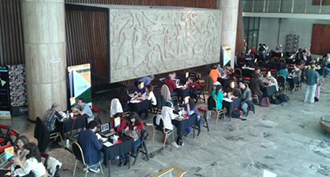
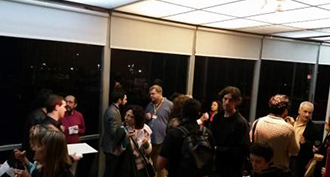
The three-day event packed with numerous official showcases and linked programs, and the tight three-hour Business Rounds demonstrated clearly what the distinct vision and objective of Escena70 was—that is, to provide the performances produced in Buenos Aires the opportunity to make inroads into international markets. It is still in the stage of awaiting results, but Escena70 faithfully served its role as a market for the performing arts and the event wrapped up relatively successfully, proving itself to be of some substance. However, the one thing that the attendees almost unanimously pointed out as having fallen short at the event was insufficient time for networking. The participants commonly expressed a sense of frustration that there was not enough time to create networks or seek chances to collaborate with other institutions. This could be convincing evidence that the attendees at the event are not just there “to discover good performances they could invite to and showcase at their own festivals.” For this reason, programmers from the Latin American countries, naturally took a rain checkto meet and talk again at Santiago a Mil International Theatre Festival in Chile next January.
Companions with strong partnerships can often appear to have an exclusiveness against those outside the circle. Similarly, as Escena70 did not provide any English interpretation except in Business Rounds, although there were quite a number of interesting and intriguing pieces, it left a lot to be desired in terms of communication. It may be because that they already share a sufficiently large market and one small nation on the other side of the globe such as Korea did not make their list of priority target markets. On the contrary, it is up to us, the ones wanting access to this huge alliance to make entry possible. It seems that “a small–world network” theory that any one of us may be connected with the entire world by a small number of hops or steps can be easily proven in the cultural arts markets of Latin America. Hoping to see more Korean shows in Latin America, I would like to let the Korean performance organizers or artists know that Argentina can be quite an appealing mediating space.
|
|
|
| Business Rounds ⓒEscena70 | Networking hours on the Opening Day |
Argentinian Cultural Industry Is Alive and Well
In late July, Argentina announced its second default, 13 years since the first in 2001. The Argentinian peso plummeted in value, and the number of people expressing their hope to emigrate to other countries is increasing due to the economic downturn and accompanying security issues. Nevertheless, Argentina’s investment in culture is not showing any sign of a downward curve. Quite the contrary, the Ministry of Culture within the federal government has recently established the Cultural Promotion Fund (Fondo Argentino de Desarrollo Cultural) of about 15 million pesos (approximately US$1.77 million). Also, there are at least two large-scale international performance arts events slated for 2015, including the Argentine Cultural Industries Market (MICA) and Buenos Aires International Festival (FIBA) which are held biennially. Thus, it seems unlikely that Argentina would hand over the lead in Latin American “cultural” bloc anytime soon. Amidst all that, it would be a matter of keen interest to see what the next step would be for the Buenos Aires Theatre Complex, which set itself up as the global exchange platform for the Argentinian performing arts.
ⓒKim Kyong hee
 PREV
PREV
.JPG)
.jpg)
.jpg)
.jpg)
.jpg)












.jpg','Whenever I attend some event held in Latin America..');)


