





“Pum” is the Cradle of Love and Creativity
[Festivals/Markets] Hwaseong Festival Pum 2014
Anyone who works in the creative industry in Seoul has times when they feel the need to break free from the confines of the city and escape to the country, getting in touch with nature. I got the chance to have such an experience as a participant in this year’s Festival Pum, held during Mindulle Theater Village’s three-week Asia Residency Project. I would like to share the vivid experience I had asa festival participant.
The Festival that offers “Motherly Warmth” by sharing Pum (lit.“Bosom” or “Work”)
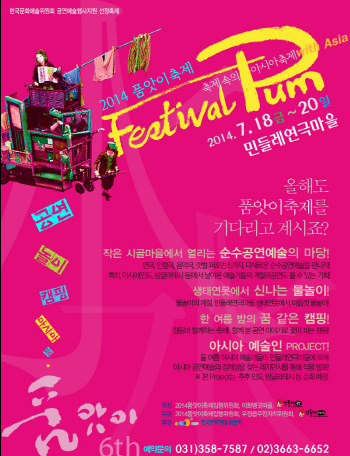 |
From July 18 to 20, the sixth annual Festival Pum was held at the Mindulle (“little dandelion”) Theater Village located in Woojeong-eup, Hwaseong-si, Gyeonggi-do. Just as the name implies, it is literally a village that is a combination of theater and farmland, where city folk can come down to enjoy performances amidst natural surroundings, experiencing the scent of the countryside as it is. Breaking free from the standard festival form, Festival Pum’s most striking feature is most likely how the Mindulle Theater’s Director Song and her family helped cultivate it together. Looking back on the festival, the first thing that comes to mind is the tender smile of the woman we affectionately called “grandma,” Director Song’s mother. What left the deepest impression on most residency participants this year was this “mother” figure. Likewise, Festival Pum created a warm, inviting environment that was like a mother’s embrace. Furthermore, the mothers of the woman’s association in the village showered participants with affection by preparing home-cooked meals made from the heart. |
| ▲ 2014 Hwaseong Festival Pum Leaflet |
Yet another characteristic feature of the event was the chance to experience firsthand the concept ofpumasi,or mutual collaboration, by helping with the farm work and cleaning up the surrounding environment, after which one receives their wages, in the form of a ticket to another activity or show. Through this experience one can realize the importance of manual labor. However, this year it has been replaced by another event where those who have completed a pum survey are entered into a raffle.
The Relationship that Forms between The Artist and their Audience when Continuously facing Each Other
|
|
|
| ▲ Mindulle Theater Village Performance on the Waterfront Stage | ▲ Photo of “Maehyangri Tidal Performance,” where artists and audience members alike take part |
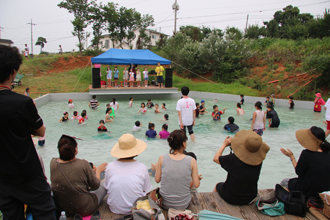
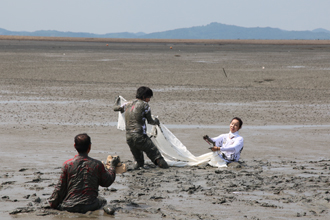
One of Festival Pum’s most attractive features is that participants get to meet family audiences. In the unique atmosphere that can only be found in the countryside, most participants plan to spend at least half their day there, where they can embrace the true meaning of “freedom.” There is even a special camping program that allows families to spend the entire day at the Theater Village throughout the festival. It is also setup so that performers may form a bond with their audience, grabbing a bite to eat with the families after the show and even going to watch other shows together. Where else but a festival like this could you connect with people so naturally, greeting and nodding to each other as you pass by? In this festival the artists do not exist solely on the stage, but the boundaries between them and their audience fade, creating an entirely warmer atmosphere.
Where Artists from Around the World who “Want to do Something” Gather
The writer stayed for a total of 22 days at the Mindulle Theater Village from June 29 to July 20 as the international coordinator cum participating artist for the residency project and the entire festival. In the words of Director Song In-hyeon, the start of the residency project was “simply a gathering of artists where you could not tell what would take place, you just watched them (do their thing).” The suggested topic was “Asian Theater Art Finding a New Identity.” This project’s most unique feature was that it had no director, and all participating artists had equal input, placing emphasis on how actively they would step into their role. A total of eleven artists hailing from India, Bangladesh, Japan, and Korea collaborated on this project, spending three weeks sharing their talents with each other in a workshop, watching performances, having debates, going on a tour of the area, doing rehearsals, and so on. The grand finale to the festival was 〈Kaleidoscope〉, a creation of both the participants and the organizers. The performance used India’s traditional myth as a background and combined movements from traditional Korean dance, staging three productions in all: 〈Heonsin(The Path of Devotion)〉; 〈Water〉 with a variety of playful movements forming a witty portrayal of the relationship between humans and nature; and the modern production 〈Birthday Party〉, which plays on the motif of observing a grandfather’s life in the village.
|
|
|
| ▲ Festival Pum FestivalPerformance 〈Heonsin(The Path of Devotion)〉 | ▲ From a performance of 〈Old Man Hokburi〉, an additional production outside of the original residency period by a trio of artists from India, Japan, and Korea |
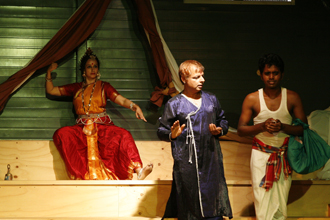
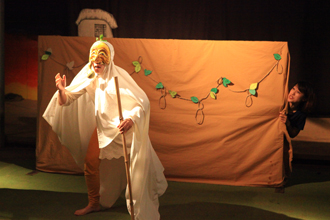
The forum that was held throughout the festival provided an ideal space for the residency participants, offering a variety of stages that were complemented by nature—spaces where they could also communicate with the Mindulle Theater Village locals. Participants expressed that they felt very fortunate for having been able to take part in this program. They also expressed hopes that in the future, the event could turn into a place for not only Asian artists but for artists from all over, a place to come together.
I would like to take the time to talk about an additional collaborative project created by three participants from India, Japan, and Korea during the residency,
Those Who are Full of Cheer, Spread it Around
On the other hand, if I had to name a part of the residency program that was lacking, it would be the exchange among Korean artists. Being a program run in the countryside, it was difficult to arrange exchange programs with artists residing in Seoul. In addition, the festival is supposed to be a place for artists with diverse backgrounds to come together and meet, but there were much less Korean artists than expected. Of course, it is not easy to bring in busy artists from the city to take a day to visit a countryside village. Be that as it may, would n’t more artists and performers try to visit the festival if current participants and organizers demonstrated what a great time it is? I would like to suggest that performance troupes and teams that are invited to the festival don’t simply return home after their performance, but stay for a day so to take the time to enjoy the festival as a participant and audience member as well.
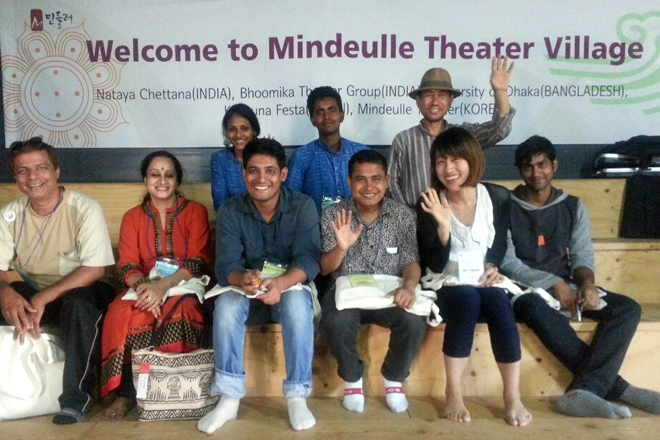 |
| ▲ Participants in the Residency Project |
On the final night of the festival, after presentations were finished, some song and dance occurred on the spot, with the accordion, janggu, guitar, and singing all mingling together naturally. A festival is, after all, something to be enjoyed by the people there. Anyone with cheer should spread it around.
ⓒHwaseong Festival Pum 2014
 PREV
PREV
.JPG)
.jpg)
.jpg)
.jpg)
.jpg)












.jpg','Anyone who works in the creative industry in Seoul..');)


