





Why Artists and Cultural Organizers alike are Leaving the City for Other Regions
[Trends] The Background and Flow of Cultural Migration
Cultural Homecoming: The Background of the Cultural Migration
Many readers will be familiar with the concepts of returning to the farm and country, but the idea of a cultural homecoming (or cultural migration) to the countryside is often a lot more challenging for people to grasp. Simply put, the difference between the two would be that while a return to farming or rural life may stem from fiscal or romantic notions, a cultural homecoming, by contrast ,is a way to redesign one’s life while contributing to the larger cultural rebirth of the countryside. Artists, designers, cultural organizers—these are the people who are learning to thrive outside the city. In order to live an artistic life in a rural area, whether that means simply getting a job or establishing a creative community with its own ethical or aesthetic grounding, preparation for inciting cultural and economic change is necessary. Any efforts made to redesign one’s life on a fundamental level must be carried out simultaneously with stirring change in that life’s background. There are many ways to do this—that is, starting down the path towards change—and there are even times where the best course of action is doing nothing at all.
|
|
|
▲ A shot from the center’s Umulteo Academy. Manager Gwang-jun Lee is seen giving a talk on living an ecological and cultural life in the countryside. |
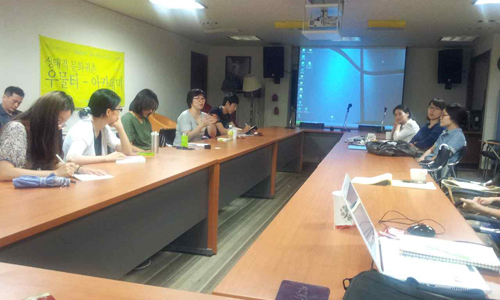
The concept of an eco-friendly return to the farm or starting your own ecological project as an alternative type of community has been a dream for many since the 1990s. Though there have been continuous efforts made to help see this dream into fruition, it was not until December 1996 when the Refarm Organizations was established as a result of a civic movement. Then, in December 1997, the seeds of change began to materialize in Korean society, beginning with the start of the International Monetary Fund (IMF) foreign exchange crisis; as requests for bailout loans triggered
consolidation in the banking in finance industries, many in their 50s and 60s were forced into early retirement, which is where their lives took a U-turn, J-turn or I-turn. These people fell into one of three categories: U-turners, or those who were born and raised in the countryside, came to Seoul for their education or career and then returned back to their hometown; J-turners, who are the same as the U-turners except they did not return to their hometowns, instead moving to another area outside of Seoul; and I-turners, referring to those who were born and raised in the city before opting to move out to a rural area. As the result of the new liberalism that stemmed from the worldwide foreign exchange crisis, the next ten years brought an epic collapse in Korea’s financial sector—savings, funds, and real estate—culminating in 2007. During this time, those in their 20s and 30s discovered that the world brought about by the ideologies of their parents’ generation—urbanization, industrialization, and information-oriented society—were not all that blissful. Mortgaging the present for the future and watching as their parents worked over thirty years to pay off their houses, the 20- and 30-somethings wondered if there is not some other way. It is this experience that has led to a rise in the number of young people returning to farm life, a cultural return to the farms and cultural migration that has taken hold from 2008 onward.
Cultural Return to the Farmland from Seoul
When seeing the public art, community art, cultural revitalization of traditional markets and the rural culture consulting that becomes visible in these communities, what I felt was the inability to shake off modernity, for just as in the city, most of the development was material. Moreover, it was a sad sight to see them put such a momentous effort into developing souvenirs and tourist attractions to cash in on tourists visiting the area. The reality is that, despite the effort that has been invested into discovering the potential cultural and ecological inroads in the area through eco-museums, fair domestic tourism, slow cities and other methods, 10 years later, the long-term goals of the original cultural development are hard to find. The reason for this seems rooted in the general aging of population being seen nation wide; a burgeoning elderly demographic is expanding consistently while the youth continue to stream into the cities, leading to a dearth in the supply of farm labor. Most young people are now looking for employment or trying to attend schools in large cities like Seoul or Pusan, draining the population in other rural areas. Amid these conditions, a new paradigm is beginning to take form; we are now seeing a reversal, where the population in areas like Jeju-do is decreasing and areas like Jin-an, Geochang, Haenam, Gangjin and other counties are seeing active growth.
|
|
|
| ▲ Umulteo Academy’s “Exploring Life in the Country—This is Not Just a Return to the Countryside” (At Chungbuk, Jecheon, Daejeon-ri) | ▲ Umulteo Academy’s “Exploring Life in the Country—The Ecological Village Experiment (Yeong-gwang County) |
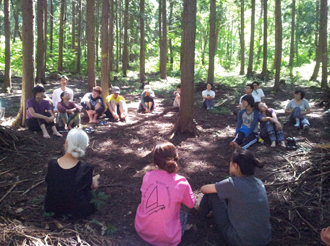
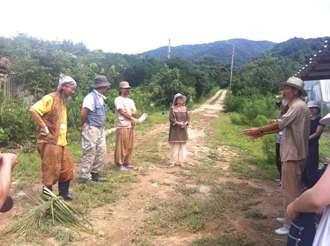
As Jeju-do’s population was on the decline, in 2010 it began to turn around and the numbers began to rise again. In 2011, the population increased by 2,340 people, and 4,873 more came the following year. According to 2011 statistics, those who were specifically returning to farm made up 19 percent of the total increase (447 people), with the remaining 81 percent arriving for other reasons. This return to farming can be divided up into the aforementioned U-, J-, or I-turns, though I-turns have experienced a bit of an upsurge in recent years. A tired soul’s prompt response to the weariness of city dwelling, many urbanites no longer wish to continue living in an environment where people live in shoe box houses, gardens are hard to come by, it takes two hours by car to get to the mountains or the sea and going to the Han River on the weekends means wading through throngs of other people. Born out of the doubts that people of different ages and perspectives are having about civilization and the rapid pace of city life, many are choosing to return to the farm—to the countryside. Since 2008, Korean society has seen increased interest in rural living from those in their 20s and 30s—a greater consideration for consumer culture and its relationship to industrial production. They resolve to move to the country when faced the reality of urban living: the polarized city system where the bottom 80 percent support the top 20 percent, they are forced to live in cramped living quarters with minimal outdoor space andare limited by the obligation to abide by a system in which they have little freedom to change their lives as they see fit.
From the Romanticized Return to Nature to a Cultural Return to the Country
As a branch of a farmers’ movement or ecological movement, the small exodus from the cities is less a return to farming than it is a conscious decision to live a life close to nature, with youth and middle-aged people setting forth to try making a new life for themselves in a new place. In addition, this cultural return to the country began as people from the city became more introspective about the consumerism of modern cities and their relation to it. For those in their 40s and 50s that spent their lives in pursuit of success in the industrialized cities, a feeling of alienation from their urban existence has left them grasping to find a life in the countryside. Similarly, there are an increasing number of people in their 20s and 30s who, despite possibly finding success in city life, are still seeking out a life more in tune with ecological values. When looking at all of the things these two groups have in common, from the rural perspective, however, they are all “young.”From the perspective of those making the change, in order to establish the “flow” that is necessary for reinvigorating the countryside—developing a community, eco-friendly farming, small-scale farming, cooperatives and so on—the area’s cultural values need to be generated anew and they need a group of people who are willing help build them. They need people who are interested in unearthing cultural resources of the area, granting it significance and helping it take on a form where communication is possible, and where it can bring about culturally and economically feasible practices that will strengthen the cooperative’s communication and collaborative ability.
 |
There have already been already a variety of artists who have been willing to pack up and leave. First, many moved from the city to satellite towns or the suburbs in the surrounding areas to find workspaces. In the early 2000s, for example, there were several migrations from Seoul to Namyangju, Gapyeong, Yangpyeong; from Incheon to Ganghwa-do Island; and moving into closed down schools in the country. Many middle-aged and senior writers live there now. Then in the mid-2000s, with the rise of the cultural hub at Daehangno and boom in the Hongdae business district, many young artists moved to places like Mullae-dong, the village south of Mt. Namsan in Itaewon, Ui-dong, Seongbuk-dong. |
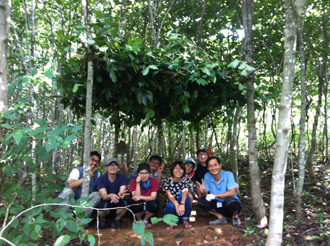
| ▲ Umulteo Academy’s “Exploring Life in the Country — The Ecological Village Experiment |
These kinds of migrations within the metropolitan area or to the surrounding suburbs were carried out in search of work spaces that were both affordable and quiet, but the recent move to places in the Chungcheongbuk-do, Jeju-do Island, Jeollanam-do (Damyang, Gangjin, Haenam), Jeollabuk-do (Jin-an, Namwon, Wanju), Chungcheongnam-do (Seocheon, Seosan, Hongseong) areas are indicative of a unique factor that is key to how it differs from the existing patterns of migration. Artists and designers used to put the urbanism on the center of their lives, but more recently, they are moving to rural areas after criticizing that the life in the large cities, which is excessively based on fossil fuel consumption, financial sectors and consumerism. As this criticism of the consumerist design of urban life continues over the long term, and the division of modern cities continues to exist at both the center and periphery, there comes a trend among artists and designers alike: absorbing new knowledge from a “glocal” perspective and dividing freedom of art and individualism in such a way that the flow of how rural areas are viewed can be seen from a wider perspective. They are attempting to both enrich their skills while also making an effort to live out a promise of a community with an alternative ethical foundation. In a system where artists can make small promises amongst themselves, learning that method, they are attempting to create a new form of culture, and during the creative process, innovative supporters and collaborators have emerged. These kinds of people who are making a cultural return to the country is growing, with artists and organizers from urban regions creating a postmodern ecological area so that human developments are no longer places that simply provide necessities of life, act as production sites, or serve as tourist attractions, but rather operate as places where one can live a very full life. As such, I believe that in the next 10 or 20 years, many will be able to continue to find their place in the country, life coming full circle.
Ⓒ Cultural Action Center of Korea
 PREV
PREV
.JPG)
.jpg)
.jpg)
.jpg)
.jpg)












.jpg','Many readers will be familiar with the concepts of..');)


