





Concept Programming can give Local Theaters their own Color
[Festivals/Markets] Developing Local Theaters through Dance Festivals
With such an ambitious title, I wonder whether I can live up to the expectations I set for this piece. This is because after two years of experience working at local theaters, I know it’s a matter that is not a feat to be taken lightly. That being said, because it is an important issue when positioning local theaters, I attempted to examine it through a theoretical approach. As most people know, devising methods of developing local theaters begins with the theater’s mission. Based on whether the theater is like a community theater, primarily for local residents, a multipurpose regional theater suitable for various programs, or a space for local government events, it is clear that the methods for growth will all differ. Geographically, Korean theaters can be divided up into those that are in the Seoul metropolitan area and others, or “local” theaters. Of course, the term “local” is a relative one so those that fall under this categorization are not necessarily the same, but for the purposes of this piece they will be defined by geographical location. For instance, Gangdong Art Center would fall under both categories as it is located in the Seoul metropolitan area but is still technically the “local” theater for the Gangdong-gu region. However, it was an ambitious undertaking from the offset; with an environmentally-friendly exterior design, its contents and the theater itself are anything but the standard, run-of-the-mill local theater. Even upon closer inspection, it did not fall short of great expectations with its seasonal dance and classical music programs. Particularly of note is the dance festival that began in the theater’s opening year, one that holds up even in comparison to Seoul’s dance festivals. First of all, one can see that it was positioned with a theme. However, rather than simply analyzing whether it was a brave choice, I approached it by offering a practical examination of what program strategies can realistically be employed and in what ways they could contribute to the theater’s development in the long run.
The Way Local Theaters Do Their Programming and Festivals
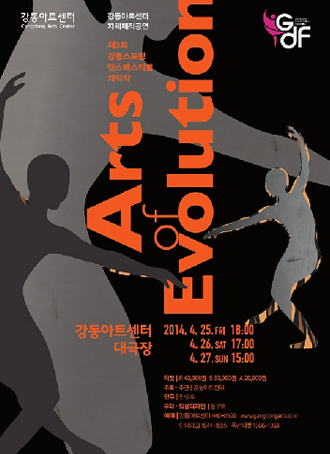
There are a number of variables when discussing local theaters outside of the capital area as a single group. Though they are all called “local” theaters, the positioning, programming direction and plans for growth for the Gangdong Arts Center, Ansan Arts center, and Daejeon Culture and Arts Center all differ. For convenience’s sake, I shall utilize these three examples to expound on my thesis. First, the Gangdong Spring Dance Festival is now in its third year. From late April to early May the main genres in Korean dance take center stage, with programs involving local participation, university dance classes, exhibitions, and events all taking place concurrently. The first impression one gets is of a festival that is more a collection of all things related to dance, rather than a straight dance festival. Of course, considering the reach of the networks of members of the organizing committee or partner institutions, the scale seems expansive, but they still face the same limitations as other local festivals, like the ones the Seongnam International Dance Festival and the Busan International Dance Festival encountered.
|
|
|
|
▲ The Poster for Gangdong Arts Center’s 2014 Gangdong Spring Dance Festival opening performance, Arts of Evolution |
▲ The Posters for Daejeon Culture and Arts Center’s 2014 Spring Festival |
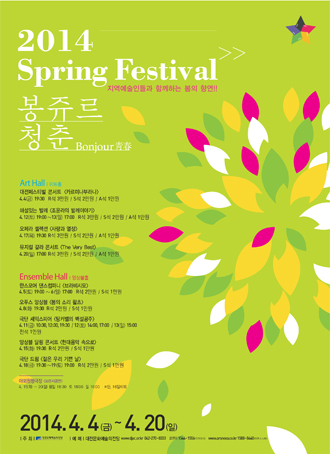
The program structures of local theaters (or of most Korean theaters for that matter) are still not based around the programmer, but focused on the representative’s connections, so it is still unclear whether we can look forward to festivals with their own unique color. However, if we were to make a blueprint for the future, the festival should be positioned within the theater’s general program so that a long-term plan can be made accordingly. Inasmuch as it is a local theater, it has to distinguish itself from festivals in Seoul while considering how to get the local community involved. This is not to simply say that as a local theater it must get locals to participate, such as a fringe project would. Only after analyzing each locality’s audiences, in areas such as personality and style, should a strategy be devised to carry out the program in phases. For example, as in the case of the United Kingdom’s Barbican Centre’s BITE or Australia’s Adelaide Theater’s Oz Asia Festival, their festivals are distinguished from the theater’s regular season. The Daejeon Culture and Arts Center, where I am currently employed, has been holding its annual Spring Festival every April since its opening, an event that focuses on local artists (strictly speaking, focusing more on the region as a whole). As the area’s leading theater, it has the responsibility of promoting local art, so it is really something they could not have avoided. Coming into its 10th year, the entire month of April this year was designated as the Spring Festival period, a festival expressly for the local artists. The result was not all that different from the past. The local artists were mainly from the region, and most of those invited were those who had already made a name for themselves in Seoul. Either that or there was a method where local artists were joined by artists invited from Seoul. At this point, we have a lot to think about. It is necessary to be so strict in sticking to the “local” artist concept to promote local artists? Would it not be more beneficial in the long-term for local artists to approach it from a more open stance? The various intertwining issues involved, however, force me to admit that there are no easy answers, which leaves only the bare toughness of reality.
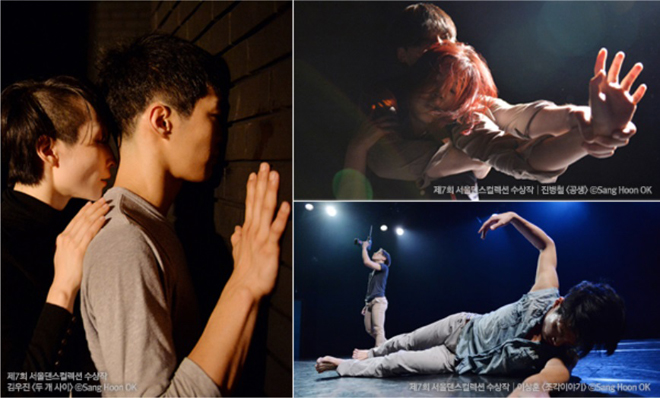
At this point I would like to take another look at the success of the Seoul Performance Arts Festival(SPAF)’s project known as the Seoul Dance Collection & Connection. Its beginnings were quite simple. At the time, young Korean choreographers were paying out of their own pocket to take part in Japan’s Yokohama Dance Collection, and so instead began the Seoul Dance Collection, one that was open to all. At its inception the prize money was channeled to any international dance festival of the winner’s choice. Afterwards, SPAF used its network to send people to Potsdam, Germany, or Angers, France, for residency. Some choreographers took it as an opportunity to go more than ten times, expanding their network while doing so, while others found breaking free from the Korean mold too difficult and ended up returning. Nonetheless, by expanding their network within Korea and abroad, the project succeeded in giving artists new opportunities.
|
|
| ▲ The winners of SPAF’s 7th Annual Seoul Dance Collection in 2013. ▲ Clock wise from the left: Kim Woo-jin 〈Between the Two〉, Jin Byeong-cheol’s 〈Symbiosis〉, Lee Sang-hoon’s 〈Piece Story〉 ⓒ 2013 SPAF |
Now to get back to the main point, what role can dance festivals play in the development of local theaters? This is a question that is neither here nor there from the start, because each has its own circumstances so there is no single solution that would be suitable for them all. However, why is it that heads tilt to the side when considering whether dance festivals can contribute to local theaters’ objectives? On the other hand, if the contributions of dance festivals to the development of Seoul’s theaters were questioned, there would be no strong alternative. In the end, it could merely be that the reality that local theaters have a much harder time bringing in audiences with a more unique program, so it faces both issues. Interpreting the issue inversely, one could come to the conclusion that if it is hard for local theaters to attract audiences in any given condition, and thus use conceptual programming to bring a unique color to the local theater for a short time. Of course, in order to avoid ending on a sophistic note, they must break free from easy programs and put in effort into devising multi-lateral ones that audiences can better connect with.
A Festival Made for Local Audiences
There’s also the question of whether or not a festival bears any significance to the local residents. Granted, local theater festivals allow works outside of the season program to gain significant exposure while providing opportunities to local artists. However, most are not performance festivals, and even those that are rarely set themselves apart from the theater’s season program. The only two that would fit this description are the Ansan Street Art Festival and the Uijeongbu International Music Theatre Festival. In these cases, when the directors change, the character of the festival will change along with them.
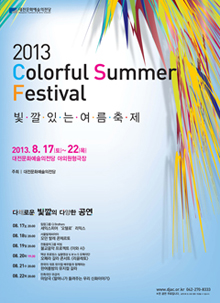 |
If the Daejeon Culture and Arts Center were to put on a special festival of its own, what would it be like? In this case, since its opening year, they have held their annual Colorful Summer Festival every August during summer break, which has free outdoor events that appeal to a wide audience. Their main performances are usually jazz, musical gala shows, and other genres that cater to mainstream tastes and garner a positive response from younger audiences. Last year, with its success in running for 10 years, they decided to step up and create a more ambitious program: The New York hip-hop duo, The Q Brothers, and their production 〈Othello: The Remix〉, Be-Being’s modern interpretation of gukak(Korean traditional music), Festival Aix-en-Provence’s 〈Rigolleto〉 outdoor screening, and modern ballet gala. Although some audience members exhibited an enthusiastic response, several event planners, families, and other audience members found the subject matter quite foreign to their tastes. I felt helpless—dumb founded. I immediately felt the need for a long-term strategy to make audiences familiar with the theater’s programs before hand, so they could adjust to the new atmosphere. |
| ▴ The Poster for Daejeon Culture and Arts Center’s 2013 Colorful Summer Festival |
Also, in order to reach out to new audiences, the planning team should have to, worked together as one body, following a precisely detailed plan. Without such unity and precision, rather than coming together to make a solid program, individual pieces end up as simply parts of shoddy patchwork.
Development for local audiences
Then the question remains: how can local audiences grow and develop? It is necessary to adapt a different method from that of Seoul’s? What other secret method could there be? A performance hall without an audience is incredibly dreary, pitiful. Even if there are audience members who leave in the middle of the show, there is nothing more rewarding to an organizer than a sold-out venue. If that cannot be accomplished, it does not matter, even if you can bring the most talked-about show in the world, you will be stuck in self-deception.
 |
| Jérôme Bel & Theater HORA’s 〈Disabled Theatre〉 ⓒ 2013 Festival BO:M |
Last April, the Jérôme Bel & Theater HORA’s Disabled Theatre was invited to Festival BO:M which was in Seoul and continued on to the Daejeon Culture and Arts Center. As expected, tickets did not sell well and most viewers, including the organizers themselves, did not fully understand the show. The name Jérôme Bel is itself unfamiliar, his works and comprehension of them also understandably so. While watching the show it was hard to discern what was unfolding, and it was hard to move beyond simply applauding as gestures towards the disabled performers. It was quite a tricky situation. The program was based on the idea that though it is important to give local performers a chance, it is also equally important to display a variety of Korean works that can make an artistic impact. Of course, organizers could n’t pass up the opportunity to give citizens a chance to experience cultural diversity. However, the result of this hasty optimism was fatal, so this year’s program will only focus on the local area as a whole. In Seoul, perhaps due to the KASSA DOCUMENTA’s bonds, tickets sold well and audiences were delighted. Although there was the question of whether Jerome Bel’s work—already established on a global scale—still possesses contemporary characteristics, in Daejeon, just one hour outside of Seoul, it was received as a kind of strange new world, and we could n’t bring ourselves to ask the question out loud.
Prospects for Local Theaters
Would it be a stretch to say that for the current performance scene in Korea, one of the methods of expansion and development lies within regional theater? Is it too much to expect that simply moving the location of institutions—such as the theater scene and Arts Council Korea branching out from Daehangno, moving the Ministry of Culture to Sejong-si, relocating Gwangju’s Asian Arts Theatre, etc.—is enough to stir up change? Of course, most local theaters sense these macro relocations, and cannot keep up with their own programs. However, on a personal level I believe it is imperative that Korea’s art world goes beyond its Seoul-only focus and spread out to other areas. This would allow for growth on various levels, from theaters in districts within Seoul, to those in Gyeonggi-do and other locales. Many festivals will try and fail during this process. However, during this process I hope that these “local” festivals may come into their own, like the Gangdong Dance Festival has, creating something special where local and global collide.
 PREV
PREV
.JPG)
.jpg)
.jpg)
.jpg)
.jpg)












.jpg','With such an ambitious title, I wonder whether I c..');)


