





ASEF launches a Mapping of Creative Industries in Asia and Europe
[Trend] New publication『Enabling Crossovers: Good Practices from the Creative Industries』
Creative industries are emerging as key components of the global economic and development agenda. These industries have demonstrated the ability to employ culture to provide insights into and solutions for the pressing social and economic challenges of our times. Adequately nurtured, creative industries are capable of fostering innovation as well as stimulating sustainable human-centered development. The topic is also high on the agenda of Ministers of Culture from Asia and Europe, who will meet from 19-21 October 2014 in the Netherlands, in the framework of the Asia-Europe Meeting/ASEM dialogue process.
|
|
In preparation for this Ministerial meeting, the Asia-Europe Foundation(ASEF) has recently launched a compilation of good practices in the creative industries across Asia and Europe. The publication, 『Enabling Crossovers: Good Practices from the Creative Industries』(2014, ASEF) was launched at first Senior Officials Meeting of the 6th Asia-Europe Culture Ministers’ Meeting held on 20 June 2014 in Rotterdam, Netherlands. The first copy of the book was handed to Marjan Hammersma, Director General-Culture and Media, Ministry of Education, Culture & Science, Netherlands by ASEF’s Deputy Executive Director, Karsten Waenecke.
The publication, which includes 36 good practices in policy and practice from 33 countries in Asia and Europe, aims to serve as inspiration for networking, collaboration and policy making, with particular focus on the upcoming Ministerial meeting. It covers the four areas to be discussed at the Ministerial meeting, namely, creative skills, creative entrepreneurs, creative cities: sustainability and creative cities: quality of life. Essays by eminent cultural thinkers and experts including Charles Landry, Paul Rutten, Mary Ann Schruers, Anmol Vellani and Ada Wong are also included. The publication is available for download online.
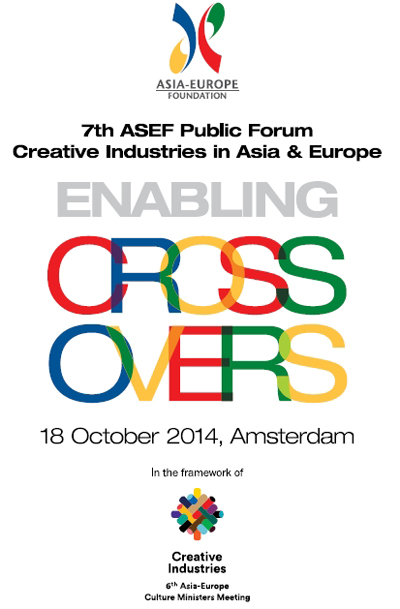
The publication was prepared in collaboration with the Ministry of Education, Culture and Science, Netherlands and Het Nieuwe Instituut, Rotterdam in ASEF’s capacity as an official partner of the 6th Asia-Europe Culture Ministers’ Meeting. Following up on the ideas and cases in the publication, a public forum on the creative industries will be organised by ASEF on 18 October in Amsterdam, Netherlands.
|
|
| 7th ASEF Public Forum on Creative Industries in Asia & Europe: Enabling Crossovers |
Here is an excerpt regarding KAMS from Good Practices from the Creative Industries (page 39 of the publication).
|
Established in 2006 as a non-profit, public foundation for the development of the performing arts in Korea, and supported by the Ministry of Culture, Sports and Tourism, KAMS offers multi-faceted assistance to bolster the sustainability of arts groups and organizations as well as that of international exchange. At the same time, it works to strengthen competitive advantages through effective and diverse support systems for more efficient arts management. The range of services provided includes knowledge and information (e.g. newsletters, seminars); training and consulting; and, international development (e.g. funding, mobility support, organization of networking events). Training and consulting activities promoted by KAMS as regards entrepreneurship are particularly interesting. Services in this area include, among others, the provision of tailored advice (on, for instance, funding, legal and financial management) and the identification and analysis of best practices(on issues such as management, programme development and fundraising for professional arts organizations). A particular scheme worth mention fosters the certification of arts and cultural organizations as social enterprises in order to secure their self-sufficiency and competitiveness. It is also worth noting that support in the area of international development includes opportunities for Korean artists and arts organizations to present their work abroad, thus contributing to their visibility, creating networking opportunities and potentially broadening markets. The Center Stage Korea Focus funding programme, for instance, supports the presentation of Korean performing arts at major festivals and performing arts venues abroad. Long-term relationships and projects between performing artists and organizations from Korea and other countries have been established through the Connection programmes with the United Kingdom and Finland, among others. The Performing Arts Market in Seoul (PAMS) is another well-regarded initiative. Held every October, this international networking platform for performing arts professionals consists of performances, information booths and seminars. KAMS’ experience points to several key issues for the development of arts organizations and entrepreneurs. An important learning is the value of specialized bodies gathering intelligence on the specificities of arts management and the international dimension of the creative sector. Knowledge management by the organization can subsequently be exploited in the form of training, publications, tailored advice, funding and networking opportunities, among others. Whilst being part of the public sector, KAMS is also in a position to establish partnerships with a wide range of actors in Korea and abroad(e.g. arts organizations, individual advisors, trainers, researchers, etc.)and to fulfil a set of varying roles. This broad ecosystem of actors and relations clearly demonstrate how creative entrepreneurship can be related to the operations of different actors in the creative sector, including public and private bodies, large and smaller stakeholders. |
◈ 『Enabling Crossovers: Good Practices from the Creative Industries』 Download
◈ Related Article
ASEF’S publication on Creative Industries launched in Rotterdam
http://eng.theapro.kr/main.asp?sub_num=12&pageNo=1&state=view&idx=6186
 PREV
PREV
.JPG)
.jpg)
.jpg)
.jpg)
.jpg)












.jpg','Creative industries are emerging as key components..');)


