





Sowing the Seeds for Korean Architecture to Take On the World
[Trends] Korea Pavilion Wins Golden Lion Award at The 14th Venice Architecture Biennale
At this year’s 14th Venice Architecture Biennale, the Korea Pavilion won the Golden Lion Award, breathing new life into the rather stagnant fields of not only architecture but also Korean culture and arts at large. When commissioner for the Korea Pavilion, Cho Minsuk, struck a pose with Rem Koolhaas, this year’s biennale curator, holding the Golden Lion award, it appeared to signal the beginning of a new era for Korean architecture. When Cho, who has worked with Rem Koolhaas at his company, OMA, and who boasts an extensive international network, was selected to be commissioner, it was easy to anticipate that the Korea Pavilion would become the center of the global limelight, but even so, people did not foresee that Korea would be the recipient of the Golden Lion award. As the principal director of Mass Studies, Cho has been investigating the urban conditions of Korean architecture and leading imaginative projects, and at this year’s Biennale took the theme of "Absorbing Modernity: 1914-2014" to review the architecture and history of the world’s only divided nation: North and Korea. The venture was aided by two architectural theorists who joined in as curators: Ahn Chang-mo of Kyonggi University, who is an expert on modern architecture, and Pai Hyung-min of the University of Seoul, who has worked as curator for past Venice Architecture Biennales and the Gwangju Design Biennale. With such solid teamwork and clarity of subject matter, the Korea Pavilion was able to leave behind past stumbles and leave a lasting legacy in Korean architectural history.
The Crow’s Eye View
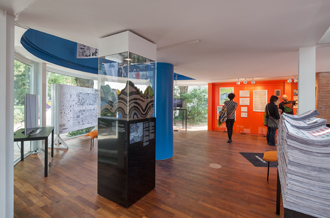
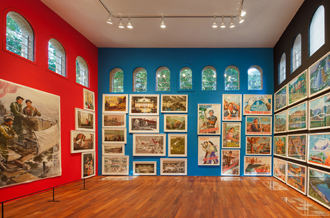
The exhibition at the Korea Pavilion, entitled 《Crow’s Eye View: The Korean Peninsula》, is made up of four large themes: Reconstructing Life, Monumental State, Borders and Utopian Tours. Cho, who has stated that he "wanted to show how the unique situation of being divided has impacted the architecture of the two Koreas," first tried to work out a joint exhibition between the North and South, but to no success. The title of the show, Crow’s Eye View, was derived from the work of the poet Yi Sang, who was also educated in architecture. "The perspective of the bird’s eye view, which is rooted in the assumption of universality and an all-encompassing quality, and the contrast it creates with the crow’s eye view," is a key lens through which to examine modern Korean history. To gather the scattered fragments within urban Korean architecture, which "cannot be defined by a single unifying theory," and to imagine the connective link between them, is the key objective to this exhibition. This was what set this year’s Korea Pavilion apart from those of previous years, which focused on a single architectural project, or those of other pavilions, which centered on single cities. It transcended architecture in the narrow sense of the word, and more specifically, was not limited to the works of architects, but encompassed the various works of 29 teams that included authors, artists, photographers, film directors, producers and collectors.
|
|
|
| ▲ Suh Ye-hre model of the DMZ and Nick Bonner’s North Korean collection 《Utopian Tour》(from left to right) | |
Korean Architecture in Venice
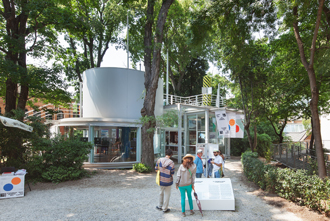
As the single largest platform upon which to showcase Korean architecture, the Korea Pavilion at the Venice Architecture Biennale has been sustained over the years through the voluntary collaboration of many architects since its establishment in 1995. As the only Asian pavilion besides that of Japan’s, the Korea Pavilion is the last one to have been added in the history of the Biennale, and was the result of a fierce competition with countries such as China. Since its founding, the Korea Pavilion has participated in eight different occasions to convey contemporary Korean architecture, with each year headed by a different commissioner: Kang Seo-kwon in 1996, Kim Seok-chul in 2000, Kim Jong-soung in 2002, Chung Guyon in 2004, Cho Sung-ryong in 2006, Kwon Moon-sung in 2010 and Kim Byoung-yoon in 2012. Every time there were problems with time and budget, and each and every show was of varying quality. The conceit of the project being to explore architecture in the form of an exhibition, at times the problem stemmed from a lack of communication or an exhibition expert. In its early days, the show was simplistic in its approach, to show various architectural projects that emerged in Korea, but by the 2000s, the project focused on Seoul, providing architectural interpretations for the various urban phenomena occurring in the city. Perhaps because the 2012 pavilion had been the target of much criticism in its approach to theme and presentation, the Arts Council Korea abandoned its existing methods; instead they received nominees via public recommendations, and selected the commissioner by a final process in which nominees individually presented their exhibition plans. The four nominees, Kim Young-joon, Cho Min-suk, Kim Chan-joong and Hah Tea-seok, were all younger, had previously participated in the Venice Biennale, and were savvy to international architectural trends, which proved hopeful. When Cho Min-suk was announced to as the winner in March 2013, he was given 15 months to prepare for the final show.
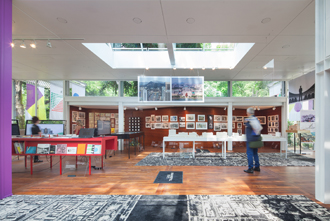
Considering that from its initial commissioner selections processes, the project proposals were thoroughly vetted, and that there was plenty of time for preparation, Crow’s Eye View: The Korean Peninsula is an exemplary case study indeed. Along with the 2004 exhibit, entitled City of the Bang, which was lauded for its good planning and clear message, the Crow’s Eye View shows just how important the role of the exhibition planner is in an architecture show. There were some criticisms that pointed out how there appeared to be too much material pushed into the limited space within the Korea Pavilion, and that this made understanding the works more difficult. It was the inevitable result of Rem Koolhaas’s instructions that every pavilion focus less on individual architects and concentrate on researching the history and accurately representing it; but nevertheless, the consequent inability to fully promote the works of Korean architects, in the reality that there are very limited chances for them to be publicized in the international market, seems a missed opportunity.
|
|
|
| ▲ For this year’s Korea Pavilion, a total of 29 teams, 14 Korean and 15 international, participated to represent North and Korean architecture through photography, painting and sculpture. | |
What the Golden Lion Award Means for Korea
On winning the award, Cho said that "it was necessary to look back on the last century to move forward into the future." Divided by war, just as the country was about to finally rejoice in its independence, Korean spaces have engaged in a speed race to cope with such historical challenges. Such rapid changes did not leave time to allow the country to pause and reflect on its footsteps, and given such circumstances, this opportunity to ruminate on the past century of architectural history is a meaningful opportunity indeed. Hence, next year’s exhibition, which will not only coincide with the Korea Pavilion’s 20th Anniversary but mark its 10th year in the Architecture Biennale, will be a chance for the project to be more adventurous in its works, to show the future of Korean architecture. In this slow economy, in which the architectural market has all but frozen up and large projects are hard to come by, architects have to flexibly manage many projects that span exhibitions, publishing, and conferences, using architecture to realize them. Such architects are people who are already familiar with collaborating with not only artists but with experts of many different fields. Given such realities, the future for Korean architecture appears brighter than expected. The Golden Lion Award was a long-awaited dream come true for the field. There are skeptics who say that this may be the one and only time it’ll ever happen, but at the very least it has laid a solid foundation in architectural discourse for future generations to proceed. Now is a time for celebration.
Ⓒ Arts Council Korea
 PREV
PREV
.JPG)
.jpg)
.jpg)
.jpg)
.jpg)












.jpg','At this year’s 14th Venice Architecture Biennale, ..');)


