





The ideal Venue of the Contemporary Theatre Scene
[Festivals/Markets] Review of 2014 the Nová dráma/New Drama Festival
The Nová dráma/New Drama Festival is Slovakia’s only theatre festival focusing on contemporary drama and its stagings. The Festival was launched in 2005 mainly because the country had lacked new Slovak texts and theatre performances based on them. It is true that the Drama Competition, which involves original Slovak plays, was initiated by the Theatre Institute in 2000. However, the competition has n’t had any visible influence on the staging of new Slovak plays. The winning plays are announced each year, but only few theatres (if any) are willing to stage them. Under these circumstances, the Theatre Institute in Bratislava launched the Nová dráma/New Drama Festival, in an attempt to strengthen the existing support for new Slovak plays. The Festival, which takes place every year, serves as a venue for a competition showcase of the best contemporary plays that were presented during the previous year at Slovak theatres. The 10th Festival was held from May 12 to 17, 2014.
|
|
|
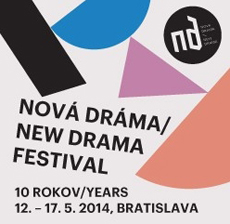
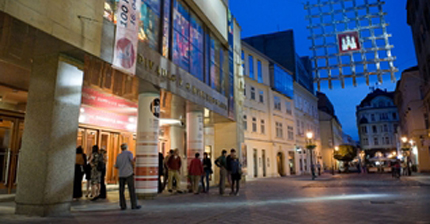
| 2014 Poster of the Nová dráma/New Drama Festival | The Nová dráma/New Drama Festival is held in Bratislava |
The measure the degree of newness, “age”
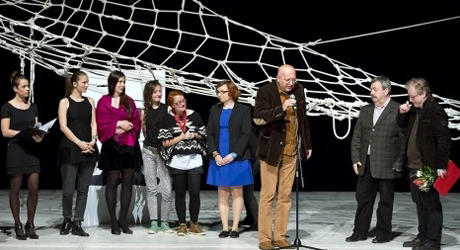
At the beginning, the Festival jury would award the performances various prizes (such as New Drama Surprise, Best Dramaturgy Surprise, Special Prize for Staging a Slovak Contemporary Play / Foreign Contemporary Play). Generally, around three of the ten competing performances would be Slovak ones. Later on, the number of contemporary texts and original plays produced at theatres multiplied to such an extent that the “motivating” prizes were no longer needed. Since the 6th Festival, only one prize, which is called the Nová dráma/New Drama Grand Prix, has been awarded. The performances participating in the Festival are evaluated by an international jury composed of Slovak and foreign theatre experts. In recent years, new Slovak plays have taken a bigger part in the main programme, as theatre directors have reflected more on the social and political situation in today’s Slovakia. So we found it necessary to invite Slovak theatre experts as judges because foreign jury members are not able to understand the Slovak context of original Slovak plays.
Three persons usually choose performances for the Festival. The dramaturgy board is made of theatre critics, rarely playwrights or dramaturgs. For the 10th year, they watched productions that premiered between March 2013 and February 2014 at state, regional and independent theatres. The number of productions monitored by the dramaturgy board every year is around fifty. Although the selection criterion “newness” may have different meanings, there is one demonstrable indicator that helps us measure the degree of newness: the “age” of the text. Indeed, the dramaturgy board focuses on the productions based on texts written after 2000. Among the texts are contemporary Slovak and international plays, and dramatizations of existing works are also regarded as new texts.
|
|
|
| Nová dráma/New Drama Grand Prix | The 10th anniversary the Nová dráma/New Drama Festival |
The Theatre Institute is subsidized by the Ministry of Culture of the Slovak Republic. It means that its finance comes from the Ministry, and it is not allowed to apply for any state grant. Other institutions or companies supporting arts and culture via various donations and support programmes usually finance independent theatre groups. The Festival team has its director Vladislava Fekete, who is also the director of the Theatre Institute, and its main coordinator who is only in charge of the Festival. Other members of the Festival staff are the regular employees of the Theatre Institute, and they are responsible for running other departments or projects throughout the year. These staff members include the programme manager, media and PR coordinator, those in charge of accommodation and guests and volunteer coordinator.
The barometer of contemporary theatre scene
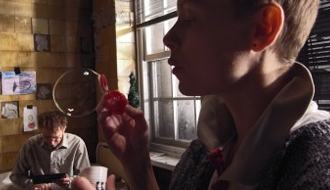
Every year, the Festival brings a rich additional programme apart from its main programme. A stable part of the programme is the special section Focus. This section is dedicated to one country each year, staging a couple of performances from the country, theory event led by the country’s theatre expert such as a playwright, director and theoretician as well as other events describing the country’s theatre culture (e.g. film screenings and discussions). The Festival’s Focus invited Serbia, Russia, Poland, Finland and in 2014, Hungary. The Hungarian Focus offered two performances: 1.Kornél Mundruczó and performed by the Proton Theatre (Budapest, Hungary); 2.
|
|
|
| Kornél Mundruczó | Compagnie Pal Frenak |

The Festival also invited various international experts who led lectures or workshops (Aleks Sierz, Patrice Pavice, Árpád Schilling and Hans-Thies Lehmann). In 2013, the Festival included a conference dedicated to dramaturgy called “New Dramaturgy, New Dramaturg.” This conference gathered together participants from all over Slovakia; Dramaturgs from Slovakia’s state, regional and independent theatres exchanged their ideas about contemporary and modern dramaturgy. To this year’s conference were invited international guests like Thomas Irmer (Germany), Viktor Minkov (Russia), Patrice Pavis (France) and John Elsom (UK). We would like to continue to organize the conference because it brings together people from Slovakia and Europe who share not only their artistic ideas, but also their opinions on the Festival.
The Festival is held in Bratislava, the capital of Slovakia. Bratislava and its surrounding region have a population of over 500,000. A lot of theatres are concentrated in that area and most of the theatre experts live there. So it is hard to create a “real” festival atmosphere for them. Moreover, of the nine performances of the Festival’s main programme, four or five are regularly performed in Bratislava. So the Festival’s major roles are to provide its participants with an opportunity to discuss contemporary drama and to bring foreign guests to Bratislava. All of its performances and most of its additional programme and debates are subtitled in English, thus making the Festival an ideal venue for Slovak and international participants to network with each other. I am pleased to say that for the past ten years, the Festival has made great progress in shaping its programme and encouraging its audience to discuss trends in the contemporary theatre scene.
ⓒThe Nová dráma/New Drama Festival
 PREV
PREV
.JPG)
.jpg)
.jpg)
.jpg)
.jpg)












.jpg','The Nová dráma/New Drama Festival is Slovakia’s on..');)


