





The Asian Boom in Australian Performing Arts
[Festivals/Markets] In and Around Adelaide and Melbourne
It is a nation that is seasonally opposite to us, but time-zonally close; culturally and linguistically Western and foreign, but geographically and economically Asian and familiar. This simultaneously distant and near country—the most recent addition to Korea’s list of Free Trade Agreement partners—is Australia. While it has only become a significant economic and political partner in the last few years, on the arts and culture front, Australia has long since established as close a relationship with Korea as it has with any of its Asian neighbors. The 2012–2013 Korea-Australia Connection Initiative: Performing Arts Internship, organized by KAMS and the Australia Council for the Arts, is a program that illustrates the depth of the two countries’ relationship. The Adelaide Festival Centre and the Melbourne Arts Centre, where the internship program has been taking place for a total of nine months, are excellent examples of the leadership and resourcefulness in Australia’s exchange of culture and the arts with Asian countries.
|
|
|
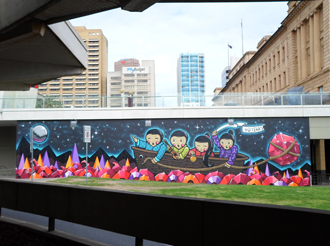
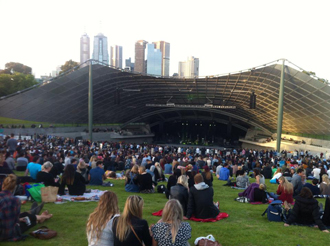
| Asian feel of the mural ◎The Adelaide Festival Centre | Sidney Myer Music Bowl ◎The Melbourne Arts Centre |
Adelaide, Where Everyday Is a Festival
The state of South Australia, where Adelaide is located, is known as the Festival State and is home to such events as the Adelaide Festival, the Adelaide Fringe Festival, WOMADelaide. The Australian Performing Arts Market(APAM) which has moved to Brisbane as of this year, also originated in Adelaide. These major festivals (existing separately from the Adelaide Festival Centre) are all held from February through March. The frenzy that occurs during this period has been nicknamed "Mad March," wherein people from all over Australia and the world come to partake in the festivities. As the state’s representative performance venue, the Adelaide Festival Centre hosts up to three or four festivals a year, of such diverse niches as the family-oriented Come Out Children’s Festival, the largest of its type in the world; the Adelaide Cabaret Festival; the biennial Adelaide International Guitar Festival; and the OzAsia Festival. The hurdles faced by organizers in Australia are no different than those in Korea, as festivals face a consistent lack of financial and human resources. And yet, in spite of those shortcomings, the festivals in Adelaide still appear to do exceptionally wellat managingthe contracts, visas, tickets, promotions, sponsors, cooperation, marketing, stage, proceedings and artists, which are all carried out using a highly methodical system of cooperation between departments. It was clear that the success of their organization and management was twofold: partially a result of their system, which excelled at managing and sharing information between members, but more important was the personal effort of each and every employee there. The talented staff knew how to enjoy themselves in addition to working hard, and clearly put work into establishing trust and affection between one another.
|
|
|
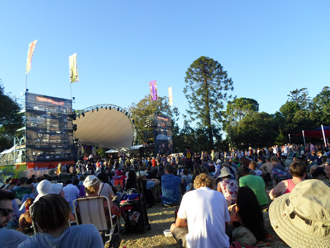
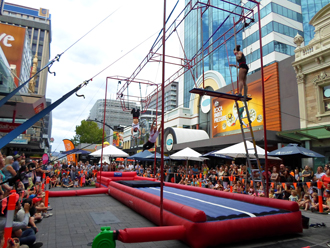
| Scene of Festival @WOMADelaide | Ready for Takeoff @Adelaide Fringe |
Spearheading the Asian Boom: The Adelaide Festival Centre
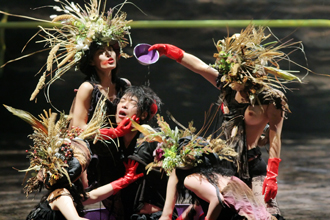
Douglas Gautier is the CEO and Art Director for the Adelaide Festival, boasting an extensive background and network in the media, tourism and festivals of Hong Kong. In October 2013, he was selected as the Chairperson of the Association of Asia Pacific Performing Arts Centres (AAPPAC). The Adelaide Festival Centre, which has foreseen the importance of cultural exchange between Australia and Asia, has been hosting the OzAsia Festival since 2007, with the Asia specialist Gautier at the helm of the project. These festivals have been a consistent platform for creative projects from Asian countries such as Japan, China, Indonesia and Malaysia, as well as collaborations between artists of the two continents. As a result of these outlets, Korean works such as 〈JUMP〉 by Yegam Productions and 〈Peer Gynt〉 by the Yohangza Theatre Company have found their way to Australian audiences. This month, Jacinta Thompson, the former Festival Director of OzAsia, will leave the program, signaling changes to come for the organization. On other fronts, last September the Adelaide Festival Centre has signed a Memorandum of Understanding with the University of South Australia regarding the establishment of the Asia Pacific Centre for Arts and Cultural Leadership. The project was initiated with the goal of creating a stage to be at the center of the Asian Boom, and to foster the talent to go with it. In October, the Adelaide Cabaret Festival successfully completed an overseas tour at the Hong Kong Fringe Club. Overall, each of these undertakings is illustrative of the steadfast and efficient hand that is guiding such events, a force that aims to continue to encourage close collaboration with talented professionals from multiple Asian cultures.
|
|
|
| Roman Tragedies@ The Adelaide Festival | 〈Peer Gynt〉 by the Yohangza Theater Company |
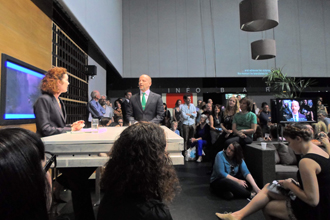
Melbourne, The Melting Pot of Art and Culture
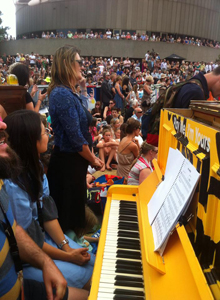
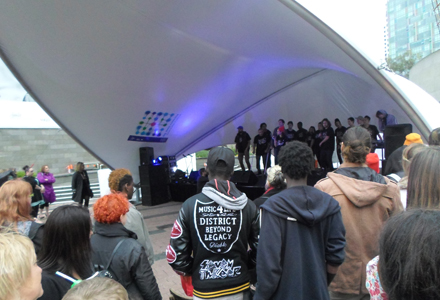
Melbourne is Australia’s artistic and cultural center. Amid the plethora of big and small performance halls, live clubs and festivals, the Melbourne Arts Centre is unlike any other. Last year was unusually difficult for the center, which had its CEO, Judith Isherwood, step down due to a budget overrun of around AUD 7.1 million, and several employees laid off as a result. Another concern for the center is that, as is the case for many cities in Europe, its core audience members are aging. But what’s hopeful is its dynamic programming, which includes a variety of offerings that range from the world class Royal Concertgebouw Orchestra to Dig Deep, a creative education program that seeks to help youths from refugee or underprivileged families to reach their dreams of hip-hop stardom. When combined with the center’s other exchange programs with Asian countries, it becomes clear that diversity is one of the Arts Centre’s persistent strengths. In particular, the fact that its programs have naturally embraced the multicultural traits of the city, of which nearly half its residents are foreign-born, is highly encouraging. It is also spreading its reach to create more opportunities for collaboration between artists from Australia and Asia, established through close partnerships with organizations such as the International Network for Contemporary Performing Arts IETM and the Australia Council for the Arts, the Next Waveas well as festivals such as. One of the most prominent examples of these partnerships is 〈Play Me, I’m Yours(PMIY)〉, a program based on audience participation. Financed by Betty Amsden’s donation of approximately KRW 1 billion, four large-scale audience participation programs were carried out consecutively over three to four years. Originally conceived of by the Luke Jerram of England, PMIY has since then spread across the world to 37 different cities, including New York and Sao Paulo, wherein pianos are installed at different points throughout the city and any citizen can play as freely as they would like. In Melbourne, community members of minority and marginalized backgrounds would decorate the donated pianos, and 37 citizens would play anoverture composed especially for the occasion. It was a meaningful moment that epitomized Melbourne when the silver-haired benefactor and recipients of diverse backgrounds gathered around the piano in a singular moment of joy.
|
|
|
| Opening Act of 〈Play Me, I’m Yours〉@The Melbourne Arts Centre | Launch of the Album, Dig Deep @The Melbourne Arts Centre |
The Melbourne Arts Centre Takes Big Step Forward In Asia Exchange
In 2009, the Melbourne Arts Centre, with the support of the Myer Foundation, created the Kenneth Myer Asian Theatre Series. Now in its fifth year, the series has gone on to become a prime opportunity to showcase contemporary performing arts programs from India, China, Cambodia and Vietnam—a reflection of the mixed society that is Melbourne and Australia itself. In the time since its inception, the series has become a fixture in the Melbourne Arts Centre as part of its Asian Performing Arts Program. And when Stephen Armstrong, the chairperson of the Australia Council for the Arts Theater Board, became Creative Producer for the Melbourne Arts Centre in July 2013, it began to seek out fresher more innovative approaches to its programming. Furthermore, the Asian Performing Arts Program is preparing for an ambitious program to coincide with the IETM’s Asia satellite conference to be held in May 2014, which will showcase for the first time a new program by the name of "the Lab," an initiative designed to facilitate free collaborations between both Australian and Asian artists, hopefully resulting in more multinational projects. What is worth noting about the program is that, as its name suggests, it does not demand that participants create a final product, but rather that they experiment and develop their creative process. In such an environment, the potential for creative synergies between artists and cultures is limitless.
The Asian Boom in Australia is only going to grow larger. As of yet, Australia prefers to engage with countries that are geographically closer to it, such as Malaysia and Indonesia, instead of slightly more distant Korea. Bearing this in mind, it’s time for Korea to devise original solutions to help bridge this physical and psychological space.
 PREV
PREV
.JPG)
.jpg)
.jpg)
.jpg)
.jpg)












.jpg','It is a nation that is seasonally opposite to us, ..');)


